
This article was written exclusively for The Film Magazine by Lucas Hill-Paul.
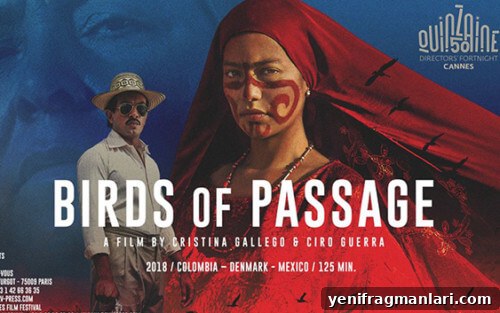
Birds of Passage (2018)
Directors: Cristina Gallego & Ciro Guerra
Screenwriters: Maria Camila Arias & Jacques Toulemonde Vidal
Starring: Carmiña Martínez, Natalia Reyes, José Acosta, Jhon Narváez
In Birds of Passage, Colombian filmmakers Ciro Guerra and Cristina Gallego turn their attention toward the Wayuu people and the cultural forces that shape a family’s fate. Where Guerra’s earlier work, Embrace of the Serpent, probed indigenous cosmology through a European outsider’s lens, this film immerses the viewer entirely in Wayuu experience. Told across five chapters, it maps the rise and collapse of a family-run drug enterprise in Colombia during the late 1960s and 1970s, threading crime drama conventions with indigenous ritual and belief.
At first glance the film borrows familiar tropes from classic crime cinema—the ambitions, loyalties, and betrayals that propel narratives like The Godfather or Goodfellas. But Guerra and Gallego refuse to reduce the story to genre mechanics alone. Instead they interweave Wayuu customs, prophetic dreams, and symbolic imagery so that the drug trade appears not simply as criminal activity but as an affront to a cultural order. The consequences are refracted through the community’s spiritual codes: a slain body is never mere collateral, spilled blood summons evil, and omens carry devastating weight.
Central to the film’s moral gravity is Úrsula, the tribe’s matriarch. Her calm authority and interpretation of dreams anchor the narrative and foreshadow the family’s unraveling. Alongside Úrsula, Naida—Rapayet’s young bride—initially represents hope and continuity. Their relationship and the rituals surrounding their union, including a ritualized dance of courtship, are depicted with tenderness and attention to cultural detail. Natalia Reyes, as Naida, delivers a memorably physical performance in that early sequence, embodying both beauty and ritual significance.
Yet as the plot advances, Naida’s role dwindles, and the film repeatedly exposes a gendered tension within the story. While women in Wayuu society often wield unseen social power—Úrsula’s influence is decisive—the screenplay still gives far more space to masculine perspectives and machismo. This imbalance is an intentional part of the film’s critique: the men’s pursuit of wealth and status undercuts the very traditions meant to preserve the community.
Stylistically, Birds of Passage moves between naturalism and the almost surreal. The directors translate cultural signs—dreams, omens, animal symbolism—into visual motifs that foreshadow catastrophe. Recurring images, such as a heron walking calmly through scenes touched by blood, and sudden flashes of colorful birds and locusts, function as more than decorative flourishes; they provide contemplative pauses that contrast with the escalating violence. These moments recall the dreamlike intensity of art-house Westerns and Jodorowsky’s mythic sensibilities, but they remain firmly rooted in Wayuu cosmology.
Technically, the film is rich in composition and landscape photography. Wide, patient shots of desert and shoreline convey both the endurance and fragility of the family’s world. The deliberate pacing resists the breathless tempo of typical drug narratives and instead builds an elegiac momentum: the accumulation of small decisions, misunderstandings, and affronts that lead to irreversible ruptures. The bookended narration by a wise seer lends a literary framing that elevates the film’s structure, even if the device occasionally grows heavy as the story nears its end.
What makes Birds of Passage notable in contemporary Colombian cinema is its focus on a community rarely seen onscreen. By centering Wayuu voices and rituals, Guerra and Gallego offer insight into the cultural cost of the drug trade—how outside commerce and internal ambition can erode social bonds and moral frameworks. The film is not an exposé of narco-glamour but a meditation on loss: of identity, of tradition, and of the future for a people caught between past and profit.
Despite some shortcomings—primarily the film’s tendency to foreground male action at the expense of female interiority—the piece remains gripping and visually striking. Its synthesis of crime storytelling with indigenous worldview produces a narrative that feels both familiar and profoundly original. For audiences interested in Colombian cinema, indigenous representation, and crime drama with cultural depth, Birds of Passage offers a powerful, haunting experience.
19/24
You can support Lucas Hill-Paul at the following links:
Personal Twitter – @lucashpaul
You can find more of his writing at Film Daily News – @FilmDailyNews