
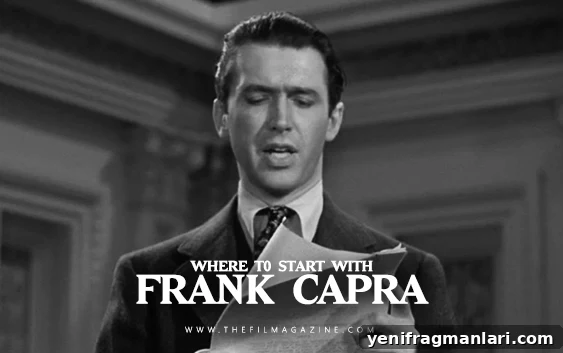
Three-time Oscar-winning Italian-American director Frank Capra was born in 1897 in Sicily and emigrated with his family to Los Angeles as a child. With an engineer’s mind and a talent for self-promotion and collaboration from early on, it was perhaps inevitable that he would build a career in the movies.
Capra confidently talked his way into directing his first short film, Fultah Fisher’s Boarding House (1922). After some early stumbles—clashes while working as a gag writer and a few false starts—he found his stride at Columbia Pictures. Between 1928 and 1939 he produced a string of acclaimed and profitable hits that established him as one of Hollywood’s leading directors.
The Second World War changed Capra’s creative focus. While producing the Why We Fight documentary series for the American forces—films he insisted were informational rather than propaganda—his earlier sentimental, moralistic features seemed increasingly out of step with post-war America. His films no longer attracted the same mass appeal, and he grew disenchanted with parts of the industry as studio control and star prominence shifted the balance of power.
In 1945 Capra co-founded the independent Liberty Films, which produced only two features before folding. One of those films, the box-office failure turned seasonal classic It’s a Wonderful Life, would become a lasting part of his legacy. After Liberty, Capra made just four more films, two of which were remakes of his earlier hits. He retired in the mid-1960s having won three Best Director Academy Awards—a record matched at the time by his Liberty partner William Wyler and later surpassed by John Ford—yet continued to receive honors for his contributions to American culture and society.
Capra’s career is both wide-ranging and influential. Below is a concise guide to some of his essential films and why they remain important for anyone discovering his work.
1. It Happened One Night (1934)
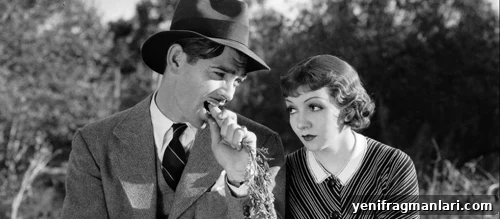
Capra’s witty romantic comedy became the first film to win the “Big Five” Oscars—Best Picture, Best Director, Best Actor, Best Actress, and Best Screenplay—and it helped define his career. While Capra often probed ideas about the American Dream, his approach to romance was unabashedly sentimental and sincere.
The plot follows heiress Ellie Andrews (Claudette Colbert), who flees her domineering father to marry the man she loves. On the run with little of a plan, she reluctantly accepts help from down-and-out journalist Peter Warne (Clark Gable), who sees a story and discovers unexpected affection. The film contains memorable comic set pieces—the Walls of Jericho sequence, inventive attempts to flag down rides, and the chaos aboard a crowded bus—that remain fresh in their timing and performances.
Gable and Colbert bring star power while remaining relatable; their chemistry and comic timing let Capra keep camera techniques simple, focusing instead on character and interaction. It Happened One Night is a classic road romance in which two mismatched people progress naturally from hostility and indifference to genuine love. The film exemplifies Capra’s belief that clear storytelling and strong performances matter most.
2. Mr. Smith Goes to Washington (1939)
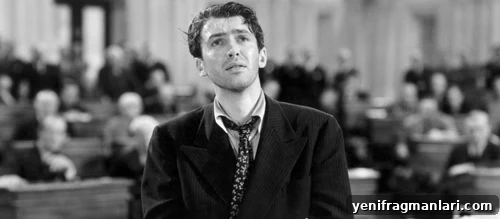
Capra’s most overtly political and moralistic film, Mr. Smith Goes to Washington, presents an underdog standing up to corruption within the American political system. Controversial in 1939 for its critique of legislative corruption, the film remains a bold statement about civic responsibility and idealism.
When a U.S. senator dies, naïve scout leader Jefferson Smith (James Stewart) is appointed as his replacement. Smith’s eager idealism is quickly tested by the corrupt interests that dominate the Capitol. Pushed to make a stand on the Senate floor, he becomes a moral counterpoint to the cynical forces around him.
James Stewart’s portrayal of Smith captures an all-American sincerity. Capra saw in Stewart an ideal vehicle for his own convictions—an everyman who refuses to abandon principle even when facing ruthless opponents. The film balances idealism with a cast of strong supporting performances: a hard-edged but complex Jean Arthur, the sinister charm of Claude Rains, and memorable turns from Edward Arnold and Harry Carey. Mr. Smith remains striking for its unapologetic belief that individual courage and moral clarity can challenge entrenched power.
3. Arsenic and Old Lace (1944)
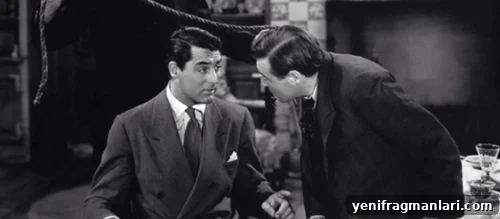
Capra also demonstrated remarkable skill with broad, absurdist comedy, and Arsenic and Old Lace is one of his finest farces. Based on Joseph Kesselring’s successful Broadway play, the film is a frantic, macabre comedy that showcases Capra’s lighter touch and knack for orchestrating chaotic ensemble performances.
The story follows Mortimer Brewster and his new wife Elaine (Cary Grant and Priscilla Lane) as they return home to prepare for their honeymoon, only to discover that Mortimer’s elderly aunts are unexpectedly homicidal. The household also contains a brother who believes he is Teddy Roosevelt and another who resembles a horror movie icon after plastic surgery. The escalating absurdity is played at full speed, producing darkly comic moments that verge on horror and land with precise timing.
Cary Grant’s transition from suave romantic lead to increasingly exasperated comic foil is a highlight. Capra’s direction allows each eccentric character space to shine: the aunts’ polite but deadly hospitality, the brothers’ bizarre delusions, and the oddball doctor who completes the surreal tableau. Arsenic and Old Lace captures the chaotic energy of stage farce while remaining cinematic and crowd-pleasing—perhaps one of Capra’s last great popular successes in comedy.
Frank Capra directed 36 feature films and numerous documentaries across four decades. While his later career showed signs of diminished passion and changing public tastes, his body of work contains few true failures. For more of Capra’s distinctive films, consider Mr. Deeds Goes to Town or Meet John Doe, both of which showcase his thematic range and commitment to stories about ordinary people facing moral dilemmas. And for many viewers, revisiting It’s a Wonderful Life remains a seasonal reminder of Capra’s enduring influence on American film and shared cultural memory.