
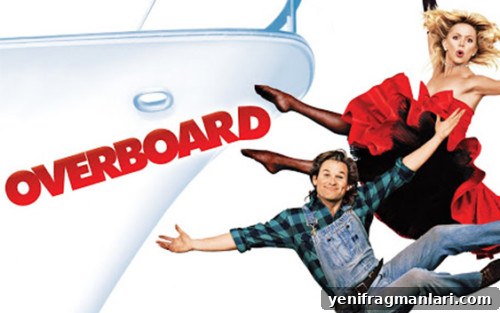

Overboard (1987)
Director: Garry Marshall
Writer: Leslie Dixon
Starring: Goldie Hawn, Kurt Russell, Edward Herrmann, Roddy McDowall, Mike Hagerty, Katherine Helmond
Overboard (1987) is a quintessential 1980s romantic comedy that blends broad farce with sentimental beats. Directed by Garry Marshall and written by Leslie Dixon, the film pairs Goldie Hawn and Kurt Russell in a mismatched, frequently riotous story built around an amnesia trope. While the premise — a spoiled heiress convinced she is the housekeeper of a struggling carpenter — raises valid ethical questions, the movie remains a telling example of the era’s approach to romantic comedy: loud, physical, and unabashedly sentimental.
The narrative begins with Joanna (Goldie Hawn), a wealthy and entitled socialite, attempting to stiff a local carpenter named Dean (Kurt Russell) after a job gone wrong. A chain of events leads to Joanna suffering from amnesia, and Dean seizes the moment to exact revenge by convincing her they are married. Stripped of her money and luxuries, Joanna is forced to adapt to Dean’s chaotic household and his four rowdy boys. The story mines comedy from Joanna’s desperate attempts at domestic life: learning to cook, manage a messy household, and relate to children while Dean watches with a mix of amusement and growing fondness.
On the surface, the plot trades on a morally dubious premise — deception and coerced servitude — and that element has drawn criticism over the years. However, the film frames these choices within broad comedic set pieces and exaggerated character work, so the tone often reads more like farce than a realistic study of relationships. Leslie Dixon’s script leans into caricature, creating situations that depend on timing, pratfalls, and the chemistry between Hawn and Russell rather than subtle psychological realism. The result is a film that can feel both dated and oddly charming, depending on how willing the viewer is to accept its premise as comic shorthand.
Kurt Russell brings his trademark sarcasm and rough-edged charm to Dean, delivering snappy one-liners and a crusty but watchable transformation as he gradually softens. Goldie Hawn, with her gift for physical comedy and a nimble, expressive face, sells Joanna’s misfortune with a blend of vulnerability and wit that keeps the audience rooting for her despite the initial cruelty of the setup. Supporting performances — including Edward Herrmann as Joanna’s aloof husband and a cast of colorful secondary characters — help sustain the film’s buoyant tone and add texture to the small-town setting.
Stylistically, Overboard is packed with the hallmarks of an eighties mainstream comedy: big gestures, conspicuous sentiment, and a soundtrack sensibility that favors upbeat cues. Garry Marshall’s direction emphasizes the warm and familiar aspects of domestic life even when the screenplay courts uncomfortable territory. The film’s humor relies heavily on slapstick and situational irony, and while some jokes are predictable, many land because of the actors’ timing and the crowd-pleasing momentum Marshall maintains.
Critics and modern audiences often debate the film’s ethics and whether its central deception is forgivable. That conversation is valid and important; the movie’s premise does require a suspension of moral disbelief. Yet seen as a period piece — an 80s romantic comedy that prioritizes laugh-out-loud moments and heartfelt reconciliation — it frequently succeeds in delivering an entertaining experience. Over the course of its runtime the film gradually introduces more sincere emotional beats, showing character growth that attempts to justify a romantic reconciliation by the end.
Beyond its thematic flaws, Overboard remains enjoyable for viewers who appreciate classic rom-com rhythms, strong lead chemistry, and physical comedy executed with confidence. The film is emblematic of Garry Marshall’s work in the genre: sentimental, occasionally clumsy, but ultimately aimed at eliciting a smile. For fans of 1980s cinema, it’s a nostalgic example of mainstream comedic filmmaking, while for others its premise may feel irredeemably problematic.
There has been talk of remakes and reinterpretations in later years, which speaks to the enduring curiosity around the story’s central conceit. Any modern reworking faces the challenge of preserving the original’s comic energy while addressing the ethical questions the premise raises for contemporary audiences.
Flawed but frequently funny, Overboard is a product of its time that still finds ways to charm through performance and momentum. If you approach it as an affectionate, if imperfect, slice of 1980s romantic comedy, it’s easy to be carried along by its humor and warmth — even when the film occasionally goes a little overboard.
Score: 10/24