The Devil’s Bath (2024)
Directors: Severin Fiala, Veronika Franz
Screenwriters: Severin Fiala, Veronika Franz
Starring: Anja Plaschg, Maria Hofstätter, David Scheid
Can overwhelming grief push someone to commit violence?
The Devil’s Bath, a folk-horror film from Austrian directors Veronika Franz and Severin Fiala, examines how society has historically misunderstood and mistreated women’s mental health. Franz and Fiala have repeatedly explored psychological trauma affecting women in their earlier work, and here they return to that terrain with a story rooted in religion, isolation, and the corrosive expectations placed on women.
The directors’ previous films, such as Goodnight Mommy and The Lodge, already probe the weight of motherhood, familial guilt, and religious fervor. Those films share a motif: a mother figure confined with children in remote settings, where tensions and past traumas surface. In The Devil’s Bath, Franz and Fiala shift the focus slightly, centering on the absence or failure of maternal roles and the social pressures that follow, while maintaining a bleak religious atmosphere.
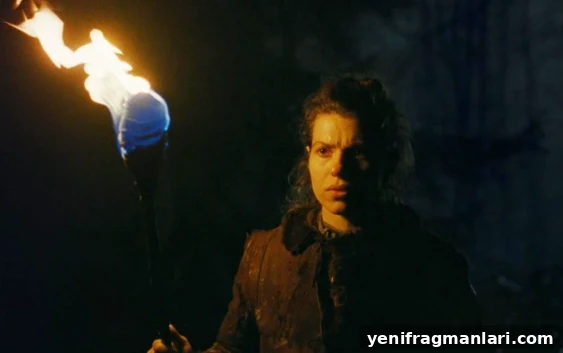
Set in 18th-century Austria, The Devil’s Bath follows Agnes, a young newlywed attempting to fit into her husband’s household and meet the community’s expectations for a wife. The film opens with a disturbing scene: an unnamed woman takes a harrowing action near a waterfall and later confesses a crime in a gothic structure. That grim beginning foreshadows the psychological descent that will engulf Agnes.
The initial dark tone contrasts sharply with the next sequence: Agnes’s wedding celebrations. Joy gives way to anxiety when the marriage remains unconsummated and Agnes worries about her ability to bear children. While walking in the woods she discovers the mutilated corpse of the woman from the opening, a discovery she later returns to again and again. Wolf’s mother increasingly criticizes Agnes for failing to perform her duties, and Wolf’s emotional and sexual neglect leaves Agnes isolated. Her mental state deteriorates further despite a brief bond she forms with a pregnant young woman, a friendship that is not approved by Wolf’s mother. Tensions in the religious community intensify after the death of one of Wolf’s acquaintances; a priest declares the death a suicide and condemns it as a sin worse than murder, exposing the harsh moral judgments shaping the town’s response to tragedy.
The film’s core conflicts arise from the demonization of mental illness and the shame attached to suicide. The title refers to a humoral theory term—“the devil’s bath”—which described prolonged melancholy as an imbalance among the body’s humors. As Agnes sinks deeper into depression, she abandons household tasks and receives crude medieval treatments intended to “rebalance” her temperament. One unsettling scene has a barber knot a horsehair into the nape of her neck and instruct her to pull it to let out the “poison,” a visceral image that underscores the era’s crude responses to mental distress.
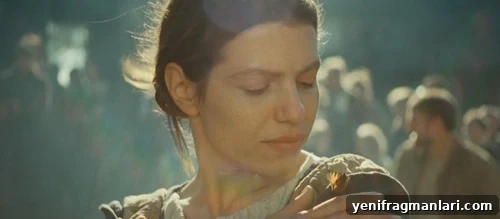
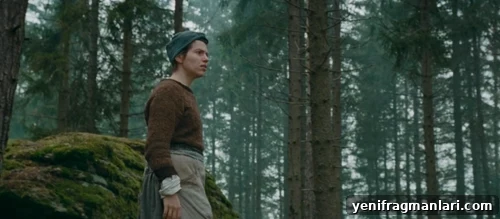
Cinematography and production design reinforce the film’s oppressive mood. The marshy, choking landscape and muted palette recall the haunted naturalism of films like The Witch, where the environment feels both beautiful and threatening. Early images of Agnes weaving flowers and inspecting insects suggest innocence and connection, but the same forest becomes menacing as her emotional isolation grows. The land itself seems to swallow characters: a corpse left to rot amid high grass and blossoms, and mud that grabs at Agnes’s legs as she attempts to work. The setting mirrors her descent, a physical manifestation of encroaching hysteria.
Historically, women were often caught in marriages and religious structures that left them with few options, and the film evokes the tragic phenomenon of suicide by proxy and other desperate acts. Anja Plaschg delivers a standout performance as Agnes, charting her shift from hopeful innocence to drained apathy with subtlety and emotional power. Plaschg’s portrayal of depression—its inertia, its sudden catatonic troughs—echoes memorable performances in other films that address mental collapse, yet it remains distinctly her own: quiet, ravaging, and heartbreaking.
Although rooted in 18th-century experience, the film speaks to contemporary issues in religious and conservative communities. It highlights how women police one another under the guise of piety, how social media and cultural revivalism can echo older demands for modesty and domesticity, and how a woman’s worth is still too often tied to roles as wife and mother. The Devil’s Bath argues against equating female value with conformity to those roles and exposes the damage such expectations can cause. The film also touches on homophobia within religious circles, further showing how doctrinal rigidity breeds cruelty.
The film’s final act, violent and visceral, consolidates the themes that simmer throughout its restrained pacing and austere imagery. Early and late episodes of brutality frame a narrative that is less conventional horror than a psychological study—one that lingers and haunts. The Devil’s Bath is a powerful, unsettling reflection on historical oppression and a cautionary meditation on the dangers of misunderstanding and marginalizing women’s suffering.
Score: 19/24
Rating: 3 out of 5
Written by Lauren Frison
You can support Lauren Frison in the following places:
X (Twitter): @paranoidzpark
Letterboxd: /suspiriaz