
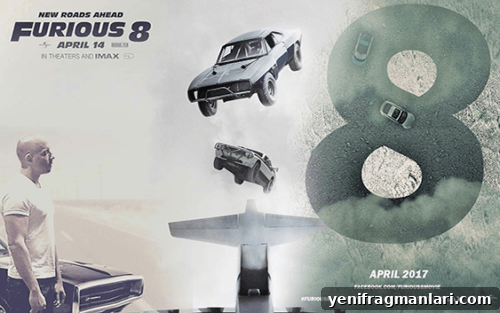
The Fate of the Furious (2017)
Director: F. Gary Gray
Screenwriter: Chris Morgan
Starring: Vin Diesel, Dwayne Johnson, Charlize Theron, Scott Eastwood, Nathalie Emmanuel, Luke Evans, Tyrese Gibson, Ludacris, Helen Mirren, Michelle Rodriguez, Kurt Russell, Jason Statham.
Warning: Minor Spoilers
The Fast & Furious family returns in their eighth installment, a loud, spectacle-driven chapter that trades some of the emotional heart of previous entries for bigger stunts, broader comedy and globe-trotting set pieces. Directed by F. Gary Gray, known for his work on Straight Outta Compton, The Fate of the Furious follows the franchise’s evolution from street-racing drama to maximalist action series. While it may not reach the emotional peaks of Furious 7, it succeeds at delivering adrenaline-fueled sequences and the franchise’s trademark focus on loyalty and family.
By now, taking any Fast & Furious movie too seriously feels almost beside the point. What began as an undercover cop story in Los Angeles has expanded into an international action saga comfortable with cheesy quips, over-the-top explosions and audacious stunts—qualities that aim to evoke the big, unapologetic action films of the 1980s and 1990s. The Fate of the Furious refines that formula: it balances serious beats with frequent one-liners, and uses an ensemble of major stars to lend weight and charisma to every scene. Gray’s approach is faithful to the series’ strengths and unapologetically aimed at mass entertainment and box office appeal.
The film’s plot centers on Dominic Toretto (Vin Diesel), who surprisingly turns against his team, prompting former enemies and allies to unite in order to find him and understand his motives. Hobbs (Dwayne Johnson) and Deckard Shaw (Jason Statham) set aside their differences to team up with Letty (Michelle Rodriguez) and the rest of the crew. As with several recent entries—Fast Five, Fast & Furious 6 and Furious 7—the story operates primarily as a framework for escalating action sequences and emotional beats centered on the idea of family. The revelations and twists are calibrated to elicit reactions from longtime fans who have followed these characters’ bonds across multiple films.
One notable casting choice was Charlize Theron as Cipher, the film’s principal antagonist. Theron’s presence brings expectations of a dynamic action villain, but the role’s limited focus—much of her work confined to a control-room position—underutilizes her considerable talents. Still, her inclusion raises stakes and gives Toretto a physically and tactically formidable opposite, even if the character could have been written with more complexity.
The movie also expands the franchise family, introducing new faces and bringing back familiar ones. Helen Mirren and Don Omar receive prominent placement, implying potential continuation in subsequent films. Equally significant is the palpable absence of Paul Walker’s Brian O’Conner. Walker’s character had functioned as a moral counterweight and emotional anchor in earlier films, and his absence is felt. Small tributes to him during the film underscore that loss, making his omission more noticeable and poignant for fans who remember his role in building the series’ relational core.
Visually, The Fate of the Furious arguably represents the franchise at one of its most accomplished technical points. The visual effects are cleaner and more ambitious than in some earlier entries. Standout sequences—the submarine chase across icy terrain, massive car pileups, and high-stakes set pieces in urban centers—deliver genuine spectacle and the satisfying sense of “I’ve never seen that before.” The film’s stunt choreography benefits from careful planning; a prison escape featuring a confrontation between Johnson and Statham is particularly effective, combining practical stunts with character-driven physicality that highlights the contrast between the two men.
Filming across locations such as Berlin, New York, Cuba and northern Russia gives the movie a varied and cinematic palette. Each locale contributes distinct visual flavor to the action scenes, from crowded city streets to stark Arctic expanses. The franchise’s willingness to tackle difficult locations—like the memorable sequences shot in Cuba and Times Square—continues to be one of its production strengths, adding authenticity and scale to sequences that might otherwise feel staged on soundstages.
Storytelling in The Fate of the Furious follows a familiar cycle for the franchise: high-concept threats, escalating physical set pieces, and the emotional pull of a found family. While character development can feel thin at times and some plot elements are recycled, the film’s strengths lie in its execution—ambitious stunts, brisk pacing, and occasional comedic beats. For viewers seeking pure, entertaining escapism and blockbuster thrills, this installment delivers. Its sizable opening weekend at the box office speaks to the enduring appeal of this brand of crowd-pleasing action cinema.
In short, The Fate of the Furious is not the most emotionally resonant entry in the series, but it embraces the franchise’s evolution and delivers large-scale, inventive action with a strong ensemble. It’s a visually striking, entertaining ride that underscores why Fast & Furious remains a dominant force in modern action filmmaking.
Score: 17/24