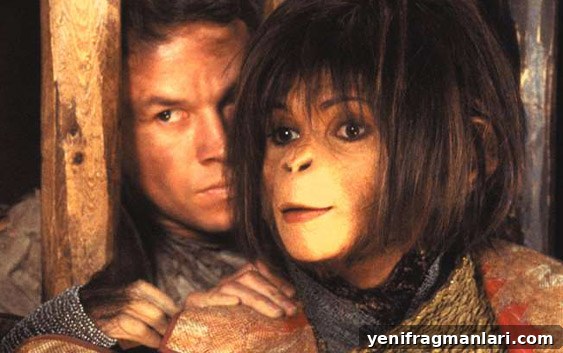

Planet of the Apes (2001)
Director: Tim Burton
Screenwriters: William Broyles Jr., Lawrence Konner
Starring: Mark Wahlberg, Helena Bonham Carter, Tim Roth, Michael Clarke Duncan, Paul Giamatti, Estella Warren, Cary-Hiroyuki Tagawa, David Warner, Kris Kristofferson, Erick Avari, Charlton Heston
After years of development attempts at 20th Century Fox, Tim Burton’s 2001 reboot of Planet of the Apes finally reached screens following a rushed production period. The new film aimed to reboot the franchise with a grander, more epic approach than the 1968 original, but it struggled to escape that classic’s long shadow. While the remake updated visual effects and prosthetics, it often invited direct comparisons—sometimes to its detriment—by borrowing lines and themes from the original without always earning them.
The plot follows astronaut Leo Davidson (Mark Wahlberg), who is swept through a portal while attempting to save a chimpanzee test subject and wakes up on a strange world dominated by intelligent apes. Humans there are treated as slaves. Leo befriends Ari (Helena Bonham Carter), an ape who sympathizes with humans, and leads a breakout from captivity. Their goal becomes reaching a sacred ape site that houses remnants of Leo’s crashed spacecraft. Opposing them is the ruthless General Thade (Tim Roth), an autocratic ape determined to crush the uprising.
Wahlberg’s performance is serviceable but underused; the screenplay reduces his character to an archetypal action-hero astronaut rather than allowing the kind of earnest human connection the actor often brings to his roles. In contrast, Helena Bonham Carter and Tim Roth deliver standout work. Both convey surprising depth and pathos through Rick Baker’s elaborate prosthetics—Carter as a compassionate outsider and Roth as a theatrical, threatening antagonist. Their portrayals lend the film emotional weight when much of the script feels thin.
The supporting cast includes several strong character actors who bring nuance to small but memorable roles. David Warner plays a dignified senator, Michael Clarke Duncan appears as a commanding general, and Paul Giamatti steals scenes as a morally compromised slave trader whose slimy opportunism provides unexpected dark humor. These performances help anchor the movie when story and tone begin to wobble.
One of the film’s greatest strengths is its production design. The sets, costumes, and overall world-building are rich and detailed, and they frequently rescue scenes that might otherwise fall flat. Interestingly, Burton’s visual approach here is less overtly “Burtonesque” than many expected; the aesthetic aims for gritty realism and epic scope rather than stylized whimsy, which both benefits and limits the film’s personality.
Structurally, the film borrows many familiar fantasy and epic tropes: a ragtag group forms to undertake a quest, a prophecy looms, skirmishes and chases punctuate the journey, and the story culminates in a large-scale battle followed by a climactic one-on-one confrontation between hero and villain. These elements create a familiar and often entertaining rhythm but also sometimes produce tonal inconsistencies—shifting abruptly between grim drama and unintentionally comic moments.
Action sequences are generally well staged, though certain effects—most notably wire work used to make the apes leap—can look unconvincing. The film also occasionally relies on stock sound design that distracts from the intended dramatic impact. Still, stunt performers contribute commendable physicality, often performing grueling work in restrictive ape costumes and maintaining convincing movement and energy.
Where the movie falters is in its handling of legacy material and its ending. Familiar lines and motifs from the original are repurposed in ways that feel forced rather than meaningful, and the final twist trades coherence for shock value. That choice left many viewers puzzled and suggested the ending was designed more to provoke debate or set up a potential sequel than to serve the story organically.
In sum, Tim Burton’s Planet of the Apes is an uneven but intermittently rewarding reboot. Strong production design and several compelling performances elevate material that is otherwise marred by a rushed production, script weaknesses, and tonal inconsistency. The film is neither a disaster nor a true successor to the original; it is a flawed attempt at modernization that shows ambition but ultimately fails to deliver the emotional clarity and narrative conviction fans expected.
8/12