
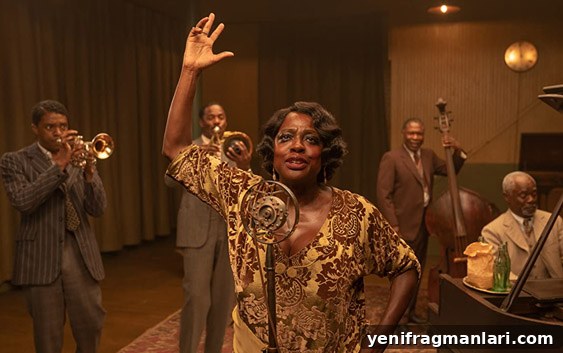

Ma Rainey’s Black Bottom (2020)
Director: George C. Wolfe
Screenwriter: Ruben Santiago-Hudson
Starring: Chadwick Boseman, Viola Davis, Jeremy Shamos, Jonny Coyne
Set in Chicago in the summer of 1927, Ma Rainey’s Black Bottom stages a charged, claustrophobic drama inside a single recording studio. The film follows Ma Rainey and her band as they prepare to record a new album, The Black Bottom, and the simmering tensions that surface between the musicians, their management and the studio. Central to the conflict is Levee, a bold and ambitious trumpet player played by Chadwick Boseman, whose desire to modernize the music and push his own songs into the spotlight collides with Ma Rainey’s authority and vision.
Viola Davis inhabits Ma Rainey with a raw, uncompromising force. Her Ma is blunt, intimidating and often abrasive, a woman who has earned respect through talent and sheer will in a world stacked against her. Davis captures the musician’s complexity—her stubborn pride, her vulnerability when confronting exploitation, and the weary confidence of a leader used to being the center of attention. From the film’s opening scenes, Davis makes it clear that Ma Rainey will not be easily ignored.
Chadwick Boseman gives what is widely regarded as one of his most powerful screen performances. Levee is a young man marked by trauma and hunger: hungry for success, recognition and control over his own creative work. Boseman brings sexuality, swagger and simmering rage to the part, building to a devastating monologue that crystallizes the character’s pain and ambition. That performance, delivered with measured intensity, anchors much of the film’s emotional impact.
The supporting cast offers strong, layered contributions. Jeremy Shamos plays Irvin, Ma Rainey’s manager, who navigates the difficult terrain between artist demands and studio pressures. Jonny Coyne portrays the studio owner who exploits the musicians’ labor and creativity. Those interactions underscore how commercial imperatives and racial power imbalances shape the recording process, leaving talented Black artists vulnerable to appropriation and manipulation.
Ma Rainey’s Black Bottom is a screen adaptation of August Wilson’s Pulitzer Prize–winning play, and its theatrical roots are evident in the film’s structure: nearly all the action unfolds within the studio, and the dialogue carries much of the storytelling weight. That focus on performance and conversation allows for potent character work, but it also means the movie feels intentionally constrained—sometimes to its detriment. Clocking in at approximately 94 minutes, the film can feel short for the depth of story it aspires to tell. A longer runtime or broader context might have deepened the backstories and given more space for quieter character moments.
Visually, the film favors a restrained approach that keeps the camera close to the actors, emphasizing faces and gestures rather than elaborate camera moves. The production design recreates the period convincingly, while the costuming and hair reinforce each character’s place in the ensemble. But there are moments when the cinematic language could have pushed further to expand the world beyond the single set, offering viewers a greater sense of the wider social landscape affecting these musicians.
The film’s themes—racial injustice, artistic ownership, ambition and betrayal—remain potent and relevant. The scenes in which the white studio management maneuvers to profit from Black music underscore how systemic exploitation functioned then and continues today. Dialogue-driven confrontations make these injustices explicit, and the actors’ performances make them deeply felt. For viewers drawn to intense character studies and theatrical adaptations, the film delivers memorable, emotional scenes that linger.
While some viewers may wish for more narrative breadth or a deeper historical canvas, the undeniable strengths of Ma Rainey’s Black Bottom are its performances. Viola Davis and Chadwick Boseman carry the film on their shoulders, elevating the material with commanding presence and subtle emotional truth. Boseman’s final-turn intensity and Davis’s uncompromising control combine to create several unmissable moments of cinema.
Ultimately, Ma Rainey’s Black Bottom is a compelling, often powerful character drama that showcases extraordinary acting and interrogates the costs of fame and exploitation in the music industry. It may not fully satisfy those seeking a sprawling historical epic, but as a concentrated, actor-driven piece adapted from a celebrated play, it remains an important and affecting work.
17/24