The Company of Wolves (1984)
Director: Neil Jordan
Screenwriters: Angela Carter, Neil Jordan
Starring: Sarah Patterson, Angela Lansbury, David Warner, Tusse Silberg, Micha Bergese
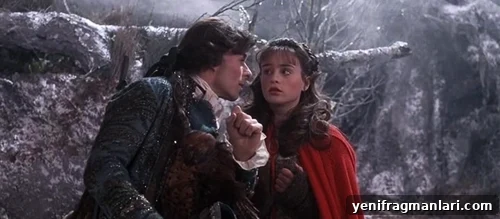
Toward the end of Neil Jordan’s 1984 fantasy horror film The Company of Wolves, a young girl in a blood-red cape walks alone through a silent wood toward her grandmother’s house. Her grandmother’s superstitious warnings echo in her mind: “never stray from the path and beware of men whose eyebrows meet in the middle, for all the most dangerous wolves are hairy on the inside.” Soon the girl encounters a handsome, finely dressed man with yellow, moon-like eyes. As the encounter grows threatening, a chorus of howls fills the night.
“Who’s come to sing us carols, then?” the girl asks. He answers, “Only my companions, darling. I love the company of wolves.”
At first glance this seems to be a familiar cautionary tale. On the surface, The Company of Wolves echoes traditional warnings given to children about strangers and to adolescent girls about propriety and predatory men. But the film, adapted from Angela Carter’s seminal fairy tale collection The Bloody Chamber and co-written by Carter and Neil Jordan, is more complex. It reframes the classic Little Red Riding Hood archetype into a surreal, often unsettling exploration of puberty, desire, and agency.
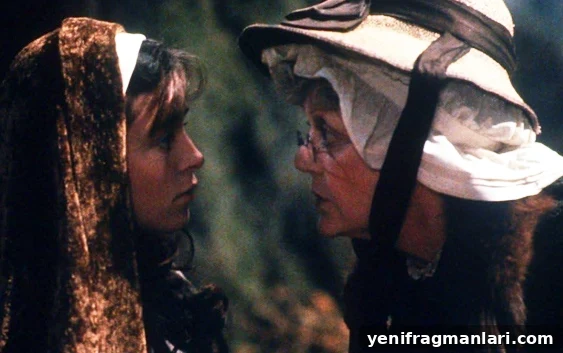
Told in a sequence of dreamlike vignettes, the film centers on 13-year-old Rosaleen (Sarah Patterson) sleeping in an attic bedroom of her family’s country estate. She tosses in a restless dream that blurs childhood and adulthood: dolls with glassy eyes line the shelves, and her lips are smeared with lipstick not her own. Rosaleen’s dream transports her to a nightmarish version of 18th-century Europe, a forest that is both seductive and dangerous. Her sister Alice has been killed by wolves, and her grandmother (Angela Lansbury) insists Rosaleen never stray from the safe path. The narrative builds through stories Granny and Rosaleen tell each other, each tale adding layers to the film’s central theme. Eventually Rosaleen confronts the wolf, who first appears as an attractive huntsman played by Micha Bergese.
Angela Carter’s writing is known for its feminist reworkings of classic fairy tales, infusing them with sexuality, gothic horror, and empowered heroines who often undergo literal or figurative metamorphosis. The Company of Wolves preserves much of Carter’s dark, lyrical spirit. With Carter’s involvement in the screenplay and Jordan’s sympathetic direction, the film retains the author’s subversive intelligence while taking full cinematic advantage of surreal imagery and paradoxical tones.
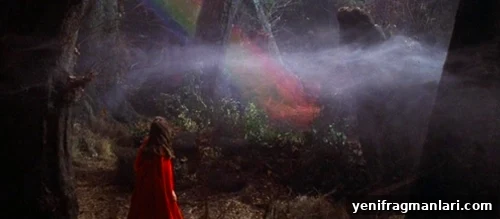
Visually, The Company of Wolves is highly stylized. Production designer Anton Furst and director Jordan create a stage-bound forest that nevertheless feels vast, drenched in mist and suggestion. The sets often read as consciously artificial, reminding the viewer that these events unfold inside Rosaleen’s imagination, where anxieties about growing up play out as theater. Strange, memorable sequences—such as the Devil appearing in a white Rolls Royce driven by Rosaleen herself—mix gothic motifs with symbolic imagery. Special effects and practical makeup yield some of the most inventive werewolf transformations in cinema, grotesque and imaginative rather than purely horrific.
Sarah Patterson’s performance anchors the film. Despite her youth, she brings a poised mix of curiosity, vulnerability, and quiet defiance to Rosaleen. The character is not a passive victim: she shows agency and a subtle hunger to understand the world beyond childhood. Jordan’s direction allows Patterson to explore these nuances, giving Rosaleen a psychological richness rarely afforded to adolescent protagonists in genre cinema.
The film’s recurring motif—lycanthropy as a metaphor for puberty—refuses to cast the wolf solely as a male threat. Characters repeatedly suggest that the beast exists inside both men and women. As Rosaleen’s mother says, “If there’s a beast in men, it meets its match in women, too.” This idea broadens the film’s thematic scope: it is not only a warning but also an acknowledgement of emerging desire, power, and transformation. The Company of Wolves treats coming of age as a strange, often ambivalent rite of passage, blending fear and fascination.
The Company of Wolves does not end with a tidy happy ending. Instead, it lingers at the threshold of childhood, inviting viewers to consider the complex transition into adulthood. Weird, sensual, and richly symbolic, the film remains one of the most artful and thought-provoking fairy tale adaptations. It transforms a familiar story into an exploration of desire, agency, and the animality that lives within us all.
Score: 19/24
Rating: ★★★