
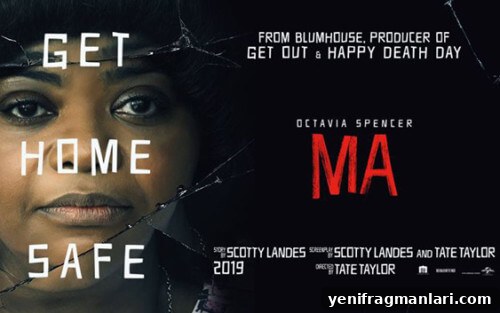
Ma (2019)
Director: Tate Taylor
Screenwriters: Tate Taylor, Scotty Landes
Starring: Octavia Spencer, Diana Silvers, Juliette Lewis
Ma follows a familiar horror-thriller template: an apparently ordinary person who conceals violent impulses, and a group of teenagers who gradually realize they are in danger. The film’s trailers make its central premise clear, so viewers arrive with expectations about its arc. Structurally, it adheres to the genre’s conventional beats—introduce the likable protagonist, introduce the antagonist, present a worrying incident that prompts investigation, escalate into violence, and resolve with a climactic confrontation.
Where Ma distinguishes itself on the page is in its attempt to humanize the antagonist. The director and lead actor reshaped a more one-dimensional original concept into a story that foregrounds trauma and generational consequences. That choice reframes the film as less a straightforward slasher and more a portrait of a damaged person whose violent actions are rooted in past abuse and personal anguish. That thematic focus—on trauma, parentage, and the echoes of past sins—gives the movie emotional weight beyond its basic premise.
Despite that promising core, the screenplay often feels undercooked. Dialogue and plot contrivances sometimes read like early-draft choices that were never tightened. One example involves a supporting character whose boastful, insulting monologue edges into caricature; the exchange is written in a way that invites viewers to interpret it as provocation, and the scene then functions less as realistic character behavior and more as a plot device to justify later retaliation. When a character behaves implausibly or when teenagers in danger react with incongruous levity, the film asks the audience to suspend disbelief in ways that weaken suspense rather than heighten it.
There are specific moments that strain credibility: characters laugh off threats and remain in a threatening situation instead of leaving immediately, which undercuts the urgency the story needs to build dread. These lapses are most pronounced in the first half, where scenes meant to establish motive and tension sometimes come across as clumsy. The script relies on a handful of heavy-handed devices where subtler choices might have better sustained audience sympathy for the victims while still making the antagonist’s escalation believable.
Still, the film’s strengths are decisive enough to keep it compelling. Octavia Spencer anchors the movie with a performance that is simultaneously sympathetic and unsettling. She brings emotional nuance to a role that could have been a mere cipher for menace; Spencer’s portrayal emphasizes loneliness, longing for acceptance, and the raw pain of untreated trauma. In the film’s quieter moments—when the character’s vulnerability surfaces—Spencer earns genuine empathy. When the character moves into darker behavior, she sells the transition with conviction, making the unpredictability feel less like melodrama and more like the outcome of a wounded psyche.
Supporting performances help as well. Several cast members bring energy and clarity to otherwise shaky exposition, treating the material seriously and thereby stabilizing scenes that could otherwise collapse into unintentionally comic territory. The director’s choices in pacing and tone often lean into these performances, letting the actors’ emotional investments carry sequences that might otherwise feel rote.
Thematically, Ma explores how past abuse reverberates through lives and families. It questions where accountability lies and whether cycles of harm inevitably repeat. By centering the antagonist’s perspective—without excusing violent acts—the film attempts to complicate the usual horror formula. This humanizing angle does not erase the story’s flaws: contrived dialogue, uneven character choices, and occasional lapses in plausibility remain. But it does elevate the film above many genre entries that keep their villains purely monstrous.
For viewers drawn to character-driven horror and to strong central acting, Ma is worth seeing largely because of Octavia Spencer’s work and Tate Taylor’s focus on emotional stakes. The movie may not reinvent the genre, and it sometimes struggles with basic narrative logic, but it carves out a place as a more empathetic, psychologically inclined thriller amid a crowded field of similar films. If you appreciate horror with an emphasis on performance and thematic depth, Ma is a better-than-average example of that approach.
14/24