
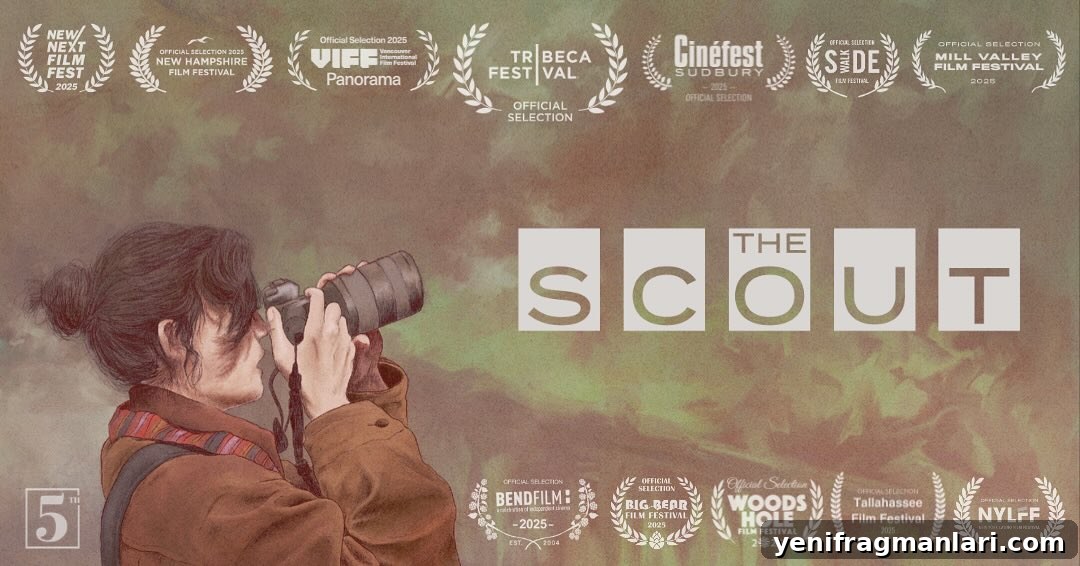
Standing Still: Paula González-Nasser on The Scout, Community, and Time
The conversation around The Scout began for me as an outgrowth of the Calgary Underground Film Festival experience. Paula Andrea González-Nasser could not attend in person, but we connected virtually afterward, which felt right for a film about distance, brief encounters, and the odd intimacy of entering someone else’s space briefly before leaving it again.
As I write this while preparing a Tribeca Festival preview, The Scout occupies that interesting post-premiere space: a year past its Tribeca world premiere and moving through the festival circuit toward wider visibility. It arrived in New York, screened in Calgary, and now sits in the slow, uncertain stretch when an independent film starts looking for a broader audience.
CUFF is a festival known for making room for the loud, strange, grotesque, and formally adventurous. In that lineup, The Scout might not read like an obvious fit. It is quieter and more observational than many selections. Yet that contrast is precisely why the film matters: in a program of bodies breaking down and genre shocks, it offers a different unease — one built from small pressures and patient attention.
On the surface, it might sit beside a title like Bagworm as an unlikely companion. One film charts grotesque decay and outward collapse; the other follows a location scout through a single New York day as she secures spaces for a television pilot. But both are character studies: internal portraits of people whose work, surroundings, and sense of self have slipped into disarray. They move in different registers, but both explore how a person’s internal life shapes — and is shaped by — the world around them.
That small, interconnected community of filmmakers is central too: people move between projects not merely as credits but as collaborators, friends, and creative peers. Those relationships are the scaffolding behind many independent films, including The Scout.
What is The Scout About?
Paula started by describing the film’s structure: a single-day journey through New York City, assembled from a collection of encounters. The protagonist, Sofia, played by Mimi Davila, is a location scout tasked with securing homes, businesses, and streets for a television pilot. On paper, this premise can sound procedural—someone doing a job, moving from place to place—but the film is less about the mechanics of scouting than about what that job reveals.
Sofia is repeatedly invited into private spaces, always for a purpose and always as a temporary presence. The work demands connection yet produces persistent distance. She observes, photographs, assesses, negotiates, and moves on. Those brief intrusions reveal fragments of other people’s lives while her own interior life steadily complicates.
The film functions like an anthology of encounters that gradually disclose the woman at its center. Because Sofia is guarded, other characters must draw things out of her; they become pressure points that alternately tenderize, unsettle, or amuse. That restraint — the refusal to explain her instantly — is one of the film’s strengths.
That makes Mimi Davila’s performance crucial. Paula had Davila in mind early on, having worked with her on a short years before. In person Davila is loud and comedic, but on screen she delivers a quiet duality: joy and sorrow both present in the eyes. That subtlety keeps Sofia readable without flattening her into a closed cipher.
Writing What You Know — Then Letting Go
There’s an obvious autobiographical entry point: Paula’s background as a location scout on shows and films. But the film moves beyond literal transcription. Early drafts leaned heavily on real experiences and, Paula discovered, literal truth does not always translate into dramatic truth.
She found structural inspiration in Chantal Akerman’s work, which suggested a segmented approach that could reveal loneliness through encounters. Instead of copying events, Paula began fictionalizing characters and compressing or rearranging incidents to form pressure: each meeting had to push or pry at Sofia in a different way.
“Write what you know” for her meant starting from lived experience, then reshaping it — discarding some facts, amplifying others — until the emotional structure of the story emerged. The result feels truer than strict transcription would have allowed.
The Scout: Frames Within Frames
Visually, the film is about rooms, thresholds, windows, doors, and leading lines. The compositions are often clean and the camera frequently locked off, but the apparent simplicity is deliberate: frames are composed to show how Sofia is organized by spaces. Architectural elements define her before she defines herself. Doorways can trap or offer escape; hallways become paths or dead ends.
This visual approach dovetails with Sofia’s job: she evaluates spaces as potential images. Nicola Newton’s cinematography — a long-standing collaboration with Paula — helped shape that way of seeing. Newton’s photographic instincts allow the film to reveal character through objects, clutter, artwork, and empty corners rather than expository dialogue.
Leading lines become narrative: they map movement, limits, exits, and constraints. The city reads as a system of images and pressures rather than merely a backdrop.
The Difficulty of Standing Still
Locking off the camera is a deliberate aesthetic choice and a practical challenge. Paula admires composed, observational photography — the work of Antonioni, Akerman, and others — but discovered that stillness demands precision. A fixed frame exposes faulty blocking, imperfect lighting, or missed performances more readily than handheld work can hide them.
The production often managed only six or seven shots a day, each requiring careful setup and an attention to how actors moved within space. Davila suggested keeping first meetings between Sofia and the people she encounters spontaneous, which added emotional honesty but made the formal blocks harder to choreograph.
The result, however, is a film that feels precise without being dead. Small improvisational shifts preserve life inside highly curated frames. That coordination — actor freedom meeting camera stillness and the scene’s emotional rhythm — is harder than it looks, and it’s part of what makes the film ambitious for a debut.
The Community Labour Behind The Scout
Although this is Paula’s feature directorial debut, it is very much a collective effort. Relationships formed at film school and through a film collective called 5th Floor Pictures created the ecosystem that made the film possible. Longtime collaborators filled key roles: a co-founder producing and editing, a cinematographer who’d worked with Paula for years, and friends and classmates contributing essential labour.
That model — mutual support, shared sweat equity, and cross-role collaboration — is common in independent filmmaking. It’s born of necessity but becomes a creative advantage: collaborators know one another’s strengths, trust risks, and sustain projects that might not exist otherwise.
Finding the Cut
Edit decisions were vital. The film balances stillness and drift: cutting too quickly undermines patience; holding too long risks disengagement. Paula worked closely in the edit room, bringing in collaborators whose different instincts created a useful tension that helped find the right rhythm.
Paula describes herself as an emotional editor: she senses when a moment’s energy has expired and trusts instinct to guide exits and entrances. For her, cutting a scene felt musical — a communal act of listening and shaping, like playing in a band until the melody emerges.
No Clean Resolution
Paula purposely avoids tidy resolutions. The supporting characters bring only brief, partial intimacies — some comic, some uncomfortable — and they rarely get clean endings. That frustrates familiar narrative expectations, but it mirrors real life: many encounters are ephemeral. Sofia meets people, glimpses parts of their lives, and moves on. Those relationships remain unresolved because that’s how a job defined by transience really feels: like “ships sailing in the night.”
Hurry Up and Wait
Time is central to the film’s shape. While the day moves slowly on screen, Sofia’s schedule often feels urgent: a lot of waiting punctuated by bursts of action. Paula captures that cadence — the downtime, the sudden rush — with patient frames that highlight the moments when little things reveal a lot.
The film isn’t trying to portray nonstop crisis. Instead it examines the connective tissue of a life: the pauses, the small embarrassments, the rooms you visit for ten minutes and never see again. Those in-between moments are the emotional core.
What Comes Next
The Scout premiered at the 2025 Tribeca Film Festival and was later acquired for distribution. Paula remains engaged with the film’s final stages while continuing to collaborate on other projects and refine her writing. She admits writing is difficult and that she’s still learning — a candid note that underscores how this debut is not a claim of mastery but a careful, thoughtful step forward.
Ultimately, The Scout stays with you because of its focus on looking: how we move through other people’s lives, what we notice, and what we miss. It’s a film about work, observation, and the loneliness that can come with constant interaction. In a festival world often defined by spectacle, its patience is a kind of strength. Sometimes a film needs to break a room open; sometimes it asks you simply to sit still inside it.