
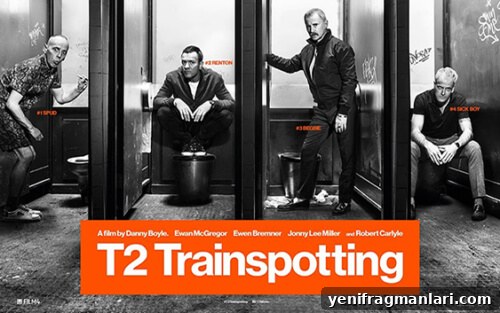
T2 Trainspotting (2017)
Director: Danny Boyle
Screenwriter: John Hodge
Starring: Ewan McGregor, Ewen Bremner, Robert Carlyle, Jonny Lee Miller, Anjela Nedyalkova
Twenty years after the cultural phenomenon that was Trainspotting (1996/97), director Danny Boyle reunited the original cast to deliver a sequel that feels both necessary and earnestly conceived. T2 Trainspotting returns Renton, Spud, Sick Boy and Begbie to the screen, trading the frenetic cultural rebellion of the 1990s for a more reflective, mature examination of memory, regret and the passage of time. The result is a film that balances nostalgia with new emotional stakes while remaining distinct from its predecessor.
Set in the late 2000s, roughly two decades after the ambiguous late-80s setting of the original, T2 captures an Edinburgh changed by recession and decay. Boyle and writer John Hodge place the characters in a city that has lost much of its vitality: the neighborhood that once hosted youthful chaos has become a worn landscape, a repository for abandoned hopes and the echoes of better days. Each character’s situation mirrors this decline. Sick Boy has turned to blackmail and small-time schemes to survive; Spud lives in a high-rise marked for demolition and struggles with the recurring pull of heroin; Begbie remains a violent, volatile presence after years behind bars; and Renton, who once absconded with a portion of the group’s money, has built a tentative life in Amsterdam that begins to unravel as he confronts his dissatisfaction and rootlessness.
The film’s emotional core is Renton’s midlife search for meaning and reconciliation with the past. Boyle uses memory and fantasy sequences to move fluidly between past and present, giving the film a dreamlike quality that deepens its themes. These transitions are among T2’s most accomplished moments: they function narratively to reveal who these characters were and who they have become, and stylistically to make the film feel like an extended meditation on aging and the romanticization of youth.
Compared with the original’s pulse-pounding, stylistically daring approach to its soundtrack and visuals, T2 adopts a subtler mode. That change is intentional and effective: the characters are older, and the film’s aesthetic follows suit. The manic highs and anarchic energy of the first movie are replaced by a more subdued, bittersweet tone. This doesn’t diminish the film’s impact; instead, it reframes the story, making its most poignant moments hit with the same crushing clarity as a comedown. Boyle’s direction keeps the visuals inventive—color and camera movement still play a major role—but the emphasis is squarely on character and consequence rather than sensory excess.
John Hodge’s screenplay balances momentum and introspection, propelling the story while inviting viewers to consider broader questions about choices, friendship and social change. Performances throughout are strong, but Ewen Bremner’s Spud stands out for his raw, empathetic portrayal of a man trapped by addiction yet still achingly human. Bremner captures Spud’s vulnerability in a way that makes him the film’s emotional anchor.
Robert Carlyle returns as Begbie, delivering a powerful and unnerving performance. Begbie remains frightening and combustible, but the film also attempts to humanize him in ways that may feel uneven. At times that humanization deepens the movie’s thematic reach, suggesting social neglect and personal failure play roles in shaping violent behavior. At other times, the sudden shifts toward sympathy feel underexplained, which can undermine the character’s menace and reduce the narrative tension he once reliably supplied.
One sequence that divided viewers shows several characters reliving heroin use after years apart. The scene is effective in its emotional and aesthetic recall of the original film, and it generates sympathy for Spud, but the aftermath leaves questions: the relapse is not pursued with the same urgency the original film gave addiction, and its longer-term consequences are left largely unexplored. This restraint might be read as an intentional choice—reflecting the characters’ different priorities and the film’s focus on regret over repetition—but it can also feel like a missed opportunity to further complicate their arcs.
Despite these quibbles, T2 Trainspotting succeeds as a rare sequel that meaningfully expands on its source. Boyle, Hodge and the cast construct a deeply human story about aging, friendship and the difficulty of escaping one’s past. The film’s evocative use of memory, its measured shift in tone, and standout performances—especially Bremner’s—combine to make T2 a worthy continuation of the Trainspotting saga. For fans of the original, the sequel is both a nostalgic return and a hauntingly contemporary reflection on what it means to grow older without losing the past entirely.
Score: 20/24
Recommended for you: Danny Boyle Films Ranked