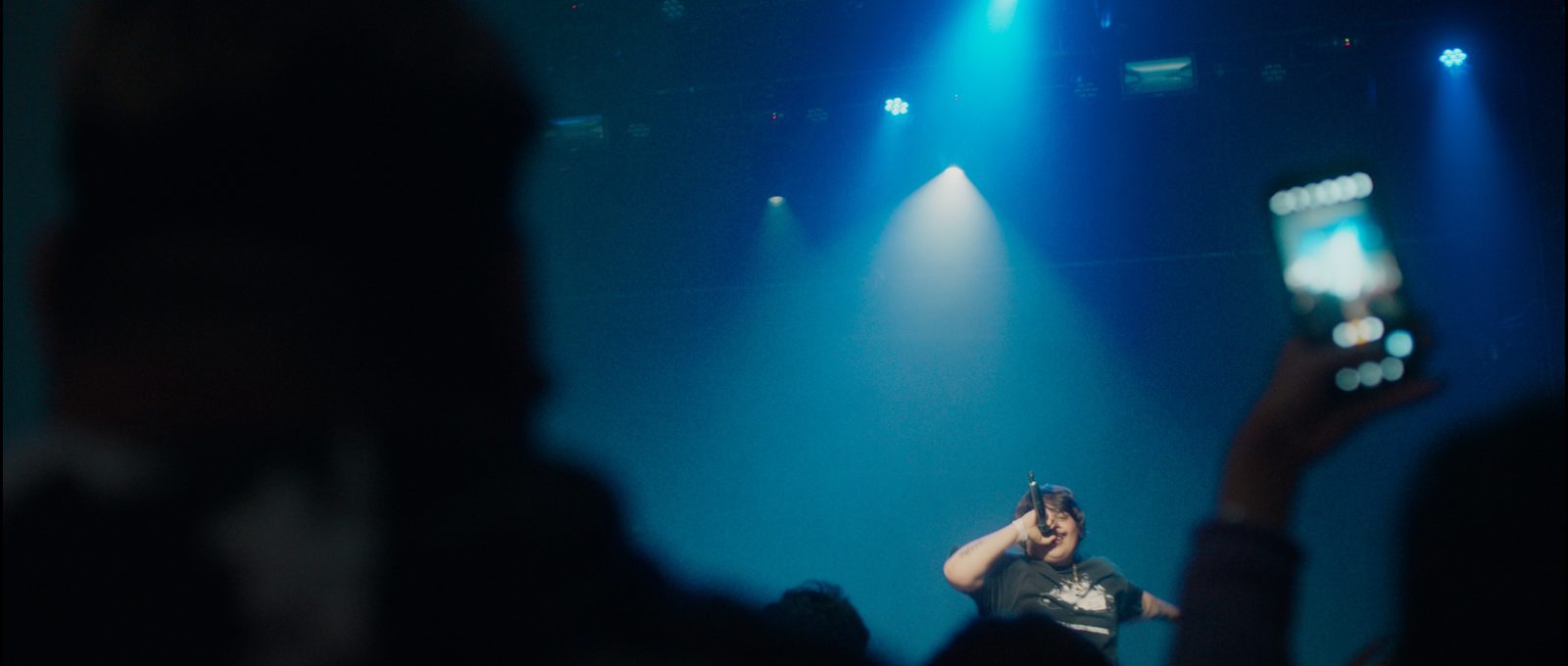
Three Indigenous rappers at different stages of their careers drew me to Turtle Island Rap on the CUFF.Docs watchlist. The music is an immediate hook, but the film also interested me for how director Alexandra Lazarowich weaves three distinct journeys without forcing them into a single narrative. One line from the film lingered long after the credits.
“If I set my sights really high, I might disappoint myself.”
Those words come from Wiidaaseh, reflecting on how he approaches ambition. At first the remark sounded like self-protection against disappointment. But then he clarified: he deliberately celebrates small achievements so the journey feels rewarding throughout. That perspective resonated—I, too, have chased one goal only to immediately shift attention to the next, letting wins slip by unappreciated. Wiidaaseh’s choice to savor “little wins” questions that habit.
Lazarowich followed Wiidaaseh, A$h Da Hunter, and Travis Thompson over three and a half years, capturing performances, studio sessions, family life, and setbacks. Their sounds and circumstances differ, and none reach a neatly finished destination by the film’s end. That unfinished quality is deliberate: the documentary documents a moment in ongoing lives rather than offering tidy conclusions.
Alexandra Lazarowich and the Three Sounds of Turtle Island Rap
Films that examine historical injustices and trauma against Indigenous peoples are vital. Films that celebrate Indigenous art, community, and excellence are equally important. Turtle Island Rap makes room for both perspectives while keeping the music central.
Lazarowich came to the project through Scenario Media, known for Hip-Hop Evolution. Early conversations considered tracing the history of Indigenous hip-hop, but Lazarowich kept returning to the present: the artists creating music now. Her aim was not just to document sound but to portray “a modern interpretation of what Indigenous community looks like in 2026.” She wanted to showcase people living their culture today.
The team met many Indigenous rappers, DJs, b-boys and performers, and ultimately chose three artists whose music and personalities provided contrast. Musical variety was important—Lazarowich didn’t want a one-note film. The three voices in the film reflect that diversity.
A$h Da Hunter (Yavapai-Apache Nation and Hopi ancestry) channels confrontational battle-rap energy with aggressive, direct bars. Travis Thompson (Navajo Nation, Seattle) offers a more polished, commercially minded sound—his collaboration with Macklemore on “Corner Store” hints at broader reach. Wiidaaseh (Anishnabek from Wiikwemkoong Unceded Territory, based in Toronto) occupies an alternative, lyric-driven space, blending personal storytelling with underground hip-hop sensibilities. Each artist brings a distinct approach, underlining that there is no single Indigenous experience and no single way to make hip-hop.
Lazarowich recognized that viewers might arrive with narrow expectations about rap or Indigenous music, so the film intentionally provides alternate perspectives and expands what audiences might assume about the genre and the communities making it.
A$h Da Hunter, Travis Thompson, and Wiidaaseh: Life Beyond the Stage
The film spends substantial time with the artists away from the stage. Performances reveal part of their identity, but what happens between shows reveals the labor, uncertainty, and persistence required to keep a career moving.
A$h projects fierce, combative confidence onstage, yet offstage she and her mother sell food from their vehicle to support travel to competitions and to get seen by the right people. The film exposes how financial pressure and industry assumptions—about Indigenous rappers and about women in hip-hop—shape her path. The aggression onstage gains new context when you see the work behind it.
Thompson’s challenge is a familiar creative frustration: a high-profile collaboration hinted at wider success, but sustained momentum has been harder to secure. He’s tasted recognition, yet the next breakthrough remains elusive, raising questions about what transforms a promising moment into lasting progress.
Wiidaaseh handles almost every element of his music himself—writing, producing, recording, mixing and mastering. That control preserves his sound but increases his workload when outside support disappears. He also faced skepticism when filmmakers first contacted him. Having seen tentative industry overtures fall apart before, he wasn’t fully convinced at first that the project would materialize. When the crew finally arrived during a music-video shoot, his relief and disbelief were evident. Over time he grew comfortable with the team, describing the experience as friends hanging out with cameras nearby.
Indigenous Joy, Family, and Cultural Identity in Turtle Island Rap
Scenes with Wiidaaseh and his parents are among the film’s most resonant. Lazarowich, a Cree filmmaker from Lubicon Lake First Nation, spends time showing the family in ordinary moments, preserving their presence on screen as a lasting record. Her short film Fast Horse earned a Special Jury Award for Directing at Sundance in 2019, and Turtle Island Rap marks her feature documentary debut. Across her work she leans into depictions of joy, community, and Indigenous excellence—responses to the limited, often traumatic portrayals she encountered growing up in northern Alberta.
Lazarowich says she wanted to show the parts of her upbringing that involved laughter and community. That personal connection explains why family scenes mattered so much to her: capturing a parent or grandparent on film can become a treasured memory for generations, a reason to choose and preserve particular moments during editing.
Wiidaaseh’s mother moved the family from the reserve to the city for better education and opportunities, yet cultural and spiritual life remained central. He continued to connect through hunting with his father and through dance and ceremonies his mother kept alive in urban life. He describes his Indigenous identity as a core part of himself—sustained by his parents’ effort to bring culture into city life rather than leave it behind.
Beyond TIFF and CUFF.Docs: An Unfinished Story for Turtle Island Rap
When you follow people for three and a half years, deciding where a film ends becomes a practical and artistic choice. Lazarowich and her team asked what would satisfy an audience, but none of the artists was ready to stop creating. The film therefore closes on a moment of transition—setting up the next phase rather than offering a definitive finish.
The documentary shows how little a single performance, collaboration or setback can determine a career in music. All three artists continue working after the cameras stop, and the film leaves that work visible and open-ended.
Lazarowich knows the sting of rejection—after two decades in film and television she’d faced repeated TIFF refusals. When Turtle Island Rap was accepted, she experienced sold-out screenings and cheering crowds, moments she deliberately tried to savor, taking her own subjects’ advice about enjoying small victories. For Wiidaaseh, appearing at one of Canada’s biggest film festivals was surreal—proof that a life under the lens can lead to unexpected opportunities.
The filmmakers plan community screenings and a grassroots tour to bring the film to Indigenous communities across Canada and the United States. Creative producers from The Halluci Nation, including Tim “2oolman” Hill and Ehren “Bear Witness” Thomas, bring touring experience and a vision of pairing screenings with live DJ events and concerts, aiming to create a communal celebration as much as a film presentation.
The artists remain active: Wiidaaseh has released new music, collaborated with A$h, and has further releases planned. The Halluci Nation also worked remotely with all three rappers on an original end-credits song, with a potential release anticipated in the coming year. Between ongoing music and community engagement, the story of Turtle Island Rap continues beyond the screen.
For more information about Turtle Island Rap and its proposed community screenings, visit the official Turtle Island Rap website.
Turtle Island Rap screens at CUFF.Docs on Saturday, November 21, 2026, at 4:30 p.m. at Globe Cinema, with director Alexandra Lazarowich, Wiidaaseh, and producer Jessica Ford scheduled to attend. Lazarowich, who has family and friends in Calgary, looks forward to returning with this film.