
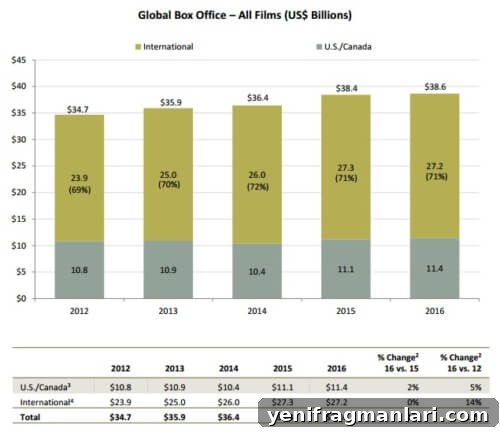
The Motion Picture Association of America (MPAA) has released an overview of the global box office performance for 2016, revealing that the film industry reached a new milestone by generating more revenue worldwide than in any previous year. The MPAA reports that global theatrical box office receipts totaled $38.6 billion in 2016, marking a record high for the industry.
This milestone came despite a slight downturn in one of the world’s fastest-growing markets. China, which had driven significant box office growth in prior years, experienced a 1% decline in ticket sales in 2016 after an exceptional 49% surge in 2015. Nevertheless, the overall global total continued to climb, driven by gains in other regions and structural changes across the exhibition and distribution sectors.
According to the MPAA, a number of factors combined to produce the record total. North America posted higher revenues, with the United States and Canada showing a 2% increase compared with the previous year. This uptick in North American receipts is widely regarded as a primary contributor to the new global high. At the same time, the worldwide footprint of cinema screens expanded: the total number of screens increased by roughly 8% across global markets. More screens can mean greater opportunity for diverse releases to reach audiences and for exhibitors to schedule more showtimes, both of which support higher aggregate attendance and revenue.
Senator Chris Dodd, Chairman and CEO of the Motion Picture Association of America, commented on the figures with a statement underscoring the continued cultural and commercial importance of theatrical exhibition. His remarks emphasized the enduring appeal of the cinema experience and pointed to demographic shifts that suggest a promising future for theatrical attendance.
“The continued strength of the box office demonstrates that cinema remains the premier way to experience great storytelling for audiences around the world. In the United States and Canada, there are key indicators that suggest the future may be even brighter, with increases in attendance among younger demographics and diverse communities, in particular. The film industry continues to thrive because every facet of the industry – production, distribution, and exhibition – is relentlessly innovating to bring new stories to life on the big screen.”
Audience participation remained robust in North America, where roughly 71% of people — approximately 246 million Americans and Canadians — attended at least one theatrical screening during 2016. Young adults aged 18–24 were the most frequent moviegoers, averaging about 6.5 visits per person over the year. The MPAA also highlighted modest but notable increases in attendance among demographic groups identified as Black and Asian/Other, with per-capita increases of 0.6 and 1.2 films, respectively. These shifts point toward a gradual diversification of theatrical audiences and suggest that targeted programming and marketing can further broaden the appeal of theatrical releases.
The MPAA’s summary also emphasizes that the strength of the box office reflects collaborative innovation throughout the industry: from filmmakers exploring new stories and formats, to distributors optimizing release strategies, to exhibitors investing in upgraded auditoriums, premium formats, and expanded schedules. Together, these efforts help maintain cinema’s relevance in an increasingly competitive entertainment market where alternatives such as home streaming and on-demand viewing continue to grow.
Among the year’s highest-grossing films were several major studio tentpoles that performed strongly at the global box office. Notable top earners included Marvel Studios’ Captain America: Civil War, which earned approximately $1.15 billion worldwide; Lucasfilm’s Rogue One: A Star Wars Story, which brought in about $1.05 billion globally; and Disney/Pixar’s Finding Dory, which reached roughly $1.03 billion. The success of these blockbuster releases underscores the continued commercial pull of franchise filmmaking and family-friendly animated features in driving international ticket sales.
Overall, the MPAA’s report on 2016 illustrates how the theatrical business continues to adapt and grow in a dynamic global marketplace. While regional fluctuations like China’s small decline remind the industry that growth is not uniform, gains in North America and the expansion of global exhibition capacity helped deliver the highest box office total to date. As studios, distributors, and exhibitors continue to innovate—experimenting with release windows, event-driven marketing, premium formats, and inclusive storytelling—cinema’s role as a central venue for shared storytelling remains strong.