
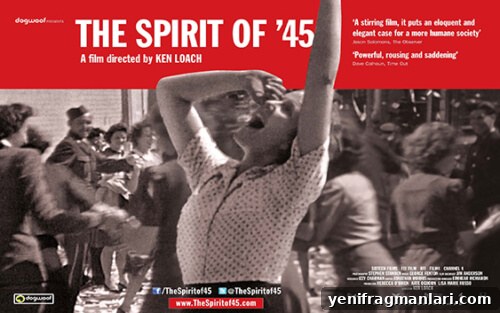
Spirit of ’45 (2013)
Director: Ken Loach
Screenwriter: Ken Loach
Summary: A retrospective on the Labour Party’s landslide victory in 1945 and how its socialist manifesto fundamentally changed the lives of ordinary working people in the UK, told by those who lived it.
“Never again.” That promise echoed across Britain as the world shifted from war to peace. After the horrors of fascism and the devastation of 1939–1945, returning service members and civilians alike vowed not to return to the poverty and class divisions of the pre-war era. Ken Loach’s documentary Spirit of ’45 captures that promise, tracing how the 1945 Labour government translated ideals into sweeping social change and how ordinary people experienced that transformation.
Unlike Loach’s familiar kitchen-sink dramas, this film adopts a straightforward documentary style: archive footage, period newsreels, public information films and intimate interviews. From the opening images of soldiers returning home—laughing, embracing, dancing to wartime tunes—the film establishes a sense of relief and collective possibility. Then it pulls back the curtain to show the depths of the Depression-era poverty people were determined to leave behind: cramped slums, malnourished children, overcrowded beds and funeral pyres that made the stakes unmistakable.
The documentary carefully explains the political and social sequence that led to Labour’s victory. Combining commentary from historians and firsthand testimony from people who lived through the period, Loach lays out how wartime solidarity and disillusionment with pre-war inequality produced an appetite for sweeping reform. Churchill’s wartime leadership did not translate into post-war popularity; instead, the public remembered social neglect from the 1930s and turned to a party promising concrete change.
Central to the film is the way Labour’s manifesto articulated a bold, public-minded vision. The documentary presents archival clips and snippets of political messaging that demonstrate an era when nationalised industries and a comprehensive welfare state were seen as practical responses to social injustice. The film includes an excerpt from the manifesto that captures the ambition of the moment:
“The Labour Party is a Socialist Party, and proud of it. Its ultimate purpose at home is the establishment of the Socialist Commonwealth of Great Britain—free, democratic, efficient, progressive, public-spirited, its material resources organised in the service of the British people.”
For a modern viewer, those words can feel astonishing. The film juxtaposes that idealism with later political shifts—particularly the privatisations and market-driven policies that followed in subsequent decades—making the contrast deeply felt. Loach’s editing and soundtrack intensify this emotional narrative: images of post-war council housing and social programmes are followed by montages of privatisation, strikes and confrontations that underscore the fragility of public achievement.
What gives the film its heart are the personal accounts. Former miners, mothers, nurses and ordinary families tell simple but powerful stories: tears of relief at a newfound security, the impact of free healthcare, and the dignity that came from public support. Moments such as a man recounting the grief of losing his mother or a mother describing the relief of no longer having to pay for a doctor’s visit are understated yet devastatingly effective. These testimonies remind viewers that policy debates translate into human lives.
Critics may dismiss the film as nostalgic or one-sided, but Loach’s intent is clear: to remind contemporary audiences of the human consequences of political choices. The documentary argues that the welfare reforms and nationalisations of 1945 delivered measurable improvements in living standards and public health, while later policies of privatisation and austerity eroded many of those gains. The film functions as both a celebration of collective achievement and a warning about complacency.
Loach’s rapport with interviewees gives the film warmth and authenticity. He lets people speak plainly, creating moments of real connection—an elderly interviewee addressing him by name, a hand briefly grasping his in shared sorrow. That intimacy distinguishes Spirit of ’45 from more detached historical surveys and anchors its political message in lived experience.
Produced with strong archival sourcing and respectful pacing, the documentary also carries a sense of urgency. Many of its participants were elderly when filmed; preserving their memories felt then—and feels now—like an essential public service. As debates about healthcare, public ownership and social safety nets continue, the film remains timely. It argues, persuasively, that the post-war settlement offers lessons for defending essential services and protecting vulnerable communities.
Ultimately, Spirit of ’45 is an evocative and humane account of a pivotal moment in British history. It celebrates the solidarity that made the welfare state possible while warning about the forces that can undo it. For viewers concerned about the future of public services—especially health care—the documentary is both inspiring and mobilising: a reminder that collective action once achieved lasting change and could do so again.
Score: 22/24