I first had Emily Robinson’s Ugly Cry on my watchlist during the 2026 SXSW Film & TV Festival, but scheduling conflicts meant I missed it there. When the film came to Calgary, the Calgary Underground Film Festival offered another chance to see it, and they organized an interview with Robinson ahead of the Alberta premiere. Ugly Cry screens at Globe Cinema on November 9 at 7 p.m. as part of CUFF’s year-round Off the CUFF series.
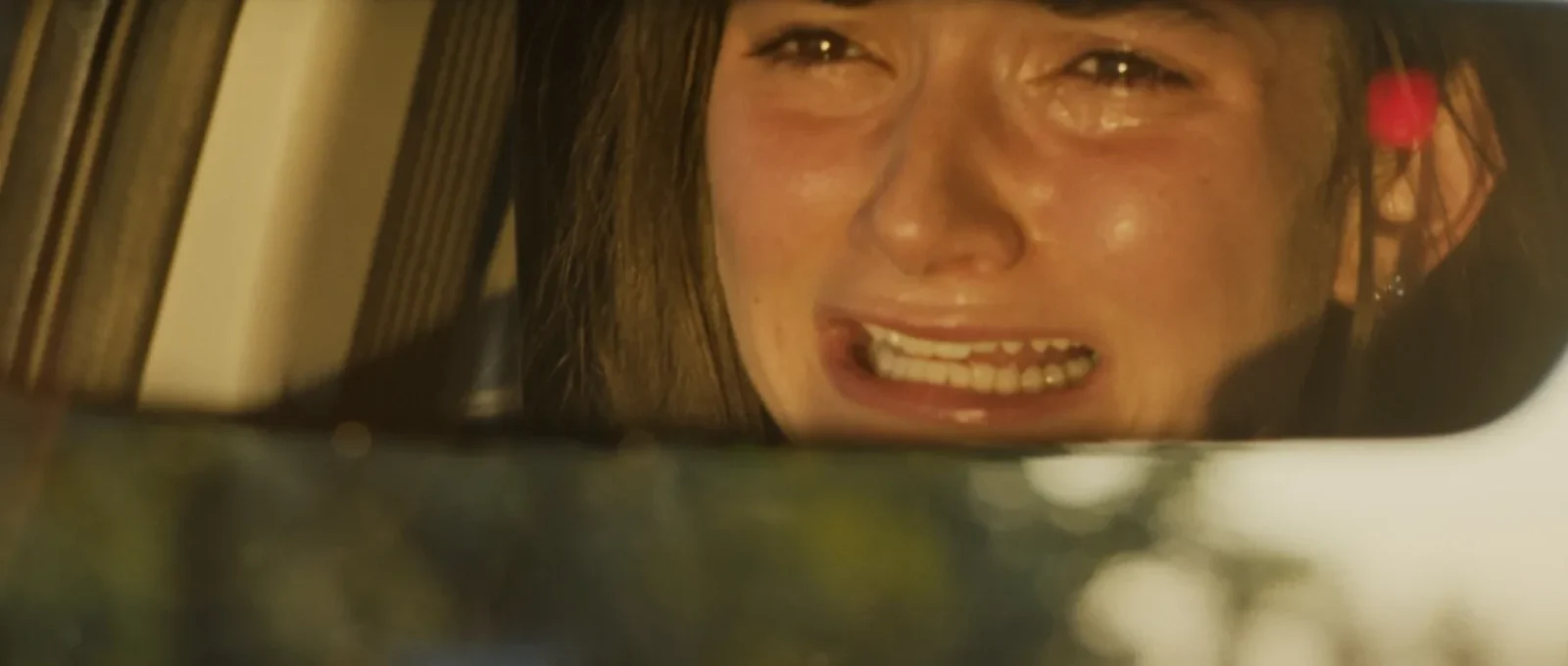
Ugly Cry is Robinson’s feature directorial debut, and she also wrote and stars in the film. The story follows Delaney, an actor who discovers she lost a coveted role because the producers objected to “the way she cried.” Determined to change that, Delaney obsessively analyzes her appearance and performance—convinced that if she can make herself cry more attractively, she can secure the parts she wants. The premise is oddly specific but reveals a broader contradiction in the expectations placed on performers, especially women: to be emotionally exposed while remaining aesthetically pleasing even at the very moment they are meant to lose control.
The film highlights how these pressures are unevenly distributed. Early on, Delaney’s boyfriend Miles, also an actor, remarks with relief that he doesn’t need to worry about crying before shooting a zombie movie. The offhand line underscores a persistent double standard: while men face scrutiny, women are often expected to maintain an attractive vulnerability. Robinson shared with me that an acting teacher contacted her after hearing about the film to confirm that someone they knew had genuinely been passed over for a job because of an “ugly cry.”
Robinson said she chose crying as the film’s focal point deliberately. Actors sometimes chase what she called an “Oscar tear,” yet in everyday life people more often struggle to hold back tears. That tension—where crying is theoretically the moment vulnerability breaks through, but is simultaneously judged for its appearance—felt like a precise way to explore performance, perfectionism, and self-policing.
Watching Delaney, I recognized the familiar spiral of perfectionism: the impulse to compare, to relentlessly improve, and to let perceived shortcomings define your next move. Robinson describes the film as an examination of perfectionism and “striving to reach a ‘there’ that doesn’t exist.” Insecurity and competition push Delaney inward until separation from others becomes part of the problem.
Emily Robinson: Growing Up in Front of the Camera
Robinson began working in entertainment at around five years old, first modeling and then expanding into acting. When I asked whether she could recall a life before performing she answered simply: “Barely.” Despite starting so young, her love of acting has persisted. She told me acting feels liberating because it forces you to stop overthinking and be present—an experience that stands in stark contrast to Delaney’s obsessive self-scrutiny in Ugly Cry.
Even though Robinson describes herself as naturally shy, performing has offered a way to inhabit space as someone else and escape the constant self-focus. The irony she points out is that the industry built on that creative freedom also demands relentless self-evaluation: auditions, image management, and the uncertain infrastructure around work can feel like obstacles to the very presence acting requires.
That unpredictable, freelance aspect of the profession is something Robinson finds especially difficult. As a Type A overthinker who likes to stay busy, she values writing as a way to create work without waiting for external opportunities. Her journals have long been part of how she develops characters and ideas. In 2023 she published her debut novel, Consumed, and Ugly Cry marks her expansion into feature writing and directing—areas she can pursue more independently.
When people ask what she does, Robinson said she usually identifies as a writer. She explained that “writer” feels protective compared with “actor” or “director,” terms that can invite questions, recognition checks, or assumptions about her availability in industry circles. Calling herself a writer allows her to control how much of herself she shares and when to open up.
Ugly Cry: Mirrors, Screens, and a Fractured Self
I’ve always been interested in reflections on screen: mirrors and photos show us versions of ourselves that feel familiar yet strange, and small changes in angle or lens can make an image unsettling. Ugly Cry uses that visual vocabulary to track Delaney’s fracturing sense of self. Her image appears repeatedly in mirrors, on phones, and behind glass—each layer introducing distortion and doubt. As her efforts to “fix” herself escalate, the film multiplies those surfaces until Delaney’s self-view is consistently fragmented.
Robinson and cinematographer Brody S. Anderson intentionally explored degradation alongside reflection. Most of the film was shot on an ARRI Alexa 35, while some sequences were captured on an iPhone to create contrast in image quality. That gradation—grains, distortions, and varying clarity—reflects the film’s themes: the multiple layers of performative identity and the breakdown of Delaney’s self-perception.
Framing also plays a role. Early scenes feature single mirrors or screens; as Delaney’s anxiety compounds, the compositions fracture into increasingly claustrophobic, multi-layered images. Robinson and Anderson referenced Black Swan for mood and, specifically, the recurring fragmented shots of Natalie Portman. The visual fragmentation extended to production design so the spaces themselves echoed Delaney’s psychological disintegration.
The Horror of Having a Body
Ugly Cry begins in a familiar register—auditions, relationships, and the day-to-day anxieties of precarious creative work—often with wry humor. As Delaney’s self-corrections become more extreme, the film moves into psychological and bodily horror, blending dark comedy with intensifying dread. Robinson told me that the script always intended this tonal shift, but the production team debated how far to push the horror elements while keeping everything grounded enough to feel plausible.
She wanted the escalation to remain connected to recognizable pressures: beauty standards, social media scrutiny, and the internalization of external judgment. Robinson cited inspirations across genres—Sunset Boulevard, Maps to the Stars, Swallow, and David Cronenberg—because the film crosses tones and genres. Films like Shiva Baby and Sick of Myself informed how to balance stress, humor, and escalating grotesqueness without losing emotional truth.
In the editing room, with editor Patrick Lawrence, timing became essential: how early should the film invite the audience to laugh, and when must the dread take over? Some social-media content was shot during editing to respond to the film’s evolving rhythm. A character originally written as an agent became a manager to allow a more casual, funny dynamic—another example of reshaping the story at every stage.
Robinson described discovering body horror almost by accident. She joked about “being a person is like weird fleshbags,” then reflected on whether that impulse is funny, unsettling, or both. In her director’s statement she called the film “not body horror, but a film about the horror of having a body.” That idea connects to growing up in the industry and working through self-objectification. The pandemic’s disembodied interactions—screens, Zoom calls, filmed life—also contributed to Delaney’s dissociation and the increasingly physical attempts to reconcile discomfort with herself.
“Existing in flesh and being on this world is the thing that allows us to live, and also that we are stuck in mortal form,” Robinson said, framing the film’s tension between embodiment and the desire for control.
What Is Next for Emily Robinson and Ugly Cry?
Ugly Cry is slated for a limited North American theatrical release this winter from Obscured Releasing. Robinson is also developing a film adaptation of her novel Consumed (2023), which she describes as more intensely body horror. Calgary audiences can catch Ugly Cry at Globe Cinema on Monday, November 9 at 7 p.m. as part of the Calgary Underground Film Festival’s Off the CUFF series.
Ugly Cry (2026): Cast and Crew
Director and Writer: Emily Robinson
Cast: Emily Robinson (Delaney), Ryan Simpkins (Maya), Aaron Dominguez (Miles), Robin Tunney (Valerie)
Producers: Sophia Sabella, Pablo Feldman, Jolene Mendes, Rhianon Jones, Tristan Scott-Behrends, Emily Robinson
Cinematography: Brody S. Anderson
Editing: Patrick Lawrence
Production Design: Annie Becker
Original Music: Sóley Stefánsdóttir
Read More:
- Interviews
- Film Reviews
- Calgary Underground Film Festival (CUFF)