
Disney’s 2016 blockbuster Moana and its titular heroine join a long lineage of celebrated women in the Disney pantheon. From Snow White onward, these characters have shaped how generations of children—especially young girls—imagine womanhood, leadership, and courage. Although Moana is explicitly described in the film as the chief’s daughter and not a princess, she nonetheless enters the cultural roster of iconic Disney heroines. The label “Disney princess” has endured since the studio’s early days, but its meaning has evolved dramatically over time.
Moana stands alongside Snow White, Cinderella, Aurora, Ariel, Belle, Jasmine, Pocahontas, Mulan, Tiana, Rapunzel, and Merida as a model of female strength and agency. Each character represents a different facet of empowerment: some reflect resilience and moral courage, others independence and curiosity, and some combine many qualities into a rounded, modern heroine. It’s not useful to compare, for example, Mulan directly with Cinderella—each inspires in her own way—but together they trace how Disney’s portrayals of women have changed.
An important theme across many Disney films is the heroine’s relationship with her father or the chief male figure in her life. Historically, this relationship often defines expectations for the daughter, shaping duties, restrictions, and prospects. Early princesses like Snow White, Cinderella, and Aurora embodied a gentler, more passive ideal of femininity. By contrast, the Disney Renaissance introduced more assertive protagonists—Ariel in 1989 being a pivotal example of a character who knew what she wanted and pursued it.
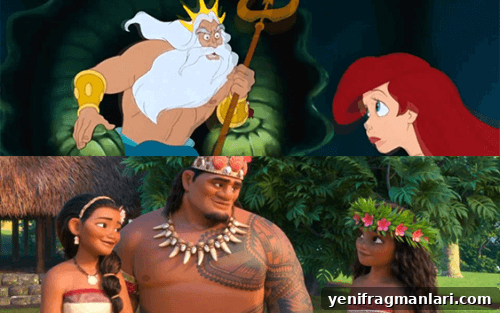
Ariel, the first prominent character of that Renaissance era, is a mermaid and the youngest daughter of Triton, King of the Sea. She is fascinated by the human world and especially drawn to Prince Eric after saving him from a shipwreck. Her curiosity drives her to make a dangerous bargain with Ursula, the Sea Witch: Ariel exchanges her voice for human legs in the hope of winning Eric’s love. That risky choice—born of rebellion against a controlling father and a desire to explore beyond her world—underscores a recurring motif: the heroine leaving home to claim her own identity, sometimes by defying paternal authority.
Moana follows a similar narrative arc in tone but differs in motivation and moral center. As the daughter of her island’s chief, she is chosen to lead and care for her people. When a curse spreads across the islands, the ocean itself calls Moana to restore the heart of the goddess Te Fiti. Discovering that she descends from legendary voyagers, Moana’s longing to sail beyond the reef becomes a mission for her people rather than a purely personal escape. She seeks out the demigod Maui to help her complete the quest—her journey is rooted in responsibility, cultural memory, and communal survival.
Both Ariel and Moana share the urge to explore unfamiliar worlds and claim agency over their futures. Yet the way their fathers respond highlights how representations of paternal authority have changed over time. Triton’s rule is protective and absolute; his fear of humans leads him to forbid Ariel’s curiosity. His instincts are driven by an anxious desire to control and shield. Chief Tui, Moana’s father, is similarly fearful—he has personal reasons to restrict voyaging after a tragic loss—but his approach is more tempered. He respects leadership and tradition and offers Moana responsibilities within the community, even as he tries to keep her safe. Moana’s defiance is spurred not simply by a wish to be free, but by a conviction that she can save her island. That blend of personal yearning and communal duty marks a development in how Disney frames female heroism.
The father-daughter dynamics on screen echo how young viewers might interpret male authority and their own potential. Ariel’s rebellion, culminating in a pact with a dangerous figure, frames her choice as risky and impulsive. She flees one controlling figure into the arms of another unknown, emphasizing romantic rescue as a solution. Moana, by contrast, breaks away with purpose: she acts to heal, restore, and lead. Her journey is about stewardship and skill, not solely romantic fulfillment.
Across Disney’s history, each princess offers a different model of womanhood. Earlier characters emphasized grace and patience; later protagonists combine intelligence, strength, and moral conviction. Over time, characters have become more fully realized—less defined only by family ties and more by personal values, abilities, and goals. Modern heroines are framed as leaders in their own right: capable of making difficult choices and accountable to themselves and their communities.
Honourable Mentions:
Belle from Beauty and the Beast maintains a strong bond with her father, and her curiosity and independent spirit shape much of her identity. Her father’s troubles draw her into the Beast’s castle, where her compassion and intellect become central to the story.
Jasmine and Merida each confront paternal expectations tied to marriage. Jasmine navigates the political realities of being a sultan’s daughter, while Merida rejects arranged marriage outright and secures her own future—illustrating a cultural shift away from marriage as the default path for women.
Pocahontas and Mulan are narratives inspired by historical figures; both explore duty, identity, and the pressures placed on daughters, though their stories are shaped by very different cultural contexts and historical interpretations.
Tiana and Rapunzel have limited paternal interactions in their films, which itself signals a move away from defining female characters primarily as “the daughter of” and toward portraying them as individuals who stand on their own.
Written by James Cullen