
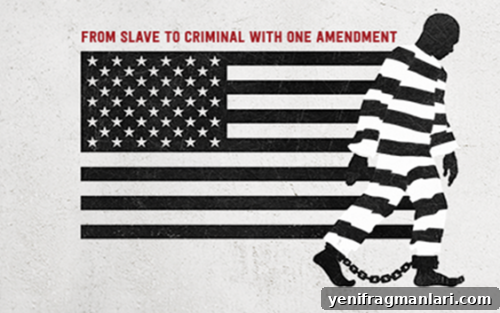
13th (2016)
Director: Ava DuVernay
Screenwriters: Spencer Averick, Ava DuVernay
“So let’s look at the statistics. The United States is home to 5% of the world’s population, but 25% of the world’s prisoners. Think about that.” – Barack Obama
Ava DuVernay’s documentary 13th is a tightly constructed, persuasive examination of the forces that have driven mass incarceration in the United States. Combining archival footage, interviews with scholars and activists, and clear, purposeful editing, the film traces how economic incentives, political strategies, and historical prejudice intersect to produce a punitive criminal justice system that disproportionately affects Black communities.
Visually precise and narratively focused, 13th avoids unnecessary digressions. DuVernay’s approach is methodical: she pairs testimony from historians, civil rights leaders, former policymakers and legal experts with archival images of protests, police violence and courtroom scenes. This juxtaposition creates an emotional and intellectual throughline, showing how legislation, media narratives and private interests helped shape public perceptions of crime and justify harsher penalties over decades.
Central to the film’s argument is the claim that the Thirteenth Amendment’s exception for punishment opened a path from slavery into systems of forced labor and mass incarceration. From Reconstruction-era Black Codes to the War on Drugs and recent policies that expanded prison populations, DuVernay and her interviewees chart a continuity in which racialized control and profit motives converge. She also examines the role of private corporations that benefit from prison expansion, and how lobbying and campaign rhetoric have influenced sentencing laws, mandatory minimums and the growth of the prison–industrial complex.
The documentary does not merely list statistics; it contextualizes them. For example, 13th highlights contemporary realities such as the large number of Americans behind bars and the loss of voting rights for many people with felony convictions. These facts are presented alongside commentary that explains the broader social and economic consequences: communities destabilized by the removal of large numbers of citizens, families burdened by legal fees and bail costs, and a public discourse shaped by fear and political opportunism.
DuVernay’s film also critiques political messaging and media framing that have stigmatized entire communities. She includes examples of political ads, soundbites and news footage that contributed to a climate of punitive policymaking. The documentary interrogates how language—terms like “tough on crime” or “law and order”—became tools for passing legislation that increased incarceration rates, while offering little attention to prevention, rehabilitation or the socioeconomic roots of crime.
While 13th is unapologetically forceful in its stance, it remains rigorous in sourcing its claims. Interviewees speak with authority and clarity, and the film uses on-screen typography to highlight key data and chronological milestones. That editorial clarity helps the viewer follow a complex narrative that spans centuries but remains urgent and relevant to contemporary debates about race, justice and democracy.
Emotionally, the film can be intense. Viewers may feel anger, sorrow, frustration and a renewed sense of urgency when confronted with scenes of brutality and systemic neglect. Yet that emotional power is part of the film’s utility: it compels audiences to consider how policy choices and economic incentives have real human consequences, and asks what reforms might restore rights and dignity to those affected.
13th earned wide critical acclaim and attention for its clear-eyed analysis and persuasive storytelling. It stands out as one of the most direct and comprehensive cinematic examinations of the United States’ carceral system in recent years, combining historical perspective with contemporary critique. As a piece of documentary filmmaking, it excels at turning complex legal and political histories into a coherent, urgent argument about accountability, reform and the need to confront entrenched racial inequality.
Whether viewed as a call to action or as an informative account of recent American history, 13th challenges its audience to reckon with uncomfortable truths and to consider policy changes that address the root causes of mass incarceration rather than its symptoms. It is a compelling, expertly crafted documentary that continues to shape conversations about criminal justice reform and racial equity.
Score: 21/24
Recommended for you: More movie reviews from The Film Magazine