

Challengers (2024)
Director: Luca Guadagnino
Screenwriter: Justin Kuritzkes
Starring: Zendaya, Mike Faist, Josh O’Connor
When 18-year-old rising tennis star Tashi Duncan (Zendaya) first meets friends and players Patrick Zweig (Josh O’Connor) and Art Donaldson (Mike Faist), she insists tennis is more than a sport — it’s a relationship. On a wind-blown beach, as waves break behind them, Tashi describes playing a perfect match as akin to being in love, an act of total surrender and unity with a partner.
Luca Guadagnino’s Challengers, his follow-up to the romantic horror of Bones and All, promises the erotic charge and intensity of that metaphor but never fully commits. The film flirts with transgressive sensuality and dramatic volatility, and benefits from sharp direction and committed performances, yet its script holds it back. The result is a movie that continually suggests something more daring beneath its surface but rarely dives in.
Challengers traces roughly thirteen years in the lives of Tashi, Art, and Patrick, moving between past and present. We first meet Tashi in her early thirties: she is a mother, the coach and wife of Art. After a career-ending knee injury, she has poured her ambitions into training Art to become the player she could not be. But Art, recovering from his own setback, has lost confidence. To rebuild him, Tashi signs him up for a challenger event where Patrick — once Art’s best friend and now a struggling journeyman sleeping in his car — is also entered. From there the film alternates timelines to reveal how their friendships formed, how tensions escalated, and how a single match comes to threaten everything they’ve built.
One welcome aspect of Challengers is that it revives the mid-budget, adult-oriented drama that Hollywood has largely pushed aside in favor of franchise cinema. Guadagnino stages a messy, morally complicated love triangle populated by flawed characters, and that willingness to be uncomfortable will appeal to viewers who miss more mature, sensual storytelling. Still, the film rarely probes its provocative ideas deeply enough to be fully satisfying.
Guadagnino channels most of the film’s sensual energy into the tennis court. Matches are shot with an almost erotic focus: sweating bodies, straining thighs, glistening torsos and guttural exhales. Zendaya emits a visceral, almost primal cry after a victory; the camera lingers on bodies in motion while Trent Reznor and Atticus Ross’s anxious, 1990s-tinged score heightens the physical intensity. For these characters, tennis is shorthand for desire and competition. The director stages fights and confrontations with the rapid, rhythmic cuts of a match, making the sport itself a language through which the trio communicate, bond, and hurt each other.
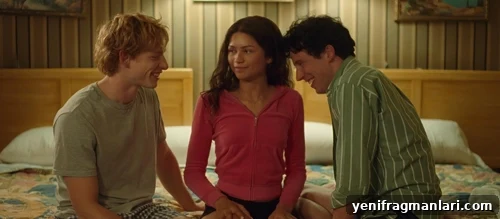
By contrast, the film’s explicit bedroom scenes often feel muted and underdeveloped. Where Guadagnino’s previous work handled sex and desire in layered, symbolic ways, Justin Kuritzkes’s screenplay here leaves several intimate moments too thin to reveal deeper character truth. Scenes that could illuminate emotional stakes fade out or cut away before they resonate, and the three central characters never feel entirely realized outside their interactions. The much-discussed hotel scene — a moment that could distill the trio’s complicated power dynamics — gestures at provocative themes without fully engaging them.

Guadagnino’s instincts for the chemistry between Patrick and Art feel natural and convincing. When Faist and O’Connor lean into the mutual sexual tension beneath their friendship, the film flickers to life. Their relationship frequently outshines Tashi’s on-screen presence: they finish each other’s sentences, move in sync, and convey a sense of shared history that’s both tender and dangerous. Mike Faist brings a quiet, manipulative vulnerability to Art — shifting convincingly between boyish ambition and a wearied, damaged adulthood. Josh O’Connor stands out for his physical control and sly charisma; with a twinkle and a smirk he makes Patrick charismatic and unsettling, the movie’s closest approximation to true risk.
For Zendaya, Challengers is a pivotal screen role. She excels as the youthful, hopeful Tashi, capturing that early-career exuberance and bright potential. After Tashi’s injury and emotional retreat, Zendaya’s portrayal of an older, hardened woman feels uneven: costuming and makeup age her, but the performance sometimes struggles to convey the weary desperation of a coach and mother clinging to remnants of her identity. Tashi’s bond with Art and Patrick is less compelling than the men’s relationship with each other, which leaves Zendaya occasionally sidelined despite her central role.
Overall, Challengers is a film of strong impulses and striking sequences. Its strengths lie in Guadagnino’s visual command, the physical storytelling on the court, and three lead actors giving layered performances. Yet the screenplay’s reluctance to fully interrogate its provocative themes prevents the picture from reaching the visceral heights it aims for. The movie often feels like a promising draft rather than a fully realized statement: exhilarating in moments, frustrating in its restraint. Ultimately, Challengers is more suggestive than satisfying, a film whose concept outshines its execution.
Score: 17/24