
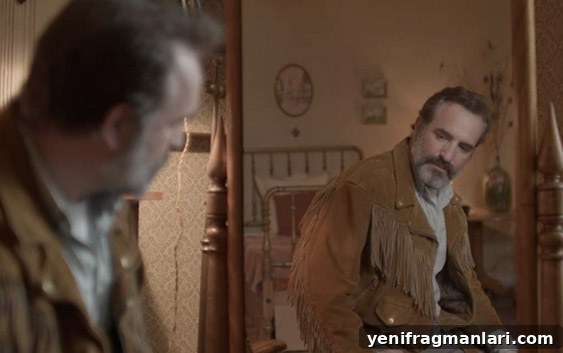

Deerskin (2019)
Director: Quentin Dupieux
Screenwriter: Quentin Dupieux
Starring: Jean Dujardin, Adèle Haenel, Albert Delpy, Pierre Gommé, Marie Bunel, Coralie Russier, Laurent Nicolas, Youssef Hajdi
Quentin Dupieux’s darkly comic horror film Deerskin explores the extreme lengths a person will go to when obsession replaces reason. The story centers on Georges (Jean Dujardin), a man who becomes consumed by a single object: a fringed deerskin jacket he believes transforms him. What begins as a peculiar taste for fashion becomes an escalating campaign of manipulation and violence that Dupieux renders with absurdist humor and unsettling clarity.
The film opens with an unnerving image of Georges examining his reflection in multiple surfaces while wearing a dull corduroy jacket. Annoyed by his own appearance, he discards the jacket in a public restroom and soon answers an advert for an exquisite deerskin coat. After paying an exorbitant 7,500 euros for it, he proclaims he finally has “killer style.” When his estranged wife blocks access to their shared funds, Georges invents a new identity as an indie filmmaker to sponge money from Denise (Adèle Haenel), a warm-hearted aspiring editor who works at a bar. Denise’s savings become the financial fuel for Georges’ supposed film—and for the darker impulses his persona allows.
Dupieux keeps Georges’ backstory deliberately thin: we learn almost nothing about his past, occupation, or deeper motivations. Instead, the film concentrates on his compulsive personality and the way the jacket reconfigures his sense of self. In Georges’ mind, this garment finally completes him; it grants him attention, a new narrative, and permission to reinvent himself as an artist. The jacket operates almost as a character in its own right. Georges speaks to it, adopting a distinct voice when he does, and the jacket is staged to appear almost possessive—watching him sleep and following him into the shower. He refuses to part with it, even when his finances become dire, and he values the video camera that came with the purchase more than his own wedding ring because it supports his fabricated creative identity.
Denise is no stranger to film technique and recognizes Georges as a poseur almost immediately, yet she accepts his offer to edit his footage. As she pieces together his chaotic clips, she notices that “the real subject of the film is the jacket,” which introduces a self-referential layer: a film-within-a-film in which the object and its mythology mirror the narrative we are watching. This meta element nudges against the fourth wall without ever fully breaking it.
Georges’ obsession soon morphs into a grandiose plan: he wants to be “the only person wearing a jacket in the world.” Under the guise of shooting an experimental film, he prowls the French countryside, forcibly removing jackets from unsuspecting people. He compels them to swear never to wear a jacket again and uses increasingly violent methods to enforce this vow. The tone shifts dramatically from whimsical comedy to disturbing brutality as Georges’ behavior grows more criminal and erratic. Denise, and we as viewers, watch his escalating crimes through the footage he delivers—drawn in by a mix of fascination and revulsion.
The performances of Jean Dujardin and Adèle Haenel form the film’s emotional core. Dujardin brings a layered, sometimes grotesque intensity to Georges, continuing a run of memorable character work that showcases his ability to balance charm and menace. Haenel provides a grounded, passionate counterpoint as Denise, delivering a portrayal that reveals both naiveté and strength. Their chemistry anchors Dupieux’s peculiar vision and gives the film a human center amid its surreal premise.
At a brisk 77 minutes, Deerskin wastes little time on extraneous material. Its compact runtime keeps the narrative taut and focused, though a slightly longer film might have allowed for deeper exploration of the characters’ psyches or the film’s metafictional implications. Even so, this odd, well-acted piece manages to be both unnerving and funny—an offbeat black comedy that lingers after the credits roll. The film is best appreciated as a satire of obsession and identity: don’t take its moral literally, but do consider the dangerous power that objects can have over us.
18/24