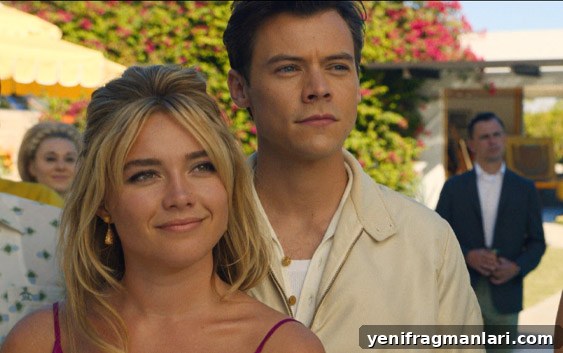

Don’t Worry Darling (2022)
Director: Olivia Wilde
Screenwriter: Katie Silberman
Starring: Florence Pugh, Harry Styles, Chris Pine, Olivia Wilde, Gemma Chan, Kiki Layne
Don’t Worry Darling arrived under a cloud of intense media scrutiny long before many viewers had seen a single frame. Behind-the-scenes controversies—from early casting upheavals to widely circulated reports about on-set tensions—kept the movie in the headlines and arguably shaped audience expectations as much as the film itself. That attention may draw curious viewers to theaters, but the finished film struggles to justify the noise on artistic terms. Its premise—Florence Pugh’s Alice waking up to troubling inconsistencies in the seemingly utopian Victory community where she lives with her husband Jack (Harry Styles)—has potential, yet the execution often falls short of its ambitions.
Florence Pugh gives a committed central performance, charting Alice’s gradual slide from contentment into fear and obsession with conviction. She skillfully balances vulnerability and steely resolve, making Alice a convincing protagonist as she questions the reality around her. Chris Pine is arguably the film’s most intriguing asset. As Frank, he brings a charismatic, slightly menacing presence—equal parts politician’s charm and stage-crafted sleaze—that sharpens the film whenever he appears. Several scenes between Pugh and Pine generate genuine tension, and the chemistry in their confrontations is a highlight: a sequence late in the film, in particular, evokes a physical unease that lingers.
By contrast, Harry Styles’ performance as Jack frequently feels flat and underpowered. Whether intentional—meant to reflect a sanitized, conformist ideal of male suburban calm—or symptomatic of miscasting, his portrayal lacks the dramatic bite needed to fully animate the film’s central relationships. Director Olivia Wilde’s cameo as Bunny, Alice’s vivacious friend, injects a lighter, more spontaneous energy that helps offset some of the film’s stilted moments. But overall, the casting choices and performances leave the movie unbalanced: Pine’s magnetic antagonism demands more screen time, while Styles’ Jack dominates scenes despite contributing less dimension to the narrative.
The film is built around two central ideas: an escalating mystery about the true nature of the Victory project, and a critique of patriarchal expectations within a nostalgic, midcentury-inspired suburban setting. Visually, the production design is strong—the sets and costuming convincingly evoke a stylized 1950s domestic ideal—and there are moments of clever art direction that enhance the film’s atmosphere. Yet the storytelling does not consistently match these strengths. For long stretches the film tiptoes around its mystery, using familiar suspense beats without ever fully committing to an audacious reveal. When the plot does resolve, it relies on tropes that feel recycled rather than revelatory, diminishing the impact of the film’s thematic ambitions.
The direction occasionally leans on hallmarks of mainstream thriller filmmaking: polished, safe surrealism and predictable visual shorthand intended to raise tension. These sequences look glossy, but they rarely surprise. The script attempts to explore female rage and resistance to domestic confinement, and there are moments where that critique lands with potency. However, the film’s insistence on broad, accessible storytelling means it often trades deeper, riskier interrogation for tidy symbolism and familiar science-fiction motifs.
Comparisons to other genre entries—films that handled similar premises with either bolder experimentation or more coherent worldbuilding—are inevitable. Where those films pushed boundaries or embraced unsettling ambiguity, Don’t Worry Darling more often pulls its punches. That conservatism makes it feel like a mainstream studio’s feminist-tinged retelling of dystopian suburban paranoia rather than a radical rethinking of the material. The production’s aesthetic achievements and some strong performances do keep the picture watchable, but the movie ultimately underutilizes its promise.
In sum, Don’t Worry Darling is visually appealing and anchored by solid work from Florence Pugh and Chris Pine, yet it is undone by uneven casting choices, safe directional decisions, and a resolution that leans on worn genre conventions. The film is worth seeing for the performances and the striking production design, but those elements are not enough to elevate it to the level its premise suggests.
Score: 9/24