
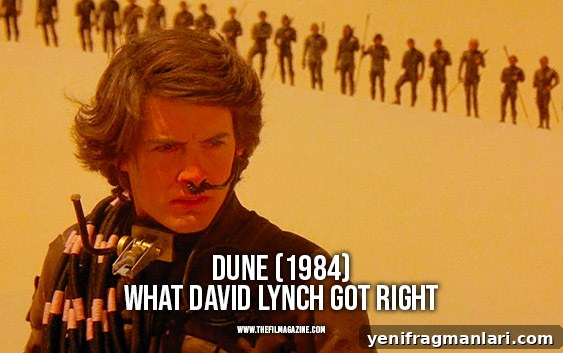
People have not been kind to David Lynch’s Dune (1984). An ambitious attempt to adapt Frank Herbert’s 1965 science-fiction classic, Lynch’s film has been called “impossible to follow” by Empire Magazine, “pointless” by Roger Ebert, and even “a huge gigantic sadness” by Lynch himself. The film struggled at the box office and has been embraced mostly by a devoted cult audience rather than mainstream viewers.
Yet the cult appreciation is not without reason. Beneath awkward visual effects, a sometimes uneven structure, and an unfinished-feeling narrative, Lynch’s Dune contains moments of genuine cinematic daring and thematic ambition that place it in conversation with the work of Stanley Kubrick and Ridley Scott. Lynch’s own disappointment—his awareness of the project’s flaws—is revealing: he understood what Dune might have become if not for creative compromises and studio interference. Still, there are viewers who, whether they have read Herbert’s novel or not, regard Lynch’s Dune as a definitive interpretation, flaws and all.
With renewed interest sparked by Denis Villeneuve’s later adaptation, Lynch’s version risks being dismissed entirely. It is worth re-examining what Lynch achieved: what he got right, which elements of Herbert’s novel he honored, and where the director’s surrealist instincts brought something unique to the screen.
Why is adapting Dune so daunting?
Herbert’s Dune is an epic dense with characters, political intrigue, ecological detail, and philosophical ideas. The novel largely follows Paul Atreides, heir to House Atreides, as his family assumes stewardship of the desert planet Arrakis—source of the universe’s most valuable resource, the Spice. Betrayal by Baron Harkonnen and the Emperor sets off a chain of events that seems to destroy Paul and his line, only for Paul to survive and rise among the native Fremen. Themes of prophecy, messianic expectations, colonial exploitation, and ecological interdependence are woven into the book’s language, style, and appendices.
That complexity is part of why adapting Dune to a standard-length film poses such challenges. Herbert’s story is not only a plot about conquest and power; it is a worldview defined by its ecological, religious, and technological details. Remove those details and you lose the novel’s core.
Pacing, structure, and narrative choices
Lynch’s Dune is often criticized for structural problems. Herbert’s interior monologues and repeated mantras—phrases like “Fear is the mind-killer”—translate awkwardly to spoken voiceover and on-screen caption, producing jarring interruptions that break dramatic momentum. The film frequently shifts into surreal cutaways that can unsettle the viewer and fragment the narrative flow. At times the film rushes through significant plot developments; at other moments it lingers so long on a scene that the audience expects a conclusion that has not yet arrived.
Despite these issues, Lynch frequently allows crucial moments to breathe. The fraught relationship between Jessica and the Bene Gesserit, and the Reverend Mother’s ritual test of Paul, are given careful attention. These scenes build emotional weight and illuminate the political and spiritual stakes of Herbert’s world. Similarly, sequences that introduce Arrakis, its people, and the larger political landscape take their time, letting viewers absorb details about geography, customs, and power structures.
Casting and character portrayals
Lynch’s casting is thoughtful and often effective. Kyle MacLachlan embodies Paul Atreides with a measured, observant presence that suits the character’s journey from privileged heir to reluctant leader. Jürgen Prochnow’s Duke Leto projects authority, and Francesca Annis’s Jessica is intelligent, determined, and emotionally complex. Lynch finds quiet humanity in the Atreides family scenes, even if some moments feel overly sentimental.
The Harkonnens are vividly realized. Kenneth McMillan’s Baron is grotesque and theatrical, a figure designed to provoke disgust and fear. Sting’s Feyd-Rautha divides opinion—his celebrity persona can be distracting—but Lynch’s willingness to cast against expectation follows Herbert’s notion that appearances do not reliably indicate moral character. Small, unattractive details—drug-ravaged faces or exaggerated features—help sell the novel’s idea that power and virtue are not synonymous with conventional beauty.
Design, visual language, and world-building
Where Lynch often excels is in visual distinction. Each faction in the film has a clear aesthetic. Arrakis feels vast and arid, colored by orange deserts and oppressive skies; Atreides settings are monumental and practical; Fremen spaces are austere and functional; the Emperor’s palace is decadent and otherworldly. Lynch’s production design—futurist-meets-art-deco meets ancient motifs—gives the film a memorable visual identity. Even when special effects age poorly, the overall design conveys a coherent, lived-in universe.
Some design choices are controversial. The Harkonnen aesthetic leans toward the grotesque and the stylized, and certain creature effects—most famously some of the sandworm work—show their age. Yet Lynch also uses long, composed shots and measured camera moves rather than the frenetic handheld style common in modern films, and this helps the movie communicate the scope of Herbert’s universe.
Thematic ambition and technological representation
Lynch does not shy away from Dune’s theological and psychological material. Rather than omit the novel’s inner dialogues and mythic passages, he attempts to render them visually, often through surreal sequences that may perplex viewers but aim to capture the book’s mystical atmosphere. Some of these scenes succeed in evoking Herbert’s themes of prophecy, addiction, and transcendence; others falter by being confusing or heavy-handed.
Technologies of the Duniverse—like the Bene Gesserit Voice and personal shields—are portrayed in striking, symbolic terms. Filters and vocal effects make the Voice feel alien and commanding; protective shields alter the choreography of combat. The special effects are uneven, sometimes dated, yet they underscore Lynch’s desire to make the novel’s ideas unmistakable and memorable rather than understated.
Verdict
It is easy to echo the many criticisms of David Lynch’s Dune. The director himself has spoken of studio interference and expressed regret about the final film, calling it one of his failures. Still, dismissing the movie solely on the basis of its flaws overlooks its ambition. Lynch’s Dune strives for a mature, mystical, and psychedelic rendering of Herbert’s work, and much of that effort succeeds on an aesthetic and emotional level. The film is imperfect, but it remains a bold and idiosyncratic adaptation that captures some of the novel’s soul. For viewers willing to accept its eccentricities, Lynch’s Dune offers imaginative production design, striking performances, and moments of real cinematic wonder.
Recommended for you: Where to Start with David Lynch
Written by Louis B Scheuer
You can support Louis B Scheuer in the following places:
Twitter – @louisbscheuer
Instagram – @louisbscheuer