
This article was written exclusively for The Film Magazine by Annice White.
I was watching Call Me By Your Name for the third (or fourteenth) time when I began to think about how clothing functions in cinema—not just as costume, but as a decisive element in shaping identity, relationships and narrative mood. As Stella Bruzzi observes, “clothing is central to film. Clothes are not mere accessories, but key elements in the construction of cinematic identities.” That idea is especially resonant in films that explore male-male romance.
Across these stories, costume operates on three interconnected levels. First, clothing helps mark a character’s personality and social position. Second, garments often symbolize the romance and union between lovers. Third—and perhaps most distinctively in male-male romance—wardrobe becomes a way of signaling when the romantic fantasy gives way to reality. Below I examine how costume works in Call Me By Your Name, God’s Own Country and Brokeback Mountain.
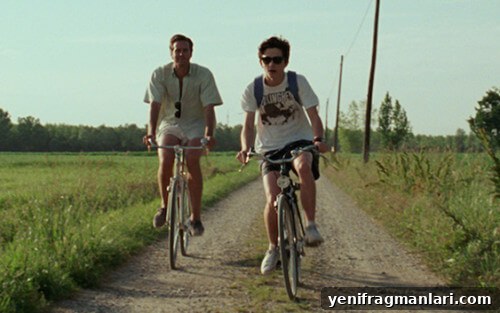
The wardrobe in Call Me By Your Name is crucial to the film’s aesthetic and emotional architecture. The movie proved highly influential in fashion discussions when it was released, but its costume choices do more than set trends: they define character and feeling. Elio’s clothes read as youthful and experimental—denim shorts, band t-shirts, or swimwear that underscores his adolescent energy and physical vulnerability. Oliver, by contrast, is older and more composed: his shirts are often oversized but structured, expanding his presence in the frame and physically dominating the scenes he shares with Elio.
Not every film about male relationships uses clothing to construct identity in the same way. In God’s Own Country and Brokeback Mountain, costume is more functional, tied to labor and environment—cowboy hats, heavy layers, workwear that reflects everyday life. That does not lessen its importance: small moments—like a grandmother carefully ironing her grandson’s shirts in God’s Own Country—signal care, routine and social structures. The difference in costume approach across these films also hints at broader social and geographic divides between them.
Costume also visually articulates intimacy and possession. In mainstream romantic imagery, a partner wearing another’s jacket or shirt often signals closeness, memory or dominion. In heterosexual cinema the trope can carry gendered implications—oversized shirts on women or Letterman jackets as marks of male identity—but in male-male romances the dynamic shifts because there is no obvious gendered clothing divide.
When two men share clothing in these films, the effect is rarely about sexualized possession and more about merging identities. In God’s Own Country and Brokeback Mountain, characters’ garments do not create barriers but instead dissolve them. In Call Me By Your Name, however, clothing can still read as a marker of dominance: Oliver’s shirts and shorts often envelop Elio, underscoring the older man’s physical and emotional authority in their relationship. The image of Elio burying his face in Oliver’s shorts is a literal and intimate moment of being swallowed by the other’s presence.
All three films stage occasions where clothing becomes indistinct—where the line between one person’s garments and another’s is blurred to suggest fusion. In God’s Own Country, a pile of dirty laundry on Johnny’s floor implies a shared domesticity between him and Gheorghe; the jumble, complete with intimacies left behind, signals a union the characters are beginning to form. When Johnny later wears Gheorghe’s jumper, he literally carries his lover’s absence and presence at once. In Brokeback Mountain, Ennis keeps Jack’s shirt as a relic and as a way to keep their relationship close to his body. In Call Me By Your Name, one of the film’s most potent visual metaphors comes in the station scene when both men wear variations of the same button-down shirt—Oliver in green, Elio in blue—so that Elio, for a moment, becomes him. Costume here is the visual language of merging, imitation and loss.
Clothing also helps mark the end of romantic fantasy. In each film, the temporary escape of the lovers collides with real-world responsibilities and consequences. In God’s Own Country, the brief domestic idyll collapses when Johnny’s father suffers another stroke, forcing the young men back to their practical realities. The film’s stripped-down scenes of bathing and sleeping together emphasize equality through the absence of garments, but the fantasy cannot endure unchanged.
In Call Me By Your Name, after Oliver leaves for America, Elio gradually re-adopts his pre-Oliver wardrobe—shorts and simple t-shirts—until a later, more grown-up Elio appears wearing an oversized button-up shirt that mixes elements of both their styles. It’s a subtle marker of emotional development: the boy has become a version of the man he loved. Brokeback Mountain ends on a more tragic note, with Ennis living among memories and one of Jack’s shirts as his tangible memento.
A lover’s shirt becomes a mnemonic object in all three films—whether it’s Oliver’s billowy shirt in Call Me By Your Name, Jack’s worn shirt in Brokeback Mountain, or the jumper exchanged in God’s Own Country. Interestingly, God’s Own Country offers a less conventionally tragic resolution by returning a jumper and permitting, for optimists, a gentler closure. But across these narratives, costume remains a powerful storyteller: it signals identity, charts intimacy, and marks the moment when lovers move from a shared fantasy back into the demands of life.
Written by Annice White
Support Annice by following her on Twitter — @Anniceswhite1