

The 1960s were a pivotal decade of social and political upheaval in the United States. Against the backdrop of Cold War anxieties and the rising civil rights movement, an independent film scene began to flourish. As Hollywood expanded, many artists reacted against mainstream aesthetics and politics, embracing lower budgets and creative freedom. Independent filmmakers experimented with narrative form and cinematic technique, free from the commercial constraints of the studio system. Film scholar Scott MacDonald has observed that this era gave filmmakers “the opportunity to play with cinema, to make films just to see, and share what the results might look like.”
Frank Perry emerged within this milieu as a distinctive voice in American independent cinema. Without formal film training, Perry nonetheless produced a body of work notable for its striking imagery and quiet political observation. Though he is less frequently cited than contemporaries like John Cassavetes or Jim Jarmusch, Perry’s films exerted a lasting influence. In 1993 he described his work as a study of “what it is to be human: vulnerability, fallibility, fragility,” a through-line evident across his films.
Perry began his professional life in theater as a stage manager and associate producer for the Theater Guild. After marrying Eleanor Perry in 1960—who would become his principal collaborator—he shifted to film. Eleanor, a decade older, wrote screenplays for six of his films. Their first notable collaboration, David and Lisa (1960), was made independently on a modest budget of roughly $200,000 and became both a critical and commercial success. The film earned Academy Award nominations for Best Director and Best Adapted Screenplay and won recognition on the festival circuit.
Although the pair did not replicate that level of acclaim with every subsequent film, several later works have been reassessed and appreciated over time. The Swimmer (1968), for example, found renewed attention and a devoted audience in later years. Across his career, Perry repeatedly returned to themes of gender roles, class tensions in American life, mental instability, and the murky moral choices of youth.
Early in his career Perry focused heavily on the culture of American youth. Released just three years after David and Lisa, Ladybug Ladybug (1963) functions as a stark anti-war parable rooted in Cold War fear. Set during the Cuban Missile Crisis, the film explores the anxiety and potential trauma imposed on children by the threat of nuclear annihilation. The immediate crisis in the story arises from a malfunctioning air-raid warning at a rural elementary school. With the principal unsure whether the alarm signals a real threat or a false alarm, the staff send groups of students home accompanied by designated teachers.
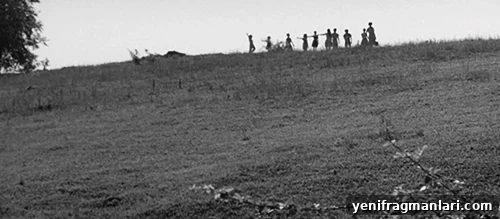
Early dialogue establishes the film’s exploration of ambiguity: a child asks whether some statements might fall “in between” true and false, an idea scorned by an adult who insists on clear answers. That insistence on certainty sets up the film’s tension—what happens when the systems meant to guarantee safety fail or produce doubt? When one teacher, Mrs. Andrew, leads her group into the countryside, the faulty alarm is revealed too late. Her anxiety builds quietly as the children react in varied ways: some remain playful and naive, others confront mortality and fear.
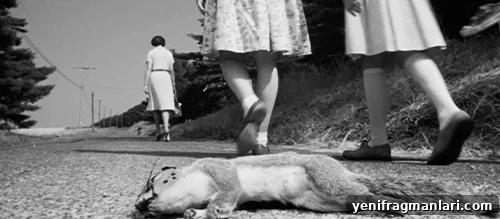
Perry’s stark black-and-white cinematography amplifies the eerie atmosphere of isolation. Long, wide shots of children walking through an empty landscape emphasize vulnerability; small, focused images—a dead squirrel in the road, a child’s legs trailing into the distance—underscore themes of mortality and emotional dislocation. As the students disperse and adult authority recedes, the children find themselves in a moral gray zone. A group shelters in a family bomb shelter where the older child, Jill, imposes rules and rations while others follow different coping strategies. When a needy peer, Sarah, seeks refuge, the group must decide whether to share scarce resources or preserve their own safety. The choices they make reveal how fear can harden self-interest and fracture compassion.
Though moments of didactic dialogue and melodrama can make Ladybug Ladybug feel repetitive at times, the film’s second half deepens its critique by focusing on how children respond to crisis. Unlike more explicitly political Cold War films such as Fail-Safe or satirical studies like Dr. Strangelove, Perry’s work offers a quieter but equally unsettling indictment: living under constant nuclear threat leaves emotional and psychological scars on the young.
Last Summer (1969) continues Perry’s exploration of youth, but shifts to a study of privilege, cruelty, and adolescent moral failure. Set on Fire Island, the film follows three bored, affluent teenagers—Dan, Peter, and Sandy—whose weekend idleness and entitlement lead to increasingly cruel behavior. An early scene finds the three caring for an injured seagull, framing them initially as sympathetic; this façade disintegrates over time.
Perry and Eleanor Perry probe gender roles and social dynamics by contrasting two female characters: Sandy, who flaunts her sexuality and manipulates others, and Rhoda, a reserved, morally grounded outsider. Sandy’s casual cruelty—symbolized by the treatment and eventual death of the seagull—reveals how privilege allows the trio to dehumanize and dominate. Rhoda, who pleads for compassion, becomes a target but still yearns for acceptance. Peter’s attraction to her complicates the dynamics: is his interest sincere, or does it stem from the desire to conquer innocence? The film forces the viewer to consider how adolescent identity, entitlement, and peer pressure can erode empathy.

The film’s final sequence is harrowing: Rhoda becomes the victim of escalating violence at the hands of her peers. The scene lingers not to titillate but to indict—showing how the absence of consequence and the protection of class privilege enable ongoing cruelty. Last Summer captures a particular variety of disengagement common among some upper-class youth of the era: a detachment from political struggles such as the civil rights movement or the Vietnam War, and an inclination toward self-centered passivity.
In the 1970s, Perry moved toward more intimate character studies. The Perrys’ Diary of a Mad Housewife (1970) brought renewed critical attention, with Carrie Snodgress earning an Academy Award nomination for her portrayal of a lonely, emotionally frustrated woman. Later, after the Perrys’ creative partnership ended, Frank Perry directed Mommie Dearest (1981), an adaptation of Christina Crawford’s account of her relationship with Joan Crawford. That film baffled critics and audiences at the time for its tonal shifts between melodrama and dark humor, and it has since developed a complicated cult reputation.

Across a diverse filmography that ranges from the austere Ladybug Ladybug to the flamboyant excess of Hello Again (1987), Frank Perry maintained a consistent interest in human imperfection and the social forces that shape behavior. He had a talent for rendering flawed protagonists with empathy, making even unsympathetic characters reveal their complexity. Many of his films remain less accessible than mainstream titles, but those willing to seek them out will find subtle, often unsettling portraits of American life.
Written by Lauren Frison
Support the author: X (Twitter) @paranoidzpark • Letterboxd /suspiriaz