Frozen (2013)
Directors: Chris Buck, Jennifer Lee
Screenwriter: Jennifer Lee
Starring: Kristen Bell, Idina Menzel, Jonathan Groff, Josh Gad, Santino Fontana, Alan Tudyk
A shimmering Arctic landscape opens the film, accompanied by a score that draws on Sámi-style vocal traditions. Under the Aurora Borealis, a world of jagged ice and glittering frost is unveiled and, from the start, the presence of magic is clear. As children at play, a young Elsa (voiced by Eva Bella) casually creates snow with a flick of her fingers. Her sister, Anna (Livvy Stubenrauch), sees only delight in Elsa’s gift — an early sign that this story will move beyond the old themes of female rivalry that once dominated fairy tales.
The innocence of childhood is shattered when Elsa accidentally hits Anna with an uncontrolled burst of ice. After the kingdom’s magical trolls intervene and cure Anna, the decision is made to erase Anna’s memory of the incident and to hide Elsa’s abilities. Elsa is confined, taught to conceal her power and live apart. When their parents later die, Anna grows up in the same secluded, guarded life.
Years later, with spring arriving, the sisters are adults. Anna (Kristen Bell) wakes excited and nervous for Elsa’s coronation day. The castle opens its gates for the first time in years, and the kingdom prepares to accept Elsa (Idina Menzel) as its new queen. Political opportunists and curious dignitaries descend on the celebration, testing the sisters in unexpected ways.
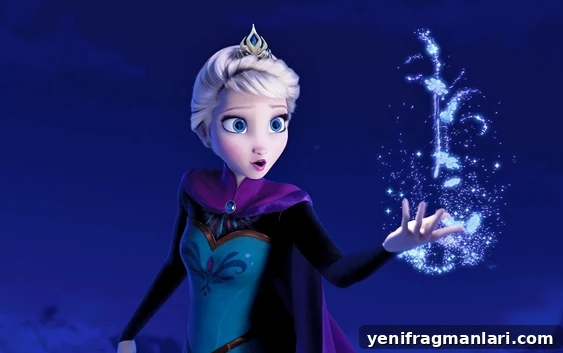
The pressures of the day drive Anna and Elsa in different directions. Anna quickly falls for the charming Prince Hans (Santino Fontana), while Elsa, overwhelmed by fear and anxiety about her powers, flees. In a moment of panic she unleashes a storm of ice, blanketing the kingdom of Arendelle in snow, and disappears into the mountains to live alone, free to express her magic without restraint.
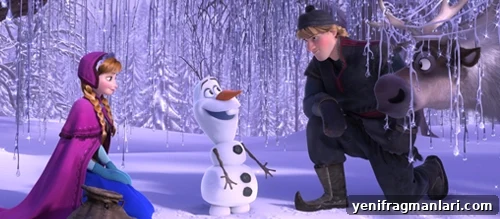
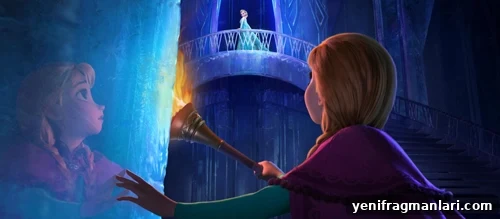
Determined to bring her back, Anna entrusts the kingdom to Hans and sets off into the wintry wastes. On her journey she meets ice harvester Kristoff (Jonathan Groff), his loyal reindeer Sven, and an exuberant living snowman, Olaf (Josh Gad). These companions reshape Anna’s journey and become central to the film’s emotional core.
Frozen marked a milestone at Disney: Jennifer Lee co-directed the film and wrote the screenplay, becoming one of the first women to steer a major animated feature to global blockbuster success. Lee’s earlier work on Wreck-It Ralph already suggested her gift for reimagining familiar character templates, and with Frozen she helped redefine the contemporary Disney heroine.
One of the film’s most effective choices is its pairing of two female leads with contrasting personalities. Anna represents the romantic, eager, and imperfect side of the traditional princess archetype; Elsa embodies restraint, distance, and latent power. By dividing those typical princess traits between them, the story appeals to audiences craving both nostalgia and a modern sensibility. Anna’s warmth balances Elsa’s solemnity, and neither woman is defined solely by a romantic relationship — a notable shift from earlier animated fare.
At the same time, the film remains broadly accessible because of a strong supporting ensemble of male characters and comic relief. Kristoff’s roguish charm, Sven’s nonverbal loyalty, and Olaf’s childlike wonder provide humor and warmth that make the film enjoyable for both boys and girls. Add in perilous wolves, dramatic ice chases, and moments of genuine tension, and the story delivers adventure alongside its emotional themes.
Another layer that lifts Frozen above many family films is its handling of perceived villainy. For much of the story, Elsa’s actions can look menacing: she isolates herself, covers the kingdom in snow, and appears to wield her power recklessly. But as the narrative unfolds the true source of danger becomes clearer, and the film subverts expectations in a way that resonates with audiences and critics alike.
In the years since Frozen premiered, Disney and Pixar have increasingly embraced stories that explore identity, grief, and personal growth without relying on traditional romantic resolutions. Films such as Big Hero 6, Inside Out, Moana, Luca, Encanto, and Turning Red focus on coming-of-age themes and inner transformation. While these titles have their own successes, Frozen remains uniquely influential for popularizing a heroine whose journey is about self-acceptance and emotional honesty.
The film’s combination of striking animation, memorable songs, clever humor, and a thoughtful revision of the princess formula gave it enduring appeal. Elsa’s rise to cultural prominence felt instantaneous, and the movie’s franchise — including a sequel, shorts, stage adaptations, toys, and more — has kept the world of Arendelle in the public imagination.
Score: 20/24
⭐⭐⭐⭐
Rating: 4 out of 5.