
The Midnight Sky (2020)
Director: George Clooney
Screenwriter: Mark L. Smith
Starring: George Clooney, Felicity Jones, David Oyelowo, Caoilinn Springall, Kyle Chandler, Demián Bichir, Tiffany Boone, Sophie Rundle, Ethan Peck
George Clooney has experience with cinematic space stories, having been involved in high-profile films such as Steven Soderbergh’s 2002 Solaris and Alfonso Cuarón’s acclaimed Gravity (2013). In The Midnight Sky he limits his on-screen presence to Earth while directing a story that spans a devastated Arctic landscape and distant worlds. The film, adapted from Lily Brooks-Dalton’s novel Good Morning, Midnight and distributed by Netflix, attempts to weave a human drama into a science-fiction framework but ultimately falls short of its ambitions.
The Midnight Sky runs two parallel narratives: Augustine (played by Clooney), an isolated scientist trying to send messages into the sky from a ruined northern research station, and an international crew aboard the spacecraft Aether, headed back to Earth after a long mission. Felicity Jones and David Oyelowo are among the crew seeking answers about their planet, unaware of the disaster that has befallen it. The film raises themes that are timely—climate change, responsibility to future generations, grief and regret—but its execution undermines those themes with awkward tone and uneven storytelling.
One of the film’s most glaring weaknesses is its visual effects. For a major 2020 production that relies heavily on digital imagery, much of the CGI looks artificial and dated. Long, elegant camera moves are clearly meant to evoke a sense of grandeur similar to 2001: A Space Odyssey or Christopher Nolan’s Interstellar, but because the effects often read as artificial, those moments feel hollow. Large establishing shots, space-station interiors and far-off planets are frequently revealed as thinly rendered, which makes it difficult to accept the intended scale and emotion. Rather than amplifying the story, these sequences repeatedly puncture immersion.
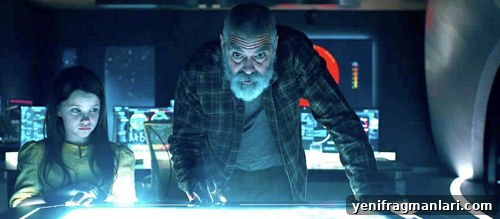
The film’s production design and on-set use of monitors filled with animated interfaces also feel overreaching and unconvincing. Scenes show a future where information is displayed across multiple translucent screens, but the interfaces rarely feel functional or integrated into the characters’ interactions. The result is a repeated visual distraction: instead of supporting the narrative, the screens draw attention to their own artifice.
Photographically, The Midnight Sky often resembles television drama more than cinematic spectacle. The camera is in constant motion—panning and circling in ways that call attention to themselves—yet this movement rarely contributes meaningfully to character or plot development. At times the color palette and stylized lighting push toward melodrama rather than cinematic subtlety, which makes the film feel both overstated and oddly flat.
Structurally, the film struggles to balance its personal character study and event-driven plot. Sequences shift between timelines and settings—Earthbound isolation, interstellar travel, and flashbacks—without always clarifying what the film wants the audience to feel. Pacing is uneven: moments that should breathe and develop character feel rushed, while others drag without deepening our understanding of the protagonists. The combination produces a work that often seems uncertain of its own identity.
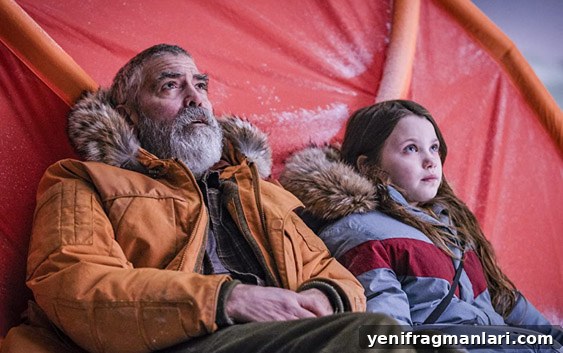
Dialogue is another area where the film falters. Despite relatively spare dialogue overall, many lines serve expositional purposes and read as shorthand rather than authentic human speech. Characters frequently explain mission details, emotional stakes or technical constraints in ways that feel contrived. Augustine’s interactions—particularly with the young girl in his care—too often reduce emotional beats to blunt statements of fact instead of lived, subtle exchanges. This reliance on explicit explanation undercuts the possibility of greater nuance and emotional resonance.
Flashbacks intended to illuminate Augustine’s past and his regrets feel underdeveloped. The moments that should reveal complexity and internal conflict instead land as simplified scenes that confirm what the audience already suspects, offering little surprise or depth. Because these sequences are so plainly functional—serving to justify present-day choices rather than to complicate them—the characters remain remote, and the film struggles to generate real empathy.
Performances are committed, and the cast does what they can with the material. Clooney projects a weary, world-worn presence; Felicity Jones and David Oyelowo convey a quiet dedication to duty. Yet even solid acting cannot fully compensate for script and structural weaknesses. The film repeatedly gestures toward profound questions about humanity and survival but rarely allows those questions to unfold organically.
There are moments of genuine beauty and a clear desire to offer a reflective, melancholy meditation on human connection. However, when visual shortcomings, awkward dialogue and uneven pacing repeatedly pull the viewer out of the story, those moments lose impact. The Midnight Sky aims to be a thoughtful, elegiac piece of science fiction grounded in human feeling, but it often feels derivative and emotionally thin.
4/24