
Guillermo del Toro’s Pinocchio (2022)
Directors: Guillermo del Toro, Mark Gustafson
Screenwriters: Guillermo del Toro, Patrick McHale
Starring: Ewan McGregor, David Bradley, Gregory Mann, Christoph Waltz, Tilda Swinton, Ron Perlman, Finn Wolfhard, Cate Blanchett, Burn Gorman, John Turturro, Tim Blake Nelson
Adaptations of Pinocchio seem to arrive in clusters—after long waits, several notable versions appear in quick succession. Guillermo del Toro’s stop-motion adaptation for Netflix is one of the boldest: a richly textured, handcrafted retelling that reframes Carlo Collodi’s tale within the shadow of rising fascism in pre–World War II Italy.
Del Toro has repeatedly cited formative influences on his work, and Collodi’s story is among them. In this film, the narrative is framed by the voice of Sebastian J. Cricket (Ewan McGregor) as he recounts the life Geppetto (David Bradley) builds around a puppet created to replace his lost son, Carlo (voiced by Gregory Mann). When the puppet comes to life as Pinocchio, he is infused with magic but quickly separated from Geppetto and thrust into a world eager to exploit a seemingly immortal wooden boy.
“No art form has influenced my life and my work more than animation, and no single character in history has had as deep of a personal connection to me as Pinocchio.” – Guillermo del Toro
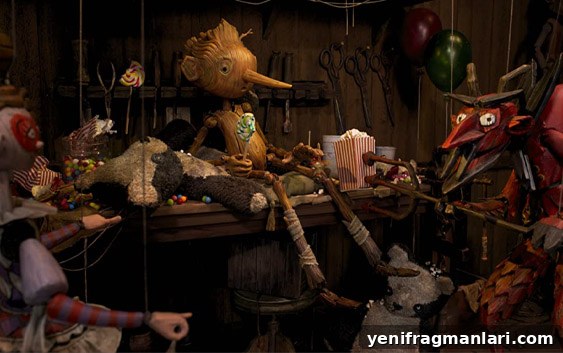
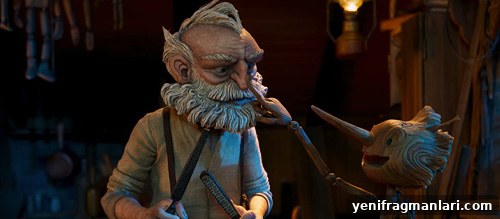
Every frame of del Toro’s Pinocchio displays an extraordinary level of craftsmanship. The stop-motion sets and figures are dense with detail: backgrounds hum with activity, incidental characters appear to have their own lives beyond the frame, and the textures of wood, fabric and weather are rendered with loving precision. Watching Geppetto patiently carve and shape wood, you sense a parallel between his devotion and the filmmakers’ devotion to their medium.
Set against the rise of Mussolini’s regime, this adaptation shifts some familiar story beats into darker, historically resonant territory. Scenes of fascist officers drilling children and transforming them into instruments of nationalism replace the more fantastical episodes common to other versions. Those sequences carry a satirical and unsettling edge that recalls other wartime childhood dramas while remaining distinctively del Toro: gothic, humanist and often metaphysical.
Del Toro’s affection for monsters surfaces throughout the film. Pinocchio’s early movements are unnerving—spidery, abrupt—an effect that highlights the gap between his mechanical body and his yearning for connection. The movie doesn’t shy away from depicting physical transformations, disassembly and reconstruction, which can be disturbing but also underscore the film’s probing questions about identity, belonging and the nature of being alive.
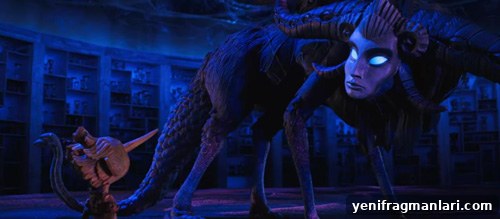
About forty minutes in, the film shifts into more explicitly metaphysical territory when Pinocchio finds himself in a liminal space overseen by undead guides and an enigmatic Angel of Death (voiced by Tilda Swinton). That sequence crystallizes how del Toro’s version is not merely a period retelling but a meditation on grief, mortality and what it means to be human. Love, loss and the struggle to live with absence are woven into the narrative as centrally as the familiar moral lessons of Collodi’s original.
Stop-motion cinema often suffers from being overshadowed by the marquee personalities attached to projects, and this film is no exception. While Guillermo del Toro’s name naturally draws attention, co-director Mark Gustafson played a vital role in guiding the day-to-day realization of the animation. The result feels like a genuine collaboration that honors the craft while bearing del Toro’s unmistakable thematic imprint.
The cast blends Collodi’s established characters with figures tailored to this historical setting. Ron Perlman’s fascist officer Podestà functions as a dark analogue to the Coachman figure, while Christoph Waltz’s Count Volpe channels the showman charlatan archetype with relish. These portrayals emphasize human cruelty and opportunism—the film’s consistent point: people, more than supernatural forces, are often the most monstrous presence in the world.
If the film has a weakness, it is its ambition. At times, del Toro attempts to juggle too many tonal registers and thematic threads. Moments of bleak, contemplative drama are occasionally interrupted by songs or jokes that don’t land as strongly, and some subplots feel crowded by the film’s broader political and metaphysical concerns. Yet this willingness to take risks is also the film’s strength: it refuses to settle for a safe, crowd-pleasing retread and instead pursues a distinctive artistic vision.
Ultimately, Guillermo del Toro’s Pinocchio is an arresting, visually sumptuous reimagining that confronts grief, mortality and the moral failures of adulthood through the lens of a familiar fairy tale. It may sacrifice a measure of childlike wonder in favor of darker, more contemplative depths, but its boldness, technical mastery and emotional sincerity make it a compelling and memorable contribution to the long lineage of Pinocchio adaptations.
Score: 20/24