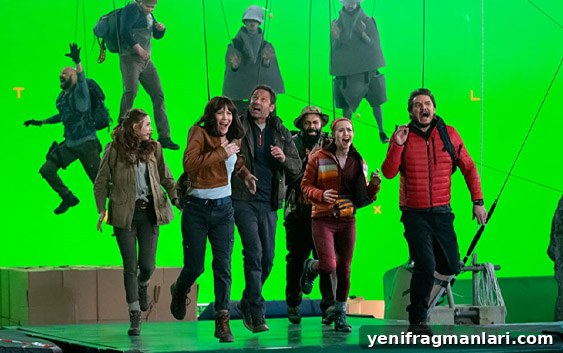
The Bubble (2022)
Director: Judd Apatow
Screenwriters: Judd Apatow, Pam Brady
Starring: Karen Gillan, Iris Apatow, Pedro Pascal, Leslie Mann, Fred Armisen, David Duchovny, Keegan-Michael Key, Kate McKinnon, Guz Khan, Peter Serafinowicz, Maria Bamford, Vir Das, Maria Bakalova
Judd Apatow’s career in comedy—spanning television and film—has long relied on an observational, character-centered approach. From Freaks & Geeks to Knocked Up and the introspective Funny People, his work often balances humor with human truth. The Bubble returns Apatow to the movie industry he knows well, this time imagining a group of actors and crew attempting to shoot the sixth installment of a blockbuster dinosaur franchise, Cliff Beasts, inside a COVID-era “bubble.” The film aims for satire but struggles to strike the right tone, creating a dissonance between subject and execution that undercuts its ambitions.
The Bubble’s satire often feels unsure of itself, as if it’s trying too hard to anticipate audience objections instead of committing to a clear perspective. If the goal is to lampoon Hollywood vanity in the vein of classic industry satires, the film hesitates between mocking its characters and empathizing with them. That indecision is most glaring because the narrative takes place during a global pandemic—an experience that for millions meant real loss and hardship—making the film’s focus on the frivolity of blockbuster filmmaking feel at times tone-deaf and self-indulgent.
At points the movie displays a flicker of self-awareness: in the final sequence, characters remark that a weak opening can be forgiven if the ending is strong. But this line reads more like an attempt to distance the film from its own critique than a meaningful commentary. The Bubble culminates in the premiere of a documentary about the events we watched, followed by a casual exchange about film endings—the kind of metafictional wink that, rather than resolving the film’s dilemmas, highlights its inconsistencies.
Unlike much of Apatow’s earlier work, which typically leaned into naturalistic performances and grounded comedy, The Bubble feels artificial. That artificiality is partly a narrative choice—shooting inside an unnatural, quarantined environment—but it also permeates the film’s character moments, which rarely achieve the honest specificity that made Apatow’s past projects resonate. Visually, the movie adopts a generic streaming aesthetic that blunts any distinction between the main film and the “disastrous” blockbuster being produced within it. Ironically, a film critiquing mindless studio productions ends up embracing the blandness it ostensibly criticizes.
Apatow assembles a large ensemble cast, including familiar collaborators and new faces: Karen Gillan, Pedro Pascal, Keegan-Michael Key, David Duchovny, Leslie Mann, and Iris Apatow among them. Many characters are sketched as entitled, oblivious, or performatively righteous, but the movie struggles to balance its vignette-driven structure with fully realized arcs. Apatow’s knack for spotting and developing comic talent is still evident—particularly in the performances of several supporting players—but he doesn’t always find a way to integrate them into a cohesive whole. Whereas Trainwreck and The King of Staten Island benefited from lightness and warmth even when centering flawed protagonists, The Bubble rarely achieves that tonal charm.
Karen Gillan’s lead role exemplifies the film’s central problem with characterization. She plays a returning franchise star who missed the previous installment and has since failed to find success outside the series. Her insecurities—about fame, relevance, and the creative compromises forced by studio interference—are meant to anchor the movie’s themes. Yet the film never clearly signals whether we should sympathize with her or view her as part of Hollywood’s problem. A dangerous on-set incident that injures crew members introduces a discussion about unsafe working conditions, but the moment is handled ambivalently: when Gillan’s character turns to Iris Apatow’s social-media-savvy character for help, she’s rebuffed with the line that “people don’t want to hear celebrities complain.” That exchange reads poorly, both in timing and in its failure to take a definitive moral stance on worker safety.
The film’s strongest elements come from the non-celebrity cast and crew members—characters played by Samson Kayo, Maria Bakalova, Galen Hopper, and Harry Trevaldwyn. These performers bring grounded energy and would have benefitted from more narrative weight. Had Apatow focused the story more tightly on the experiences of these peripheral but sympathetic workers—people exposed to risk without the protections of fame or money—The Bubble might have achieved sharper social critique and more consistent laughs. Instead, the film spreads itself thin across celebrity neuroses and industry gags, which blunts the emotional core.
Another recurring shortfall is the film’s inability to interrogate Apatow’s own position. Casting his wife Leslie Mann and daughter Iris Apatow alongside himself and other Hollywood figures creates an opportunity for introspection about privilege and complicity. The Bubble rarely seizes that opportunity; its treatment of familial and professional dynamics never quite reads as self-critical. As a result, the movie can feel complacent, even when it purports to examine the very systems that sustain it.
With a runtime that stretches beyond two hours, The Bubble sometimes drifts into redundancy, repeating satirical beats without building toward meaningful revelations. Still, the movie is not without moments of amusement and occasional insight. The supporting cast, in particular, showcases fresh comedic voices that suggest the film’s best ideas lie in smaller, more human-scale stories about labor and precarity on a film set.
7/24
Written by Nicholas Armstrong
Support for the author is acknowledged.