
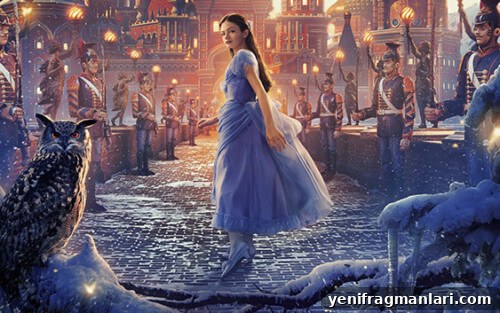
The Nutcracker and the Four Realms (2018)
Director: Lasse Hallström, Joe Johnston
Cast: Mackenzie Foy, Keira Knightley, Jayden Fowora-Knight, Matthew Macfadyen, Helen Mirren, Morgan Freeman, Misty Copeland
Plot: After receiving a mysterious egg-shaped box as a gift from her deceased mother, young Clara Stahlbaum finds herself in the magical world of the Four Realms and must embark on an adventure to preserve the very existence of the Realms.
Disney’s The Nutcracker and the Four Realms reimagines elements from E.T.A. Hoffmann’s short story “The Nutcracker and the Mouse King” and the libretto of Tchaikovsky’s ballet. Rather than choosing one source to follow closely, the film merges motifs, characters and set pieces from both, producing a hybrid adaptation that will feel familiar to some viewers and disorienting to others. That blend of source material is the film’s defining creative choice and also its most divisive one: it aims to modernize the tale, but occasionally loses the narrative clarity that made the original story and ballet enduring.
The adaptation shifts key relationships and plot beats. In Hoffmann’s tale and the classical ballet, the Nutcracker begins as a gift and later transforms; here Clara meets the Nutcracker—Captain Philip—already in human form when she first enters the Four Realms. The film also renames its heroine Clara Stahlbaum (the original heroine is Marie), and the movie positions Marie as Clara’s mother, creating ambiguous connections between the versions rather than a straightforward retelling. These changes emphasize Clara’s personal journey over a romantic or traditional fairy-tale arc, making the story more about self-discovery than an enchanted romance.
That choice—centering Clara’s internal growth—yields mixed results. On one hand, the film attempts a modern, female-led coming-of-age narrative that minimizes the conventional love-story thread. On the other hand, the emotional bond between Clara and the Nutcracker feels underdeveloped, which weakens the stakes the original story generates through that relationship. Several supporting characters, including Morgan Freeman’s Drosselmeyer and Jayden Fowora-Knight’s Nutcracker/Captain Philip, hint at deeper roles but are not always given the screen time or development to fully satisfy.
Visually, The Nutcracker and the Four Realms largely succeeds. Production design and visual effects create a colorful, richly detailed world divided into distinct realms. Clara’s palace, with its onion-domed spires, evokes Russian architecture and offers an obvious nod to Tchaikovsky’s cultural origins, while the film’s sequence in which Clara first steps into the Four Realms recalls the wardrobe-to-world transition from The Chronicles of Narnia—an effective cinematic device that communicates wonder and scale. Costume design, set decoration and choreography, including Misty Copeland’s ballet sequences, contribute strong aesthetic moments that celebrate the ballet’s influence.
Tchaikovsky’s music remains an asset to the film. The score and select musical passages reinforce the story’s connection to ballet and heighten key scenes; the Sugar Plum Fairy’s public introduction of Clara to the Land of Sweets set to Tchaikovsky’s march is one of the film’s more memorable instances, blending spectacle and tradition.
Performances vary in impact. Helen Mirren brings a playful eccentricity to Madame Ginger, ruler of the Fourth Realm, while Keira Knightley offers a whimsical, slightly subversive take on the Sugar Plum Fairy. Mackenzie Foy anchors the film as Clara, though the script’s emphasis on plot reinvention sometimes limits emotional payoff. Jayden Fowora-Knight and Morgan Freeman both display potential in their roles, but the narrative focus and pacing do not always allow their characters to reach full dramatic potential.
Pacing and tone pose occasional problems. The film moves briskly through its set pieces, and some plot strands feel compressed or under-explored in service of visual spectacle. Viewers seeking the intimacy and charm of the original Nutcracker story or the disciplined narrative of a classic fantasy may find it less satisfying. Yet for audiences willing to accept a looser, more modern fairy-tale approach, the movie offers lush production values, striking visuals and moments of genuine charm.
In summary, Disney’s The Nutcracker and the Four Realms is a visually appealing, musically resonant adaptation that takes bold liberties with its source material. Its strengths lie in design, choreography and select performances, while its narrative choices—particularly the reshaping of key relationships and the compression of character arcs—prevent it from fully realizing the emotional depth of the original tale. It is an enjoyable, if not entirely memorable, fantasy experience best appreciated for its aesthetics and reinterpretation rather than as a faithful retelling.
13 /24