
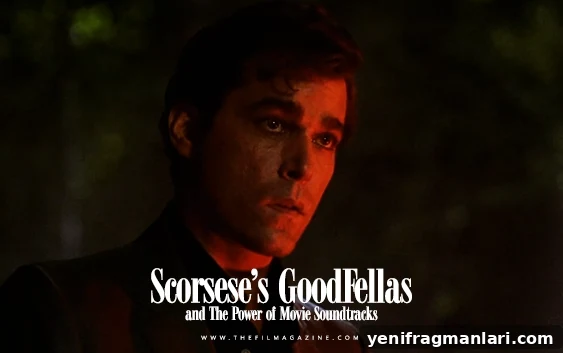
We’ve all strolled down the street with music in our ears, imagining our lives as a film. The beat drops and suddenly we’re in a montage: walking into the ring to “Gonna Fly Now,” spinning into Patrick Swayze’s arms to “(I’ve Had) The Time of My Life,” or—well, maybe not the most polite example—but for as long as we can remember we’ve wanted to feel cinematic.
Some of cinema’s most memorable moments come from original scores or from repurposing older film music, but an equally powerful technique is building a film around pre-existing popular songs. Directors such as Quentin Tarantino and Edgar Wright made this method a hallmark of their style, and its rise in mainstream Western cinema is often traced back to Easy Rider (1969) and to the films of Martin Scorsese. Scorsese’s trademark needle drops are many, but his use of a curated popular-music soundtrack reaches a zenith in the 1990 gangster classic Goodfellas.
Goodfellas features a meticulously chosen soundtrack of songs from the 1950s through the 1970s that do more than set a period—they shape emotion, perspective, and narrative. Music editor Chris Brooks once noted that Scorsese knew every song that would appear in the film years before shooting began. That forethought paid off: the songs in Goodfellas underscore character, chronology, and theme in ways that feel both effortless and deeply intentional.
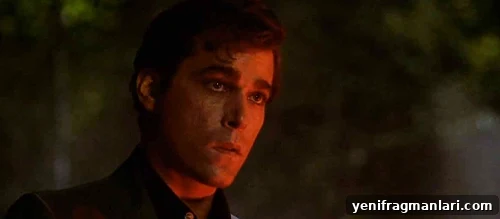
Although the story is largely chronological, Goodfellas opens in media res with Henry Hill (Ray Liotta), Jimmy Conway (Robert De Niro) and Tommy DeVito (Joe Pesci) driving to dispose of a body in 1970. The scene quickly turns brutal, and immediately after the violence Henry delivers the film’s famous opening line—“As far back as I can remember, I always wanted to be a gangster”—slamming the car boot shut. The first needle drop follows: Tony Bennett’s “Rags to Riches.” The buoyant brass and Bennett’s warm vocal quality plunge us into the glamor and allure of mob life, momentarily obscuring the violence we have just witnessed and setting up the film’s central arc: ambition, ascent, and eventual decline.
Scorsese’s commitment to authenticity extends to the soundtrack choices that reflect his own upbringing in mid-century Italian-American neighborhoods in New York. Early sequences tied to Henry’s childhood are accompanied by Italian-language songs, reinforcing cultural tradition, community values, and the environment that shaped him.
The narrative jumps forward to 1967, a year that marks both a turning point in Henry’s life and a musical shift. Phil Spector’s Wall of Sound popularized dense, orchestral textures in pop recordings, and the girl-group sound perfectly complements Henry’s new, more glamorous phase. When Henry takes Karen Friedman (Lorraine Bracco) on a date to the Copacabana—ushering her through the back door and into an impossibly produced table at the front of the house—the sequence unfolds in a single unbroken take set to The Crystals’ “Then He Kissed Me.” The song’s sweetness and romantic energy mirror Henry’s own transformation and the glitter of his lifestyle.
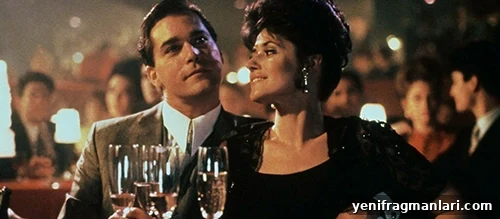
That rosy period culminates in a wedding montage underscored by The Harptones’ dreamy “Life is But a Dream.” The Harptones never achieved major chart success, yet their nostalgic doo-wop sound perfectly captures the fragile optimism of Henry and Karen’s early married life—an optimism that, in hindsight, feels too good to last.
Throughout the mid-section of the film, familiar standards and doo-wop tunes continue to score Henry’s day-to-day life as a mob associate. Dean Martin’s “Ain’t That a Kick in the Head” and Aretha Franklin’s “Baby I Love You” surface at moments of swagger and domestic routine. Even the lighter moments of incarceration are rendered with a knowing irony: Bobby Darin’s “Beyond the Sea” plays over scenes where prison life seems, for these men, almost breezy.
As Henry descends into the drug trade, Scorsese shifts the soundtrack to match his moral slide. The Rolling Stones’ “Gimme Shelter”—a song Scorsese would use repeatedly across subsequent films—signals danger, paranoia, and a loss of innocence. Its darker, urgent tone contrasts sharply with the earlier easy-listening tracks, making clear that Henry’s path has changed.
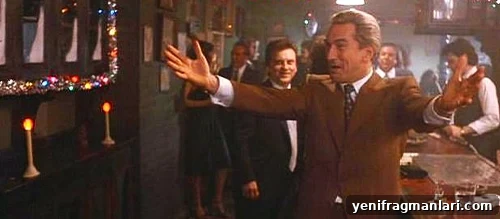
By the time the Lufthansa heist is celebrated, echoes of 1960s pop linger—Spector-produced Christmas tunes by The Ronettes and Darlene Love underscore the hollow joy of ill-gotten success. That joy collapses quickly: Tommy is executed to the piano coda of Derek and the Dominoes’ “Layla,” and Jimmy makes his chilling, pragmatic decisions against the backdrop of Cream’s “Sunshine of Your Love.” Scorsese even played “Layla” on set to synchronize movement and camera work with the music, demonstrating how integral these songs were to staging and emotional rhythm.
The film’s climax leaps toward the 1980s as Henry’s life unravels. A chaotic day of collapsing relationships, exposure, and fear is heightened by a barrage of rock tracks from artists like Harry Nilsson, The Rolling Stones, The Who, George Harrison and Muddy Waters. The soundtrack’s transition to harder, edgier rock sonically signals the end of glamor and the permanence of consequence.
Goodfellas closes with a stinging final choice. Henry, now living under witness protection and stripped of status, is reduced to an ordinary, anonymous existence. Scorsese finishes the film with Sid Vicious’s punk cover of Frank Sinatra’s “My Way”—a deliberately provocative inversion of the crooner’s classic. The irony is sharp: the song associated with elegance and self-assurance is rendered as a snarling imitation, underlining Henry’s fall from glamour to outcast.
The Goodfellas soundtrack remains a masterclass in how pre-existing popular songs can be used to enrich storytelling. Scorsese’s selections do more than evoke a period: they define character, foreshadow change, emphasize emotional contrast, and supply a lived-in authenticity to the film’s world. The result is a scoreless score—a collage of familiar songs that together become one of cinema’s most powerful soundtracks.
Alexa, play “Gimme Shelter.”
Written by Grace Laidler
Follow Grace Laidler on Twitter: @gracewillhuntin