
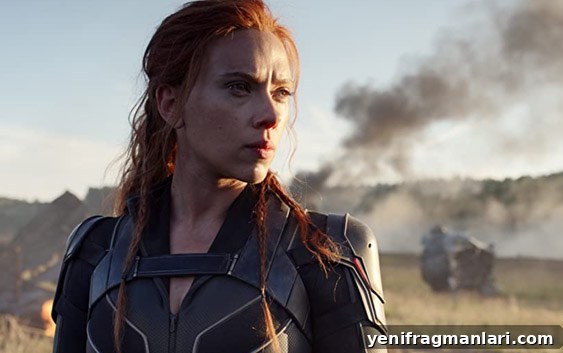
Black Widow (2021)
Director: Cate Shortland
Screenwriter: Eric Pearson
Starring: Scarlett Johansson, Florence Pugh, David Harbour, Rachel Weisz, Ray Winstone
After a two-year absence of theatrical releases from the Marvel Cinematic Universe, Black Widow arrives to expand Natasha Romanoff’s backstory and give fans a direct look at a character whose past has been hinted at for years. Positioned chronologically between earlier MCU events and Avengers: Endgame, the film aims to balance darker psychological themes with the franchise’s characteristic action and humor.
Cate Shortland’s direction leans into the grimmer aspects of Natasha’s history, especially her time connected to the Red Room. The film benefits from this tone, offering a moodier visual palette and moments that feel distinct from the brighter, more optimistic MCU entries. Shortland stages several sequences with care, creating a convincing sense of threat and emotional weight when the narrative focuses on Natasha’s trauma and unresolved relationships.
However, the screenplay by Eric Pearson struggles to maintain a consistent tone. The film oscillates between bleak revelations and broad family comedy in ways that often feel uneven. Jarring transitions undercut the impact of dramatic revelations by inserting lighthearted or slapstick beats in the wrong places. While Marvel’s PG-13 framework places limits on how far the film can push darkness, the script nonetheless attempts to mix sorrowful confessionals with goofy banter, and the blend frequently clashes.
The new supporting cast produces mixed results. Florence Pugh’s Yelena Belova is a standout: lively, sarcastic and emotionally grounded, she brings much-needed spark and gives Scarlett Johansson a convincing partner in both action and chemistry. Pugh’s performance is a highlight and suggests a character with franchise potential.
David Harbour’s Red Guardian is written as an exaggerated, caricatured figure — a faux-Russian super-soldier whose presence often swings scenes from sincere to silly. Harbour finds laughs and heart where he can, but the character’s broadness contributes to the tonal whiplash. Rachel Weisz’s Melina Vostokoff offers a quieter, steadier presence and anchors several plot threads, though the film doesn’t afford her as much complexity or screen time as her role merits. Mason, played by O-T Fagbenle, functions mainly as a plot device, moving the story along without making a particularly memorable impression.
The antagonists are also among the weaker elements. Ray Winstone’s Dreykov has a compelling concept at the center of the story, but the film’s structure limits his impact; the villain’s influence is more often described than dramatically realized. Fight choreography varies in effectiveness: some sequences are taut and well-cut, while others feel routine compared to the franchise’s best action set pieces.
What the film attempts — to enrich Natasha Romanoff’s narrative and give her a standalone arc that contextualizes her sacrifice in Endgame — is worthwhile. In places, the movie deepens the emotional resonance of her choices and shows why she matters beyond her role on the Avengers team. At the same time, the film rarely feels essential; it supplements her story rather than redefining it, and it sometimes undercuts the poignancy of her fate by revisiting the past in a way that feels more like an add-on than an inevitable chapter.
Female-led entries in the MCU remain significant on a representational level, and Black Widow succeeds in showcasing strong performances from its central cast, particularly Johansson and Pugh. The movie’s darker inclination refreshes the franchise to some degree, yet inconsistencies in tone and underwritten secondary characters prevent it from rising above the level of a middling MCU installment.
In short, Black Widow is a movie with worthwhile intentions and several strong performances, but its tonal instability and forgettable supporting roles hold it back from becoming a truly compelling character study. Fans will appreciate the added context and a memorable turn from Florence Pugh, while others may find the film’s mix of drama and comedy uneven.
13/24