
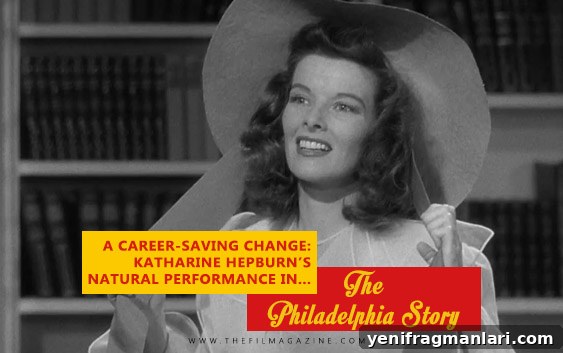
In Acting for the Camera, Tony Barr defines acting as “the response to stimuli in imaginary circumstances in an imaginative, dynamic manner that is stylistically true to time and place, so as to communicate ideas and emotions to an audience.” The phrase “dynamic manner” is crucial: a convincing performance must show variation and development even within a single scene to reflect the shifting feelings of a real person. Hume Cronyn makes a similar point in his essay “Notes on Film Acting,” emphasizing the necessity of change in film performances because it affects the audience and meets the practical demands of movie production. Katharine Hepburn’s performance in The Philadelphia Story exemplifies this principle of change. Her portrayal of Tracy is multi-layered, emotionally varied, and consistently true to the character, which sustains audience engagement in this intimate character drama.
The Philadelphia Story follows Tracy Lord (Katharine Hepburn), a Philadelphia socialite about to marry a respectable, self-made man, George (John Howard). The calm before the wedding is disrupted by a tabloid reporter, Mike (James Stewart), and Tracy’s charming but complicated ex-husband, Dexter (Cary Grant). Both men become entangled with Tracy, and the three characters embark on a journey of discovery. Because Tracy dominates the film’s scenes, Hepburn must supply the film’s emotional range: she exposes the vulnerabilities behind a tough exterior and reveals the tensions of someone under social pressure—expected to be a pillar of a dysfunctional family, a subject of public fascination, and a woman who wants to be loved without pretense. Hepburn’s approach aligns with Hollywood Naturalism: under tight production schedules and high expectations for a leading actress, she convincingly renders the inner life of her character through nuanced, natural behavior.
Actors from Hollywood’s Golden Age, including Hume Cronyn and Bette Davis, described working methods that illuminate this Naturalist style. Cronyn recounted the lack of rehearsal on many productions, recalling that his first important scene in Alfred Hitchcock’s Shadow of a Doubt arrived without warning. To prepare, he developed private details—places, objects, habits—that helped him inhabit the character even without living the role fully. Bette Davis described a similarly methodical approach: she was selective about roles, limited the number she accepted each year, and dedicated “endless hours” to studying her characters’ lives and habits. These practices—creating inner life, researching habits, and rehearsing privately—helped actors produce truthful, layered performances under studio constraints. At the time The Philadelphia Story was filmed, Hepburn’s career momentum had slowed; she invested in the project and delivered a performance that restored her standing. Her portrayal of Tracy likely drew on these kinds of preparatory techniques, producing an internal reality that translates naturally to the screen.
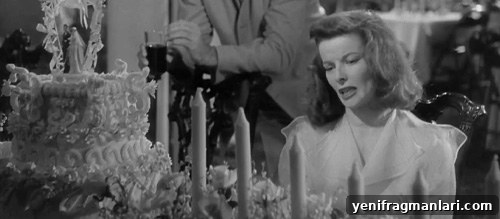
Hepburn’s layered acting is visible in one of the film’s opening sequences, when Tracy and her sister visit a stable to meet Uncle Willie (Roland Young) and her fiancé George. Hepburn opens the scene with mischief: she dabs Uncle Willie’s handkerchief with his favorite perfume and sneaks up behind him, smiling broadly as he mistakes the approach for a flirtation. Her body language—slow, deliberate stalking and an exuberant grin—sells the joke. When Uncle Willie pinches her, she reacts with a quick leap and then seizes his copy of Spy, a tawdry magazine associated with Mike. Her expression changes to a flat dismissal as she reads it, then brightens into playful roughhousing with George. Hepburn tracks subtle shifts in tone and physicality—playful, annoyed, tender, guarded—each tied to the emotional content of the moment. These transitions create the impression of a whole person whose exterior gestures and interior feelings interact naturally.
The same attention to change is evident in a later, more charged exchange with Dexter. From his entrance, Tracy adopts a confrontational stance—hands on hips, then folded arms—conveying defensiveness. When Dexter delivers a sharp, personal critique, Hepburn allows her lip to tremble and the edge of tears to appear, a momentary crack in the armor that confirms the truth of his words. She quickly composes herself when George enters, restoring outward composure while the interior remains unsettled. This brief exposure of vulnerability, then concealment, deepens the character: Tracy’s public toughness masks private fragility.
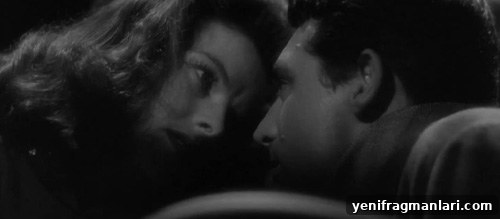
A subsequent scene reveals tenderness between Tracy and Dexter that helps explain how their marriage once existed. After a drunken bathtub episode with George, Tracy sleeps in her car and Dexter slips into the seat beside her. He greets her with gentle words—calling her beautiful—and her response is weary and dulled by sleep and drink. Her voice is softer, reactions delayed, and her usual sharpness is muted. The intimacy of that moment suggests a real affection between them, while her turning away underscores her instinct to keep distance. Hepburn balances the intoxication, the fatigue, the guarded affection and the impulse to hide, offering a compact but revealing study in emotional contradiction.
Katharine Hepburn’s performance in The Philadelphia Story demonstrates the strengths of the Hollywood Natural style: listening to scene partners, reacting to physical stimuli, and embodying a character’s psychological complexity. Through small, truthful choices in tone, gesture, and timing, she builds a layered portrait of a woman who vacillates between pride and vulnerability, playfulness and despair. The dynamic shifts in her performance keep the character believable and engaging, and they helped revive Hepburn’s career after a period of setbacks with the studios. Her Tracy Lord remains a model of naturalistic, nuanced acting that reads as human and emotionally authentic.
Bibliography
Barr, Tony. Acting for the Camera. Revised Edition, Eric Stephan Kline, William Morrow, 1997, New York.
Cronyn, Hume. “Notes on Film Acting.” Theory and Practice of Acting, printed by Richard Allen, 13 Feb. 2023. 193-200.