
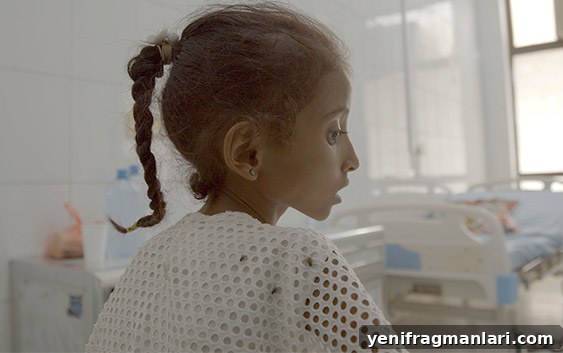
Hunger Ward (2021)
Director: Skye Fitzgerald
To imagine the loss of a child is to confront a grief so profound it reshapes everything you think you know about suffering. Skye Fitzgerald’s short documentary Hunger Ward places that unbearable grief at its center and refuses to let viewers look away. Filmed inside two malnutrition treatment centers in Yemen, the film is intimate, harrowing, and ultimately a call to recognize the human cost of conflict and scarcity.
Set against the backdrop of a prolonged humanitarian crisis, Hunger Ward follows medical staff working in “hunger wards” in both northern and southern Yemen. These facilities prioritize treatment for severely malnourished children and become the film’s literal and emotional heart. Over a tightly controlled 39-minute runtime, Fitzgerald and his crew remain close to the doctors, nurses, children, and parents, capturing the quiet, urgent work of saving lives and the wrenching moments when that work cannot succeed.
The film’s power derives from its focus on human details rather than geopolitical analysis. While the war and outside interventions are the forces that create the conditions of famine, Fitzgerald’s approach emphasizes universal human experiences—care, love, loss, and compassion. By concentrating on the faces, bedside conversations, and small routines of medical workers and families, Hunger Ward transforms abstract statistics into living, breathing people whose suffering demands attention.
Viewers watch as medical teams feed fragile infants, measure emaciated limbs, administer injections, and offer what comfort they can. The camera often holds on gestures: the hand that steadies a child, the phone that displays a photograph of a child who did not survive, the mother who refuses to leave her child’s side. These moments accumulate, building a portrait of endurance and vulnerability. The film does not shy away from the most painful scenes—children on the brink of death and parents overwhelmed by loss—because withholding those images would soften the truth the film seeks to tell.
Hunger Ward is an example of documentary filmmaking that aims to cultivate empathy through proximity. Rather than explaining every political cause in detail, it asks viewers to accept the ethical imperative inherent in witnessing. The film insists that our common humanity should override distant and abstract divisions; it suggests that the love parents feel for their children is a universal bridge to understanding what is at stake when war and deprivation collide.
The documentary’s emotional intensity is balanced by the dignity of its subjects and the quiet professionalism of the caregivers. We see doctors and nurses grieving too—scrolling through images of children who have died, holding back tears, and continuing their work in the same breath. These scenes highlight the emotional labor of healthcare providers in crisis zones, and they underscore the ongoing nature of the emergency: for the people on the ground, there is no neat beginning or end, only an unrelenting struggle to preserve life.
Fitzgerald’s film was nominated for the Documentary Short Subject category at the 2021 Academy Awards, a recognition that brought wider attention to the conditions it documents. But the film’s true accomplishment is not awards; it is the way it shifts perception. By insisting that viewers attend to individual stories, Hunger Ward moves the conversation from distant statistics to concrete moral responsibility.
“Enough. Enough of war. It doesn’t matter who wins or loses. War plus children equals deprivation. Deprived of everything. If only our voices could be heard. The voices of people who are simple and humble. We cannot say we are used to seeing this. We cannot say we are used to the deaths. Never.” – Dr. Alda Alsadeeq
The film also functions as a prompt to action. It reminds audiences that humanitarian crises often continue out of sight, and that public awareness, advocacy, and support for medical relief can make a meaningful difference. While Hunger Ward does not position itself as a policy piece, its human images generate moral urgency that can motivate viewers to learn more and support relief efforts.
As a compact, intense documentary, Hunger Ward is essential viewing for anyone seeking to understand the human consequences of conflict-related famine. It is a film that respects its subjects, refuses to minimize pain, and ultimately calls on viewers to recognize their shared responsibility to protect vulnerable children and families from avoidable suffering.
24/24
To join the campaign to end intervention in Yemen and to donate directly to the malnutrition wards featured in this film, visit hungerward.org