
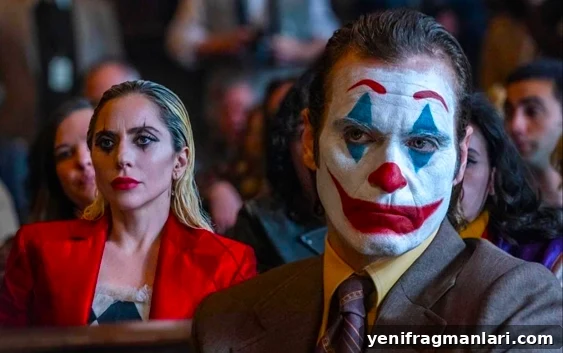
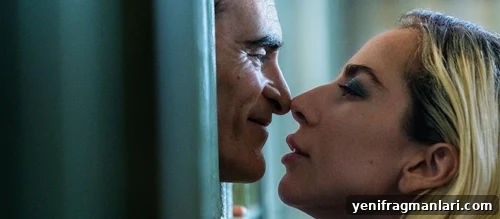
Joker: Folie à Deux (2024)
Director: Todd Phillips
Screenwriters: Scott Silver, Todd Phillips
Starring: Joaquin Phoenix, Lady Gaga, Brendan Gleeson, Harry Lawtey, Bill Smitrovich, Catherine Keener
When Todd Phillips’ Joker arrived in 2019 it became one of the defining films of that year, provoking conversations about society, mental health and the nature of cinematic myth-making. The original film’s blend of gritty production design, a central performance that garnered Joaquin Phoenix an Academy Award for Best Actor, and a narrative that left questions about reality and responsibility open to interpretation made it both a box-office phenomenon and a cultural touchstone. The first Joker captured a moment in time: an angry, fractured cityscape and a protagonist who could be read in more than one way by different audiences.
Released into a very different cultural climate—after lockdowns, strikes, studio consolidations and major geopolitical shifts—Joker: Folie à Deux attempts to re-enter that world with a new tonal experiment: a musical-inflected sequel that trades some of the original’s mystery for assertion. The result is a film that struggles beneath competing impulses. It aims to expand the world of Arthur Fleck and his Joker persona, but it often unravels what made the first film compelling by explaining too much, diluting pace, and leaning on theatrical set pieces that interrupt the flow rather than enhance it.
The film opens with a striking prologue that promises creativity and boldness, but this early promise gives way to a structurally conventional prison-and-courtroom drama. Arthur Fleck, now imprisoned, is represented by a lawyer determined to argue that his violent actions sprang from a serious mental health condition. Brendan Gleeson plays an imposing corrections officer, and Lady Gaga joins the cast as “Lee,” an enigmatic figure who enters Arthur’s life amid an arts-class setting staged for publicity value. As the story pivots between attempts to save Arthur’s life and a driven district attorney aiming to secure the death penalty, the film settles into familiar beats more often than it takes risks.
One of the most controversial choices here is the incorporation of musical numbers. In theory, music offers an opportunity to merge fantasy and reality and to explore Arthur’s psyche in a more expressionistic way. In practice, these interludes frequently feel inserted rather than integrated. They slow the film’s momentum, and many of them lack the inventive staging or thematic sharpness necessary to justify their length. Instead of revealing deeper layers of Fleck’s mind, the songs can feel like detours that interrupt the core narrative and sap dramatic energy.
Visually, the sequel retains the grimy palette of the original, contrasting the bleakness of institutional life with bursts of color in Fleck’s fantasies. Lawrence Sher’s cinematography still understands how to make that contrast read emotionally on screen, and Hildur Guðnadóttir’s score returns to lend atmosphere. However, the score often works overtime to compensate for scenes that don’t cohere dramatically, and the musical arrangements sometimes warp around the set pieces without the subtlety that distinguished the first film’s sound design.
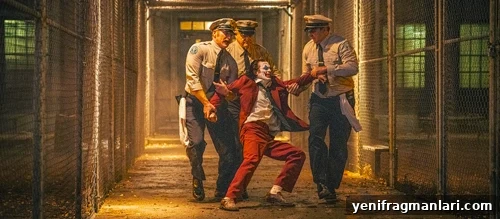
Acting remains a major strength. Joaquin Phoenix continues to be a committed, evocative presence, finding nuance even when the script gives him limited avenues for discovery. Lady Gaga makes a striking addition, delivering dramatic intensity and musical bravura in moments that work. Brendan Gleeson provides a physical anchor in supporting scenes. Yet the performances cannot fully offset the screenplay’s tendency to spell out motivations and outcomes rather than let them emerge organically. Where 2019’s Joker benefitted from ambiguity that allowed viewers to debate what was real, Folie à Deux too often removes that ambiguity and diminishes the mythic quality of the central figure.
There are signs that the film was pulled in multiple directions during development. The screenplay features an expanded number of story beats and explicit dialogue that explains rather than implies, a possible response to studio pressure to deliver a more conventional, broadly accessible narrative. At the same time, Todd Phillips’ desire to experiment—by folding in musical elements and shifting genre expectations—suggests a creative team trying to satisfy both commercial and artistic aims. That tension produces a film that feels stretched: too explanatory for those who wanted mystery, and too cautious for those hoping for the bold tonal leaps suggested by the prologue.
Ultimately, the film’s chief problem is a lack of sustained momentum. The original Joker built toward an escalating sense of outrage and release; this sequel stalls, with scene after scene trapped in repetitive institutional settings and occasional musical set pieces that fail to advance the central character or the film’s emotional arc. Even when individual moments shine—thanks to direction, design, or performance—the overall experience fails to cohere into something that matches the cultural impact or cinematic invention of the first installment.
For viewers seeking a direct continuation of Arthur Fleck’s inner life that preserves ambiguity and sustains dramatic tension, Joker: Folie à Deux will likely disappoint. It offers worthwhile performances and a few memorable images, but it will struggle to stand on its own as a definitive artistic statement. In short, the sequel has ambition, but its execution leaves the film feeling less than the sum of its parts.
Score: 10/24
Rating: 2 out of 5.
Recommended reading: Live-Action Jokers Ranked