
Nope (2022) Review
Director: Jordan Peele
Screenwriter: Jordan Peele
Starring: Daniel Kaluuya, Keke Palmer, Steven Yeun, Brandon Perea, Michael Wincott, Wren Schmidt, Kieth David, Terry Notary, Jacob Kim
Jordan Peele’s third feature, Nope, arrived shrouded in secrecy and high expectations. Early marketing offered little more than a single ominous poster and brief teasers of people looking up at the sky. The film rewards viewers who avoid heavy spoilers: it mixes science fiction, suspense, and satirical observation in ways that are often surprising and rarely predictable.
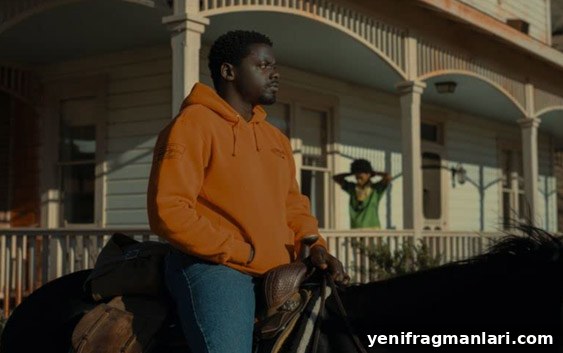
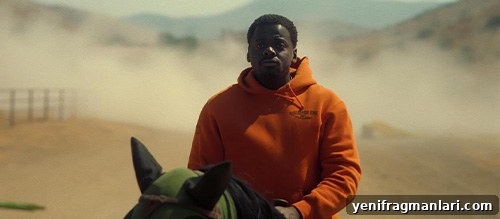
The story centers on siblings OJ and Emerald Haywood (Daniel Kaluuya and Keke Palmer), whose family runs a horse-training business that supplies Hollywood. After the sudden death of their father, the Haywoods begin to notice strange phenomena at their Southern California ranch that suggest an extraterrestrial presence. They recruit Angel (Brandon Perea), an eager tech-savvy assistant, and Antlers Holst (Michael Wincott), an eccentric cinematographer, to help document whatever is happening. Their goal is simple yet urgent: capture undeniable proof that we are not alone.
Peele frames the family’s legacy around a little-known moment from cinematic history—the earliest moving images of a Black man on a horse—using that erasure as a thematic anchor. Otis Haywood (Kieth David) and his children are presented as descendants of that forgotten figure, carrying with them a practical knowledge of horses and show business. This lineage shapes their identities and motivations, and it gives Peele a way to explore how history, visibility, and spectacle intersect.
The film traces two interwoven themes. First, it examines the human appetite for spectacle: our hunger to witness, record, and profit from extraordinary events. Second, it investigates how animals—and other beings—react unpredictably when they sense direct attention, especially visual focus. These ideas converge to produce both tension and commentary on modern culture’s relationship to images, technology, and entertainment.
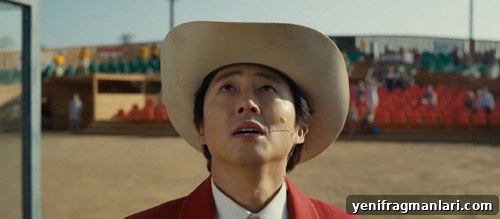
Early in the movie, Peele inserts a seemingly standalone incident: a 1990s sitcom set attack by a chimpanzee that profoundly affects one child actor, later known as Jupe (initially played by Jacob Kim and grown up as Steven Yeun). Jupe survives and converts his trauma into spectacle, building a Western-themed amusement venue near the Haywood ranch. His desperate bid to keep audiences enthralled creates a direct link between his past and the Haywoods’ present, tying human curiosity and commerce to the larger mystery unfolding overhead.
The film’s first half is a patient, slowly intensifying character study that echoes classics of slow-burn science fiction: it builds unease through detail, dialogue, and atmosphere. Peele gives us time to understand who these characters are and what they care about, which makes the stakes feel real when the threat becomes more immediate. Kaluuya and Palmer have a natural, believable sibling chemistry; Wincott’s Antlers provides oddball gravitas that livens the ensemble.
In its second half, Nope shifts into a more conventional creature-feature mode. The setting changes from the cramped intimacy of character scenes to the wide-open vistas of California hills, where an unnerving stillness in the sky becomes the signal of danger. Peele borrows the pulse and pacing of classic monster films while maintaining his own voice, turning broad landscape shots into arenas for suspense and action.
Symbolism and myth play important roles throughout the screenplay. Biblical and classical references echo across the film, from pre-credit epigraphs about spectacle and shame to allusions to myths that link monstrous power to being observed. In Peele’s world the camera has nearly as much agency as any character: it represents modern humanity’s faith in mediated images, our belief that seeing—with devices or screens—confers truth. That idea becomes central to the film’s moral questions about exploitation, attention, and survival.
Technically, Nope is impressive. Hoyte van Hoytema’s IMAX cinematography gives the film a grand, cinematic sweep, and the visual design of the alien presence is fresh and unsettling—at first evoking retro flying saucers, then revealing an organic strangeness that feels oddly plausible. Peele uses scale intelligently: the open terrain amplifies vulnerability, while close, intimate shots remind us of the personal costs behind the spectacle.
While Nope may not deliver the visceral social-shock of Get Out or the blunt horror of Us, it grows on you. It rewards repeat viewings with layers of detail, thematic richness, and bold visual choices. Peele continues to prioritize character-driven storytelling even as he explores big genre concepts, mixing satire, suspense, and genuine emotional stakes. This film further establishes him as a director capable of balancing ambition, craft, and human insight.
Score: 22/24