

Knock at the Cabin (2023)
Director: M. Night Shyamalan
Screenwriters: M. Night Shyamalan, Steve Desmond, Michael Sherman
Starring: Dave Bautista, Jonathan Groff, Ben Aldridge, Kristen Cui, Rupert Grint, Nikki Amuka-Bird, Abby Quinn
M. Night Shyamalan has long been a polarizing figure in contemporary cinema. His career alternates between acclaim and derision, yet across that uneven landscape there is a distinct creative voice: an appetite for moral dilemmas, contained settings, and narrative devices that build to unsettling revelations. Knock at the Cabin fits squarely within that tradition — a tense, intimate thriller that trades in moral extremity and emotional stakes rather than spectacle.
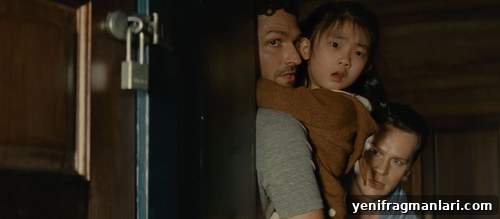
The film centers on a family vacationing at a remote cabin: Eric (Jonathan Groff), Andrew (Ben Aldridge), and their young daughter Wen (Kristen Cui). Their peaceful retreat is shattered when four armed strangers arrive, led by the imposing Leonard (Dave Bautista). The intruders deliver an impossible ultimatum: one life must be willingly sacrificed to avert a global catastrophe. What follows is a slow-burning siege built from fear, conviction, and the crushing weight of choice.
Shyamalan directs with the economy he has refined over decades. The cabin, isolated and claustrophobic, becomes a crucible where characters reveal their cores. Tension is generated not through constant action but through sustained, uneasy conversation and the knowledge that every moment of bargaining carries moral consequence. The film’s pacing is deliberate; Shyamalan takes his time to allow dread and doubt to accumulate, which pays off in scenes that feel raw and immediate.
Performance-wise, the ensemble anchors the premise. Jonathan Groff and Ben Aldridge convincingly portray parents who are alternately protective, defiant, and grief-stricken. Their chemistry gives the family a believable heart, and viewers quickly understand why they would be willing to defy nearly anything to protect their child. Kristen Cui’s Wen is sharp and observant, a child whose intelligence and emotional clarity provide much of the film’s moral weight.
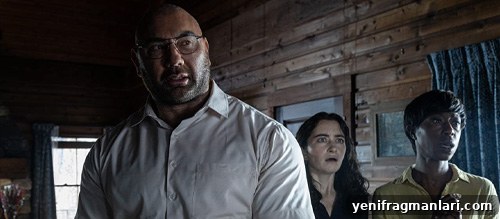
Dave Bautista offers a restrained, humane performance as Leonard. His physical presence is balanced by moments of surprising vulnerability; rather than playing a one-note fanatic, Bautista suggests complexity beneath the character’s conviction. That layering makes Leonard both intimidating and oddly sympathetic at times, which is central to the film’s moral tension. Rupert Grint’s role is smaller and darker, and while he brings an edge to the character of Redmond, the script affords him limited breadth to develop beyond antagonism.
Dialogues in the film occasionally veer toward the didactic, and some lines feel heavy-handed. Shyamalan’s penchant for explicit thematic statements can make certain exchanges feel clunky. Still, the film’s strengths lie in its ability to sustain dread and prompt reflection. The central question — how far would you go to save the people you love? — is explored through persuasive emotional beats and a structure that forces characters into impossible moral arithmetic.
Visually, the movie relies on close framings and shadowed interiors to maintain a pressure-cooker atmosphere. The sound design amplifies this mood, with silences and sudden, jarring noises used to unsettle rather than simply startle. There are moments of violence that feel brutal and consequential; Shyamalan does not shy away from showing the cost of the choices the characters face, and those sequences are filmed with immediacy that underscores their impact.
Thematically, Knock at the Cabin plays with ideas of faith, sacrifice, and the limits of moral certainty. It does not provide tidy answers. Instead, the film is most effective when it keeps its focus on the human scale — the private conversations, the looks exchanged between partners, the way a child perceives adults grappling with threats beyond comprehension. While some viewers may find the finale less surprising than past Shyamalan twists, the emotional truth at the movie’s core remains compelling.
Overall, Knock at the Cabin is not the director’s most audacious work, but it is a tightly wound, emotionally charged thriller that showcases Shyamalan’s continued interest in moral paradox and intense, character-driven storytelling. It benefits from committed performances, a taut central premise, and a steady directorial hand willing to prioritize human stakes over spectacle.
Score: 16/24