
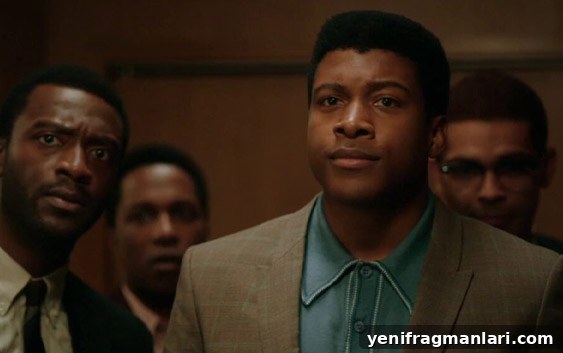

One Night In Miami (2020)
Director: Regina King
Screenwriter: Kemp Powers
Starring: Kingsley Ben-Adir, Eli Goree, Aldis Hodge, Leslie Odom Jr., Lance Reddick, Christian Magby
If you could choose any four people in the world and put them in a room together, who would they be? In her assured directorial debut, Regina King imagines a compelling answer: Sam Cooke, Malcolm X, Cassius Clay, and Jim Brown. Based on Kemp Powers’ stage play, One Night in Miami stages a speculative, intimate encounter on February 25, 1964—the night Cassius Clay defeated Sonny Liston—and examines how fame, race, responsibility, and identity intersect for four Black icons caught at pivotal moments in their lives.
King opens the film with a measured portrait of America in 1964, using brief but pointed scenes to underline how success did not erase the indignities of racism. Jim Brown (Aldis Hodge) is denied entry into a neighbor’s home while offering to help with furniture; Sam Cooke (Leslie Odom Jr.) performs for a dismissive, majority-white club audience. These moments establish a context where Black achievement is admired at a distance but not accepted as equal. For a young Cassius Clay (Eli Goree), newly famous and eager for guidance, that context makes the conversation that follows feel urgent and consequential.
After Clay’s unexpected victory, the four men return to Malcolm X’s (Kingsley Ben-Adir) hotel room to celebrate. Rather than throwing a party, Malcolm steers the evening toward interrogation and debate. With little more than vanilla ice cream for sustenance, the friends trade insights and accusations across a single night that will have outsized consequences for each of them. Clay stands on the brink of a religious conversion and a public reinvention; Brown is considering a career beyond the football field; Cooke and Malcolm both face mounting pressures and questions about where their work and loyalties should lead them. The tension in the room grows from their differing responses to fame, influence, and collective duty.
The film’s emotional core is the clash between Malcolm and Cooke. Malcolm challenges Cooke for crafting music that can be comfortably embraced by white audiences instead of songs that might spur political action or reflect the urgency of the civil rights struggle. Cooke defends his strategy of influence from within the system, arguing that reaching a wider audience can be a form of leverage. In a stinging counter, Malcolm plays a Bob Dylan record and asks why a white artist’s protest song can feel more politically crystalline than Cooke’s own catalog. Jim Brown adds nuance by pointing out Cooke’s relative independence from white patronage, and he presses Malcolm on the roots and limits of his militancy. Each man’s argument is delivered with eloquence and force; King resists tidy resolutions, reminding us that the real work of change rarely concludes in one night or one conversation.
King’s direction honors the play’s theatrical origin without making the film feel static. She leans into the claustrophobic intensity of the hotel room to heighten the verbal jousting, but she also opens the story up, moving the characters through the roof, the parking lot and a neighborhood liquor store to give the drama breathing room. Cinematographer Tami Reiker keeps the visuals dynamic, changing vantage points and framing to sustain tension. The film’s most inventive sequence is a flashback in which Malcolm recounts seeing Cooke perform live: when the band drops out, Cooke quiets a restless audience, leads them in a chant and sings a capella. The moment is simple and profound, an image of communal voice that resonates strongly with contemporary movements for racial justice.
What sets King’s film apart is its refusal to flatten these larger-than-life figures into single-note icons. Previous cinematic portraits have often emphasized the public actions and politics of men like Malcolm X and Muhammad Ali; One Night in Miami gives those figures interiority. The camera lingers on vulnerability—on doubt, longing and the private stakes behind public gestures. King punctures traditional notions of masculinity by letting emotion surface and by allowing conflict to trace the outlines of real human complexity.
The performances are uniformly excellent. Leslie Odom Jr. brings a weary dignity to Sam Cooke; Kingsley Ben-Adir’s Malcolm X is forceful but not a caricature; Eli Goree captures Clay’s youthful hunger for validation and guidance; Aldis Hodge’s Jim Brown offers the balance of humor and seriousness that keeps the debates grounded. Supporting work, including Lance Reddick in a smaller but memorable role, rounds out a cast that inhabits the material fully.
One Night in Miami is a thoughtful, beautifully acted film that balances theatrical intensity with cinematic invention. It invites viewers into a single night of high-stakes conversation and lets that dialogue echo outward, asking how influence should be wielded and what responsibility comes with a public voice. Regina King’s sensitive, assured direction transforms Kemp Powers’ play into a film that feels both timely and timeless—a meditation on leadership, art and the complicated work of social change.
24/24