
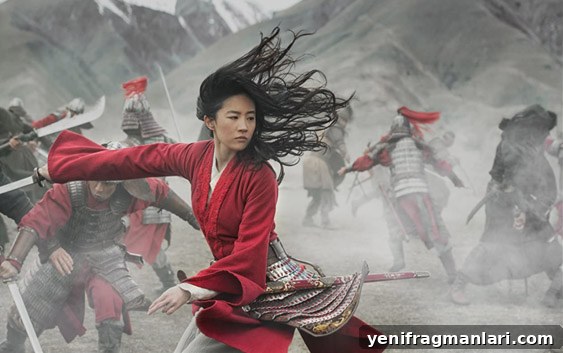
Mulan (2020)
Director: Niki Caro
Screenwriters: Rick Jaffa, Amanda Silver, Elizabeth Martin, Lauren Hynek
Starring: Yifei Liu, Donnie Yen, Gong Li, Jet Li, Jason Scott Lee, Yoson An, Tzi Ma, Rosalind Chao
After a series of release delays, Disney’s live-action reimagining of Mulan has finally arrived. With a major budget and an almost exclusively Asian cast, director Niki Caro offers a visually striking, more grounded adaptation of the classic Chinese legend. This take departs from the animated original in tone and structure while keeping the core of the hero’s journey intact.
The story follows Hua Mulan (Yifei Liu), a capable young woman who disguises herself as a man to take her ailing father’s place in the Imperial Army. The film explores whether a single act of deception can both protect family and preserve honor, and it reframes honor, duty, and identity for a contemporary audience.
Mulan’s relationship with her father (Tzi Ma) anchors the emotional core of the film. He admires her strength and regrets the constraints society places on daughters: “Your chi is strong, but chi is for warriors, not daughters… I say this to protect you, that is my job. Your job is to bring honour to the family.” That tension—the pull between protection and suppression—drives much of Mulan’s motivation throughout the narrative.
Unlike the animated version, where Mulan’s accomplishments come through hard-earned practice and gradual self-discovery, this adaptation presents her as naturally gifted from the outset. She must conceal her exceptional abilities to avoid attention, a choice that paradoxically exposes her gifts in new and dangerous ways. This portrayal aligns more closely with elements of the original folk tale, in which Mulan is renowned for her battlefield skill.
The film also reshapes its antagonists. Jason Scott Lee’s Bori Khan is a formidable warlord, but the more complex threat is Gong Li’s Xian Lang, a shape-shifting sorceress whose motivations mirror Mulan’s desire for acceptance and agency. Both women are mistrusted and feared in a male-dominated world because they wield power that resists control. The parallel between hero and villain creates a richer thematic texture than a straight good-versus-evil framing.
Niki Caro’s direction is dynamic and often inventive. Action scenes use a range of camera moves and Wuxia-style wirework to create fluid, balletic combat. Some edits feel abrupt, making certain sequences harder to follow, but other moments—especially the wide-angled horseback stunts—are filmed with clarity and a real sense of spectacle. One standout sequence shows a rider flipping around a saddle to shoot backward at pursuers, an impressive and memorable stunt that underscores the film’s physical ambition.
Certain set pieces are particularly striking: a confrontation across volatile sulfur flats, and the final push into the occupied Imperial City that showcases a range of unique fighting styles. The production values are evident everywhere—the $200 million budget allows for expansive locations and large-scale sets that make the world feel lived-in and epic.
Though it’s not a musical, the score nods to the Disney songs fans remember. The melody from “Reflection” resurfaces at a quiet yet stirring moment as Mulan rides into battle, a subtle connective thread to the animated predecessor without reverting to pastiche.
Performances are a highlight. Yifei Liu brings charisma and emotional clarity to the lead role, while Tzi Ma delivers a deeply felt paternal performance. Donnie Yen and Gong Li provide nuance to their respective roles, avoiding one-dimensionality. Jet Li appears briefly as the Emperor and, while his screen time is limited, his presence adds gravitas.
The screenplay occasionally over-explains its themes, leaning into explicit dialogue where quieter dramatization might suffice. Repetition of ideas in successive scenes slightly undercuts the film’s subtle emotional beats. The climactic bamboo-scaffold fight, though ambitious, feels less resonant than some earlier set pieces.
Despite these flaws, this Mulan stands as a powerful, visually impressive reimagining. It balances spectacle with a contemporary reading of gender and honor, while giving the heroine agency and complexity. For many viewers, the film will be a welcome, modernized interpretation of a timeless story—one that emphasizes strength, identity, and belonging.
18/24