

Promising Young Woman (2021)
Director: Emerald Fennell
Screenwriter: Emerald Fennell
Starring: Carey Mulligan, Bo Burnham, Alison Brie, Adam Brody, Jennifer Coolidge, Laverne Cox, Christopher Mintz-Plasse, Molly Shannon, Max Greenfield, Chris Lowell
Statistics vary by country, but studies consistently show that a significant number of women experience sexual assault in their lifetimes—often cited as roughly one in five. That figure is both shocking and, sadly, familiar. Sexual violence is a widespread social crisis, yet public responses tend to focus on advice for potential victims rather than systemic change: warnings about what women should wear, how they should behave, or how they should protect themselves. Those well-meaning but ultimately insufficient measures shift responsibility away from perpetrators and the culture that enables them.
Emerald Fennell’s debut feature, Promising Young Woman, confronts that cultural failure head-on. The film centers on Cassandra “Cassie” Thomas (Carey Mulligan), a thirty-year-old who dropped out of medical school after a traumatic incident involving her friend Nina. The specifics of what happened to Nina are deliberately left vague, reflecting the frustrating reality victims often face when their experiences are minimized or dismissed. Fennell uses that ambiguity to mirror the social erasure survivors experience: the details are known to a few, but the consequences ripple outward while public attention fades.
Cassie’s life becomes mission-driven. By day she works a modest job; by night she uses an unsettling strategy to expose predatory men. Posing as an intoxicated woman in bars and clubs, she lures men into revealing their cavalier or predatory attitudes. When she unexpectedly reveals that she is sober, the men who believed they had the upper hand are forced to confront their behavior. Cassie keeps a notebook documenting encounters, a testament to the scale of the problem she’s trying to illuminate. While many of these confrontations provide momentary satisfaction, the deeper catharsis she seeks remains out of reach—until a reunion with a former classmate, Ryan (Bo Burnham), opens a new and more dangerous path toward justice.

Fennell’s script is careful and measured: Cassie’s quest isn’t framed as pure vengeance but as an attempt to convert unresolved grief and anger into a form of accountability. She confronts a broad web of complicity—perpetrators, classmates who look the other way, and institutions that fail in their duty of care. The film methodically dismantles the attitudes that normalize sexual violence, from victim blaming to the protective instincts society extends to accused men, particularly those with status or privilege.
The casting reinforces Fennell’s point. Many of the men Cassie encounters are played by actors audiences typically associate with charm and harmlessness—Bo Burnham, Max Greenfield, Christopher Mintz-Plasse, Adam Brody, and others. Their likability adds disquieting complexity: predators can be familiar, attractive, and admired. The film’s supporting cast, including Jennifer Coolidge, Laverne Cox, Alison Brie, and Connie Britton, balances tonal shifts between dark satire and tragic urgency, contributing to an unsettling emotional cocktail that keeps the viewer off-balance in productive ways.
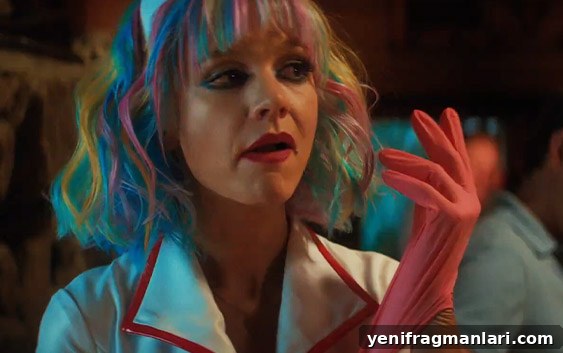
Costume designer Nancy Steiner and Fennell make a purposeful choice to subvert the typical revenge-movie palette. Cassie’s armor is not leather or utilitarian clothing; it’s femininity—bubble-gum pinks, neat hair, impeccable makeup and accessories. That aesthetic choice weaponizes the stereotypes and assumptions around “girly” appearances, exposing how easily society writes women off based on looks and how those assumptions protect abusers. The film uses color and style as narrative tools, turning the familiar iconography of femininity into a form of resistance.
Carey Mulligan’s performance anchors the film. She brings nuance to a character who could easily be flattened into a single emotion. Cassie is neither saint nor simple antihero; she is complicated and often uncomfortable, driven by pain and a ruthless intelligence. Mulligan shifts between menace, vulnerability, and dark humor with precision, giving the film its emotional center. Her portrayal highlights the sacrifices and moral ambiguity often required for survivors—or their allies—to seek accountability in a system that resists it.
Fennell’s direction is bold and cinematic, refusing to offer easy answers. The screenplay exposes double standards and cultural hypocrisies surrounding sexual assault, and the soundtrack amplifies those themes—songs that have been part of celebrity gossip culture appear in new, unsettling arrangements that underscore public attitudes toward women’s sexuality. These creative decisions emphasize how much of the conversation around women is shaped by judgments about image and reputation rather than truth and responsibility.
Promising Young Woman asks uncomfortable questions. It forces viewers to examine their assumptions and to consider whether they have contributed—through silence, laughter, or disbelief—to a culture that enables abuse. For many, the film will be a difficult watch; for others, it will be a call to reevaluate how society responds to allegations of sexual violence. Whatever the reaction, the movie insists on bringing the discussion into the mainstream and on centering the experiences of survivors.
24/24