
Siberia (2020)
Director: Abel Ferrara
Screenwriters: Abel Ferrara, Christ Zois
Starring: Willem Dafoe, Dounia Sichov, Simon McBurney, Laurent Arnatsiaq
Abel Ferrara’s Siberia (2020), screened at the BFI London Film Festival, is a compact, intimate study of memory and self-examination that foregrounds atmosphere over exposition. With Willem Dafoe in the central role, the film operates as a cinematic interior monologue: a succession of images, tonal shifts and associative leaps that trace a man’s inner life as he reviews moments of love, violence, regret and longing. At roughly 92 minutes, the film is deliberately spare, choosing elliptical gesture and lingering tableaux in place of linear storytelling.
The film is structured around two principal devices. First is a storybook voiceover delivered by Dafoe’s character, Clint, a voice that guides the audience through fragments of recollection. The second is Ferrara’s dense, sometimes confrontational visual language — long takes, stark framing, abrupt juxtapositions and tightly edited sequences that move from one sensory impression to the next. Together these elements aim to reproduce how memory often works: associative, nonlinear and triggered by small sensory details rather than clear causal logic.
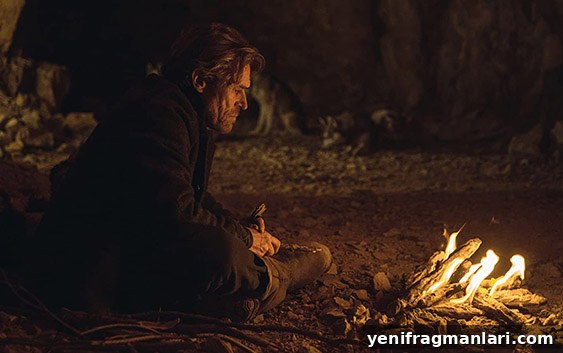
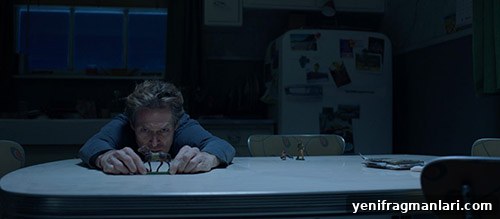
Ferrara’s approach yields striking images. The film moves across landscapes — snowbound mountains, drifting sand dunes, and pastoral green hills — each environment folded into the protagonist’s mental geography. Cinematography and editing create a rhythm of build and release, often punctuated by moments of shocking physicality or tenderness. At times the film feels almost expressionist: a barren cave overrun by naked figures, a hospital-like sterility giving way to dreamlike sequences where the lines between past and present dissolve. These sequences are powerful and memorable, demonstrating Ferrara’s skill at crafting atmosphere.
Yet the film’s reliance on subjective montage and sparse exposition is a two-edged sword. The narration, intermittently present, gives Siberia a theatrical, one-man-show quality. Dafoe is magnetic — his presence lends credibility and focus — but the film’s authorial voice is unmistakably Ferrara’s. That voice can feel self-referential at times, and the balance between poetic ambition and indulgent retreat into auteurism is uneven. The lengthy, sometimes portentous opening credits and the insistence on moments that seem designed to aggrandize the director’s vision make the piece occasionally feel more like personal catharsis than shared revelation.
Another consequence of the film’s design is occasional opacity. Many scenes are delivered in languages and fragmented exchanges that resist easy translation; they are deliberately obscure, meant to evoke emotional truth rather than narrate it. While this can be rewarding — inviting viewers to fill associative gaps — it can also frustrate those seeking clearer narrative stakes. The film’s emotional core, intended as a purgatorial reflection on life and mortality, sometimes feels out of reach; the poetry of the images does not always cohere into the emotional clarity the film aspires to achieve.
Still, Siberia is notable for its craft. Ferrara’s composition and pace demonstrate a filmmaker working deliberately with cinematic tools to replicate the texture of inner life. The transitions between memory fragments are inventive, and the film’s visual contrasts — cold to warm, isolation to intimacy — register strongly. Dafoe’s performance anchors these choices, carrying the film through moments of ambiguity and lending weight to scenes that might otherwise drift into abstraction.
In the end, Siberia is a divisive work. It will likely appeal to viewers who appreciate films that prioritize mood, associative editing, and formal experimentation over conventional storytelling. Those expecting a clearer connective thread or a more emotionally accessible narrative may find the film distant or self-indulgent. As an entry in Abel Ferrara’s filmography, it reads as a personal, stylistic statement: beautiful and occasionally elusive, impressive in its ambitions but not always successful in delivering the emotional payoff it promises.
10/24