
This article was written exclusively for The Film Magazine by Peter Charney.
The Father (2021)
Director: Florian Zeller
Screenwriters: Christopher Hampton, Florian Zeller
Starring: Anthony Hopkins, Olivia Colman, Mark Gatiss, Olivia Williams, Imogen Poots, Rufus Sewell
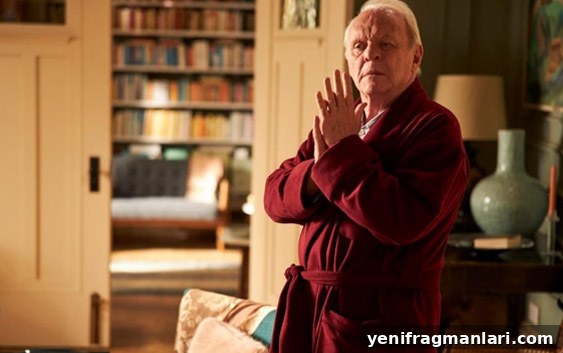
Aging is inevitable, and for many it arrives with confusion, loss and a painful erosion of identity. Florian Zeller’s directorial debut, adapted from his award-winning stage play, captures that slow dismantling of self in stark, intimate detail. The Father, a film nominated for Best Picture at the Oscars, centers on Anthony (Anthony Hopkins), an eighty-year-old man grappling with severe memory loss. The screenplay deliberately blurs biography and fiction—Anthony shares Hopkins’ first name and even his birthdate in one scene—yet the film never seeks to clinicalize the condition. Instead, it presents dementia as an experiential mystery, seen entirely through the mind of the person who is losing it.
Anthony’s relationship with his daughter Anne (Olivia Colman) forms the emotional backbone of the movie. Anne has devoted years to caring for him and now confronts a wrenching choice: continue as primary caregiver, hire professional help, or place him in a care facility. That dilemma unfolds in the background while the film focuses on Anthony’s rapidly shifting perception of his surroundings. He begins tasks and loses track of them, misplaces objects and time, and repeatedly questions the reality presented to him. Small moments—empty shopping bags, vanishing paintings, rooms that rearrange themselves—become profound indicators of an inner collapse.
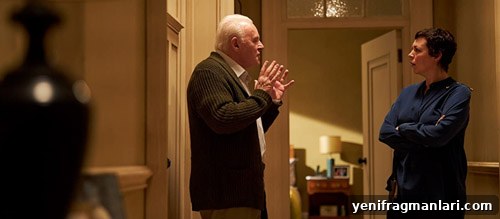
Rather than relying on exposition, Zeller constructs the film as an immersive, destabilizing labyrinth. He borrows techniques from stagecraft and cinematic illusion to place the audience squarely inside Anthony’s unreliable mind. Set design becomes a narrative device: colors shift, furniture subtly moves, and familiar objects disappear between scenes. People arrive who claim to be someone else, or familiar faces swap identities; the script and production design conspire to keep the viewer off-balance. These manipulations are not tricks for their own sake but a means to simulate the terror and disorientation of fading memory.
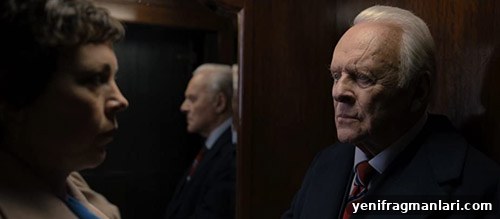
The film also undermines the notion that other characters provide a stable reality. Anne, caregivers and neighbors contradict themselves and each other, so the viewer cannot rely on any single perspective. Zeller stages repeated conversations and revisits the same exchanges with altered context, forcing us to question what has happened and when. Time itself becomes malleable: a morning can become night between shots, a single visit may feel like days, and a watch—Anthony’s anchor to continuity—reappears and vanishes in ways that reinforce his dependence on external markers of time. These choices create a disorienting but empathetic point of view that mirrors the confusion of dementia.
At the heart of the film is Anthony Hopkins’ extraordinary performance. Hopkins balances physical fragility and cognitive intensity, showing a broad emotional range from domineering clarity to fragile vulnerability. He conveys, in subtle gestures and sudden shifts of tone, the reality of a man who remembers being sharp and respected while slowly losing his bearings. When he flirts with a prospective caregiver like Laura (Imogen Poots), he can be charming, then abruptly accusatory and cruel. Hopkins captures the humiliation, anger and terror that accompany the realization of decline—moments when a mind that was once proud recognizes its own disintegration.
Olivia Colman and the supporting cast contribute crucially to the film’s unsettling atmosphere. Colman’s Anne is exhausted and torn, portraying the caregiver’s painful mix of compassion, resentment and responsibility. The ensemble’s nuanced interactions help sustain the film’s central conceit: that memory loss is not merely a clinical diagnosis but a profound, relational crisis that affects everyone around the person who is ill.
Technically, The Father is lean and precise. Editing and staging allow time to fray and recombine, while the production design and sound design keep the mind’s instability tangible. Zeller’s approach avoids melodrama, preferring instead to depict decline as ordinary and terrifyingly inevitable. The result is a film that is both compassionate and unsparing—a portrait that asks viewers to inhabit a reality in which trust, continuity and identity are constantly slipping away.
This is a film that lingers. It invites repeated viewings precisely because each viewing can reveal new misdirections and emotional truths. Above all, The Father is a humane, harrowing depiction of what it means to lose oneself and to be witnessed while doing so—one of the most affecting treatments of dementia on screen.
22/24
Written by Peter Charney
You can support Peter Charney in the following places:
Twitter – @PCharnz
Instagram – @PCharnz
Website – petercharney.com