
Score: B+
Director: Ben Wheatley
Cast: Brie Larson, Armie Hammer, Sharto Copley, Michael Smiley, Sam Riley
Running Time: 88 Minutes
Rated: R
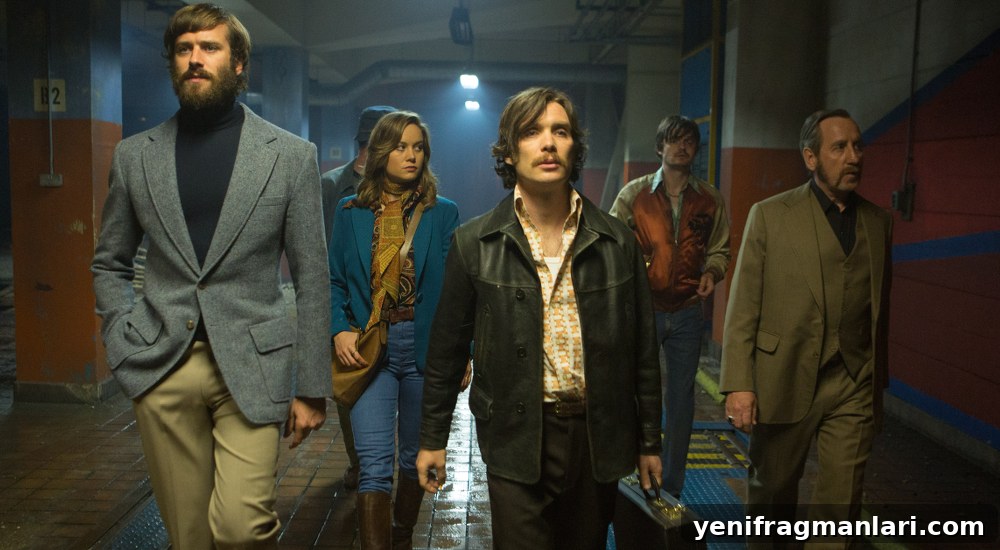
“Fuck the small talk. Let’s buy some guns.” It’s a blunt opening line that sets the tone for Free Fire, a taut, darkly comic gunplay chamber piece from British director Ben Wheatley. Set in an abandoned Boston warehouse in 1978, the film stages a single, extended confrontation between two groups who come together to complete an arms deal. What follows is a tightly choreographed, real-time shootout that plays like an exercise in escalating absurdity, tension and physical comedy.
Brie Larson, fresh from an Oscar win, is the lone woman in a cramped field of men whose weapons seem to be extensions of their fragile egos. The groups are roughly balanced, and at the center sits Ord (Armie Hammer), a bearded, slick middleman whose charm and bravado keep the negotiation—and the posturing—alive. Thirty assault rifles are set to change hands, a briefcase of money sits within reach, and everyone in the warehouse is armed. With those ingredients, something going wrong isn’t just possible—it’s inevitable.
Wheatley frames the entire sequence as a real-time event, allowing viewers to ride the highs and lows of the encounter without temporal cuts or easy escapes. The director’s eye for choreographing chaos is precise: the shootout is meticulously staged, often hilarious, and frequently inventive. Free Fire resists being pigeonholed as a straight action movie; instead it occupies a hybrid space that blends action, dark comedy and character study. Its sensibility nods to the low-budget B-movies of the 1980s while also wearing a stylistic wink toward directors like Quentin Tarantino—without ever becoming a pastiche.
If the film’s premise sounds simple, its execution is anything but. Early on, a gruesome wound provides a stark reminder of the stakes, but much of the carnage that unfolds is oddly clinical and sporadically cartoonish: ricochets off steel racks and scattered debris turn ordinary gunfire into unpredictable hazards. This use of environment makes every shot potentially catastrophic and keeps the tension taut. Wheatley uses the claustrophobic warehouse to emphasize both the physical entrapment and the absurdity of the situation—these characters cannot simply walk away from the mess they created.
Dialogue in Free Fire isn’t always elegant, but the cast brings life to the script. Armie Hammer finds a winning mixture of arrogance and likability that makes Ord fascinating to watch; he’s the film’s unexpected anchor. Jack Reynor, known from Sing Street, matches Hammer’s contributions with his own brash energy, and together they form a dynamic that often lifts the film in quieter moments between firefights. Brie Larson holds her own by carving out a presence that feels grounded amid the surrounding posturing.
The film’s tonal balance is one of its strengths. Wheatley allows the absurd to coexist with genuine peril, and the back-and-forth banter becomes a source of comic relief rather than mere filler. Characters reveal their motivations gradually: some are there for the money, others simply hope to leave alive, and a few see the chaos as cover for settling personal scores. This layering of intent helps sustain interest through a runtime of 88 minutes, ensuring the film rarely lags.
Stylistically, Free Fire is economical. Wheatley doesn’t rely on flashy exposition or impossible stunts; instead he trusts the contained set, the rhythm of the shootout, and the interplay between characters to carry the story. The sound design emphasizes the rawness of gunfire and the startling way it reverberates through concrete and metal, while the occasional musical choice—most memorably John Denver’s “Annie’s Song”—adds an ironic emotional counterpoint that underscores the film’s dark humor.
Ultimately, Free Fire succeeds not by reinventing the wheel but by executing its central conceit with confidence and wit. It’s a movie about masculinity, panic and posturing disguised as an action-comedy, and it rewards patience with moments that are both tense and unexpectedly funny. For viewers looking for a compact, well-acted, and stylistically confident experiment in real-time gunplay, Ben Wheatley’s film delivers an entertaining ride.
Free Fire isn’t trying to be epic; it aims to be precise, entertaining and unafraid to laugh at its own violence. Its strengths lie in confident direction, committed performances, and a script willing to let characters bicker, betray and survive—or not—within the metal and concrete confines of a single night.