
Score: A-
Director: Denis Villeneuve
Cast: Amy Adams, Jeremy Renner, Forest Whitaker
Running Time: 116 Minutes
Rated: PG-13
“There are days that define your story beyond your life.”
Denis Villeneuve’s Arrival is a thoughtful, emotionally charged science fiction film that prioritizes ideas and character over spectacle. Adapted from Ted Chiang’s short story “Story of Your Life,” the film centers on Dr. Louise Banks (Amy Adams), a linguist recruited by the military when a dozen mysterious spacecraft appear around the globe. Arrival is as much a study of communication and memory as it is an alien-contact picture, and it consistently rewards close attention.
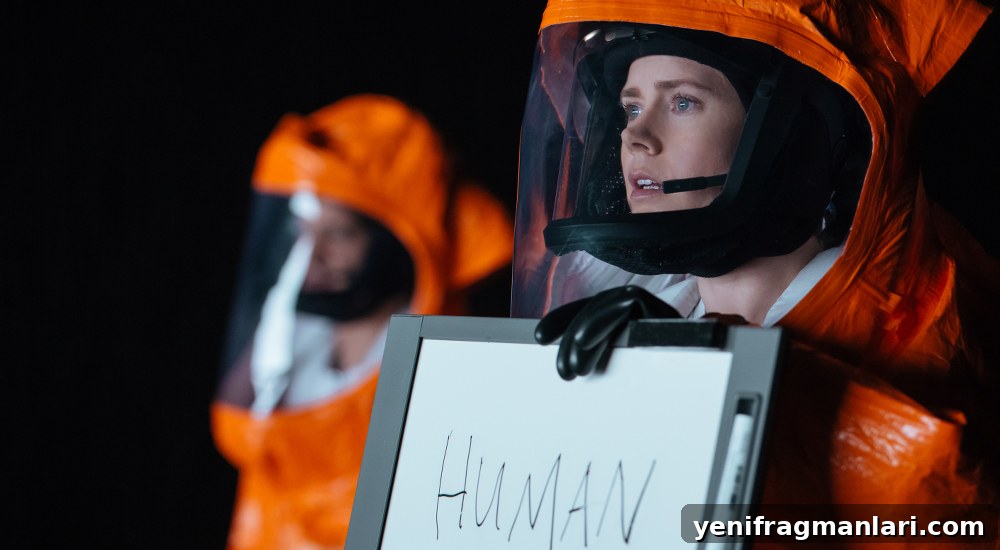
From the opening moments—Banks entering a quiet lecture hall to teach a class about Romance languages—the film establishes a calm, observant tone. Amy Adams brings a quietly riveting presence to the role. Her performance is measured, intelligent, and vulnerable; she conveys Louise’s curiosity, professional rigor, and personal fragility without broad gestures. Adams makes the academic work of language acquisition feel gripping, turning technical conversations into moments of real dramatic weight.
Arrival unfolds at a deliberate pace, letting the audience absorb both the scientific challenges and the human stakes involved in first contact. Jeremy Renner plays physicist Ian Donnelly, and Forest Whitaker is Colonel Weber, the military officer coordinating the response. Their roles are supportive and well-calibrated, providing contrast to Louise’s methodical focus while keeping the film grounded in believable interpersonal dynamics. The script, adapted by Eric Heisserer, resists melodrama and opts for clarity and restraint.
Villeneuve’s direction emphasizes atmosphere and precision. The production design and cinematography create an otherworldly but plausible environment inside the alien “shells,” and the film’s visual language supports the central theme of interpretation. Rather than relying on action set pieces, Arrival keeps its set pieces intimate and intellectually driven: translations, failed attempts at shared meaning, and the deliberate, methodical work of building a bridge between species.
One of the film’s strengths is how it treats the aliens not as monstrous antagonists or simplistic plot devices, but as catalysts for reflection. The extraterrestrial visitors force humans to confront limits in language and perspective, and this conceptual focus gives the movie emotional heft. The creature design and the interior environments feel carefully thought out—distinct without being sensationalist—so the aliens function as a meaningful backdrop to the human story.
Arrival’s sound design and score serve the film’s mood impeccably, reinforcing tension and contemplation without ever overwhelming the dialogue. The movie’s aesthetic is attentive to small details, which helps sell the plausibility of its premise. At times the film’s measured tone may challenge viewers expecting nonstop thrills, but its rewards come in the form of intellectual engagement and emotional resonance.
As the narrative progresses toward its third act, global tensions escalate and the possibility of conflict becomes real. Louise’s task—deciphering an alien language whose structure may transform how humans understand time and meaning—carries both practical consequence and philosophical implications. The screenplay handles this complexity with care, and Arrival’s final revelations shift the film into a territory that is surprising and deeply moving without resorting to cheap tricks. I will not spoil the concluding moments; they are central to the film’s power and are best experienced firsthand.
Arrival is a rare science fiction film that balances craft, performance, and intellectual ambition. Amy Adams anchors the piece with a compelling portrayal of a scientist immersed in both professional challenge and private life. Villeneuve’s sure-handed direction and a thoughtful screenplay produce a movie that rewards repeated viewing and reflection. It asks big questions about communication, memory, and choice while remaining emotionally honest.
For viewers who appreciate science fiction that challenges the mind and touches the heart, Arrival is essential. It avoids easy answers, treats its central premise with respect, and delivers a finale that lingers long after the credits roll. This is a film that proves how powerful the genre can be when it focuses on human connection and the complexities of understanding one another.