
Don’t Worry Darling — Review
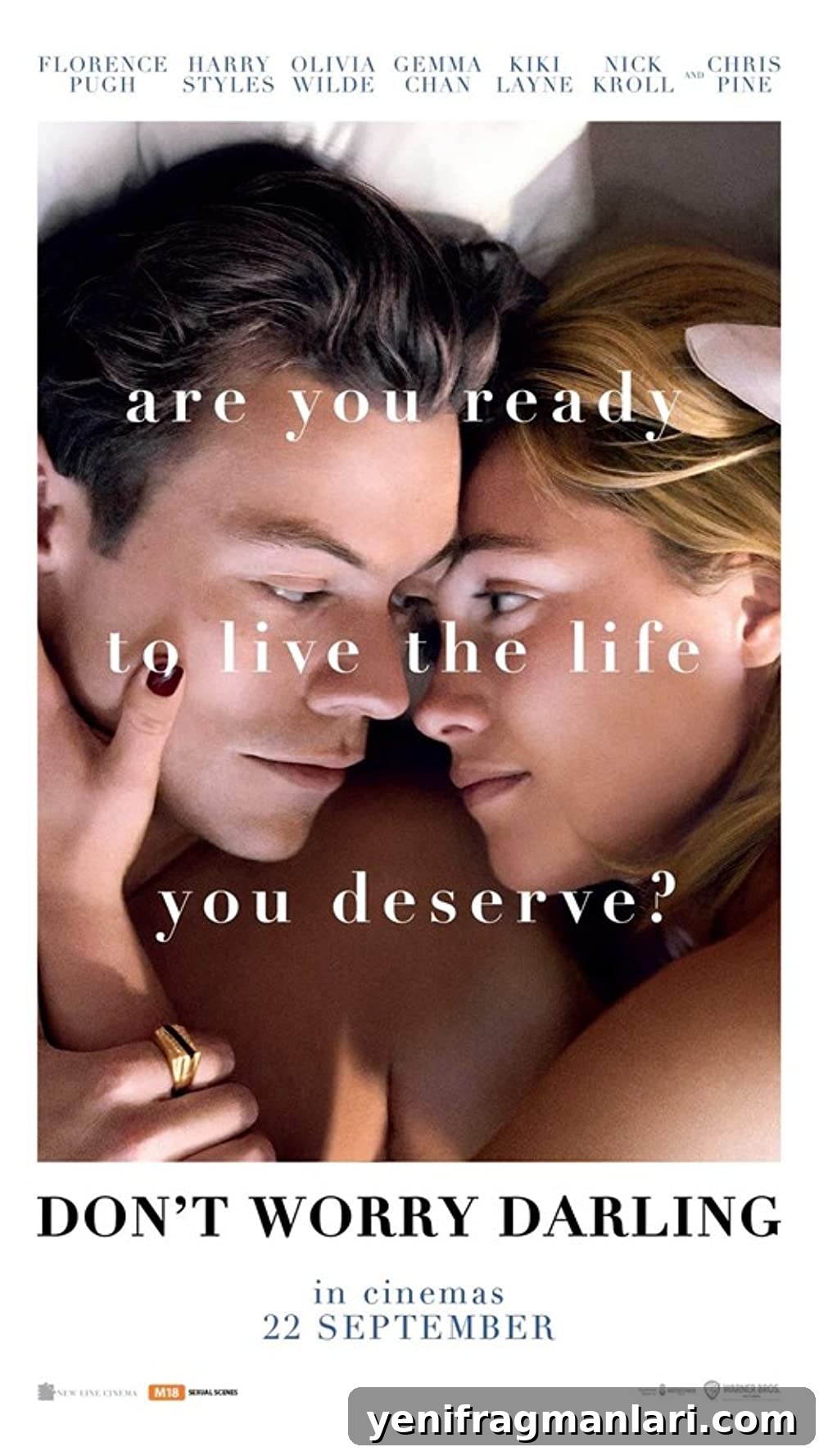
Don’t Worry Darling is Olivia Wilde’s follow-up to her widely praised directorial debut, Booksmart. While Wilde’s ambition is evident, this second film ultimately fails to live up to the expectations set by her earlier work. Before moving into a deeper critique, I want to note the screening experience, which shaped my perspective on the film.

I attended an early IMAX showing on Monday, September 19th, a limited event that ran at over 100 theaters across North America and included a live Q&A streamed from New York with members of the cast. These kinds of special presentations—bringing an intimate, communal screening experience and a connection to the filmmakers—are welcome and, I hope, become more common for larger releases.
The Q&A offered only a few brief questions, and one exchange stood out. When asked what drew him to the project, Harry Styles paused and then answered simply, “the mood board,” adding after another pause, “I like mood boards.” The remark was oddly perfunctory; it suggested a surface-level attraction to the film’s aesthetic rather than a deep engagement with its themes. Unfortunately, that impression carries over into his performance. Styles gives moments of earnestness, but often his delivery feels two-dimensional—either deadpan or explosively intense—without a convincing bridge between the extremes.
Wilde’s stated intentions are bold: to examine patriarchy, gaslighting, and the subtle mechanisms of control in modern life. Conceptually, this is fertile ground. In practice, however, the film’s approach is heavy-handed. Imagery and dialogue are blunt instruments rather than tools of nuance, and the film often repeats familiar points without fresh insight. Rather than deepening the conversation about systemic oppression and microaggressions, the film simplifies complex issues to the point where their urgency is diminished.
Florence Pugh is a bright spot amid these shortcomings. Working with limited character development, she still crafts a protagonist the audience can empathize with—her performance gives the film its emotional anchor. Pugh’s “Miss Flo” conveys vulnerability and quiet strength, and she manages to make the character feel human when the screenplay does not always allow for that depth.
By contrast, many supporting performances feel schematic. Styles slips into a caricature of a man in power, and Chris Pine’s portrayal of the community leader lacks subtlety; his villainy reads as “power corrupts” without additional layers. Nick Kroll and Olivia Wilde in supporting roles provide intermittent relief—Kroll in particular brings moments of levity and familiarity that land as intended—but they cannot fully compensate for the script’s structural weaknesses.
The film’s technical choices are mixed. Certain images are arresting—there are beautiful black-and-white sequences centered on a group of ballerinas that work as standalone pieces of visual poetry—but many visual flourishes feel like stylistic affectation rather than narrative necessity. Editing choices frequently interrupt scenes just as they begin to build, cutting momentum and leaving emotional beats underdeveloped. World-building is thin, so the setting never fully feels lived-in, which undercuts the stakes the screenplay tries to establish.
Tone proves another hurdle. The film jumps between psychological drama, thriller conventions, and moments of broad satire without fully committing to any one register. Soundtrack choices sometimes amplify these tonal shifts in jarring ways. Even action set pieces—most notably a series of car chases—come off as unintentionally comic rather than suspenseful, weakening the film’s attempts at urgency.
Ultimately, Don’t Worry Darling is an admirable, imperfect experiment. Olivia Wilde is clearly trying to build a provocative, conversation-starting film that interrogates gender and control, and there are individual moments—largely driven by Pugh’s performance and certain striking visuals—that succeed. But the movie’s lack of narrative cohesion, inconsistent performances, and heavy-handed messaging leave it short of the thoughtful, nuanced critique it aspires to be.
On a lighter note, there are scenes featuring a notably disheveled Harry Styles—beard and glasses included—that are likely to become widely shared images and memes. While that offers some pop-cultural amusement, it’s not a substitute for the deeper, more coherent filmmaking many viewers will expect from a director following the success of Booksmart.