
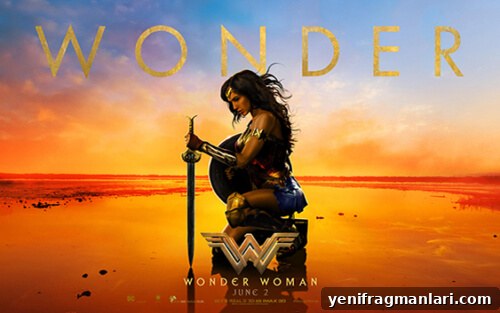
Wonder Woman (2017)
Director: Patty Jenkins
Screenwriter: Allan Heinberg
Starring: Gal Gadot, Chris Pine, Ewen Bremner, Danny Huston, Connie Nielsen, Eugene Brave Rock, Saïd Taghmaoui, David Thewlis, Robin Wright
Wonder Woman (2017) marked a turning point for superhero cinema: a major studio superhero feature directed by a woman, helmed by Patty Jenkins, and led by Gal Gadot as Diana Prince. It arrived as a high-profile, female-led entry in the DC Extended Universe (DCEU) and achieved impressive box office and cultural impact while offering a thoughtful, entertaining take on the origin story of one of comics’ most iconic heroes.
The film uses its World War I setting to give the story weight and stakes. Diana, the princess of Themyscira and an Amazon warrior, meets Steve Trevor (Chris Pine) after he washes ashore, pursued by enemy soldiers. Through Trevor, Diana learns about the Great War and the possibility that Ares, the god of war from the myths she grew up with, may be behind humanity’s suffering. Motivated by a sense of duty and outrage at the scale of human suffering, Diana leaves her sheltered island to confront the source of the conflict and to discover what it truly means to be Wonder Woman.
This premise gives the film a moral urgency that elevates many of the action sequences and character choices. Writer Allan Heinberg and director Patty Jenkins emphasize the “us versus them” mentality of wartime propaganda and personal narratives, using moments of small humanity to make the larger battles feel consequential. Even when outcomes seem inevitable, the film builds investment through the perspectives of victims, allies, and Diana’s own evolving understanding of the world. That emotional core keeps the character-focused drama central to the film’s momentum.
Visually, the contrast between the glowing, idyllic island of Themyscira and the bleak, foggy battlefields of early twentieth-century Europe underlines Diana’s journey from innocence to responsibility. That visual dichotomy supports the film’s anti-war themes: the absurdity and tragedy of conflict are made clear against the purity of Diana’s upbringing. The movie’s strongest moments often come when it balances spectacle with this quieter moral clarity.
One of the film’s most distinguishing traits within the DCEU is its tone. Unlike some other entries in the franchise, Wonder Woman blends seriousness with warmth and a genuine sense of humor that arises from character interactions rather than forced studio beats. Much of this charm stems from Diana’s outsider perspective as she discovers modern norms, and from the ragtag group assembled around Steve Trevor. Characters played by Saïd Taghmaoui, Ewen Bremner, and Eugene Brave Rock add different stakes and human textures to the journey, ensuring the film rarely feels one-note.
The action sequences are dynamic and well-choreographed, often serving the emotional throughline of the story rather than functioning as spectacle alone. This combination of character-driven stakes and inventive action makes the film feel like a classic summer blockbuster with emotional resonance rather than a CGI showcase without heart.
However, the film is not without flaws. At roughly 141 minutes, Wonder Woman can feel longer than necessary; a tighter edit would have sharpened its pacing. The movie also relies heavily on digital effects, and some moments of CGI feel less convincing than the filmmaking otherwise deserves. These visual inconsistencies occasionally pull viewers out of the story.
Another recurring issue for the DCEU appears here as well: thematic threads and questions are sometimes introduced without full payoffs. While the film succeeds in many narrative and emotional areas, a few ideas could have benefited from deeper exploration or clearer resolution. These loose ends slightly dilute the overall impact, though they do not undermine the film’s many strengths.
On the positive side, the film’s score and soundtrack stand out in a genre that often overlooks memorable musical identity. The orchestration enhances key moments and contributes to the film’s emotional heft, restoring a more classical blockbuster sensibility that complements the visuals and performances.
In conclusion, Wonder Woman is a female-led superhero film made by a woman that manages to be both entertaining and thoughtful. It revitalizes elements of the DCEU by centering character, moral stakes, and humane storytelling alongside thrilling action. While not perfect—its runtime, some visual effects, and a few unresolved narrative threads hold it back—the movie remains a highly enjoyable, emotionally satisfying entry in the modern superhero canon and one of the strongest DCEU films to date.
Score: 16/24