
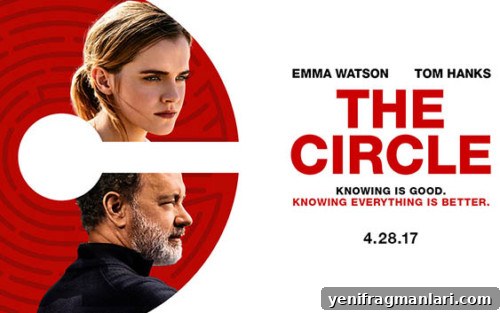
The Circle (2017)
Director: James Ponsoldt
Screenwriters: Dave Eggers, James Ponsoldt
Starring: Emma Watson, Tom Hanks, John Boyega, Ellar Coltrane, Karen Gillan, Glenne Headly, Patton Oswalt, Bill Paxton
This review examines The Circle (2017), a film adaptation of Dave Eggers’ novel directed by James Ponsoldt and starring Emma Watson and Tom Hanks. Positioned as a modern cautionary tale about privacy, mass surveillance, and the intoxicating promises of technology companies, the movie arrived with considerable expectations—thanks to its source material and high-profile cast—but ultimately struggles to deliver a satisfying critique.
The film follows Mae, played by Emma Watson, a young customer service worker whose life changes when she joins a powerful tech company known as The Circle. The company’s campus functions like a closed, university-like community, offering employees an immersive workplace culture centered on connectivity and complete transparency. As Mae becomes more deeply involved, she encounters charismatic colleagues, including Ty (John Boyega) and a long-time friend and potential love interest, Mercer (Ellar Coltrane). The story aims to explore how persuasive corporate narratives and social enthusiasm can erode personal privacy and dilute individual agency.
Where The Circle falters most is its screenplay. The film’s themes are relevant—data privacy, the seductive nature of visibility, and the ethical limits of technological convenience—but the execution treats these topics with a blunt, almost juvenile simplicity. Rather than presenting nuanced debate or layered character motivations, the script often relies on broad caricatures: an unquestioning public, zealot-like company proponents, and a handful of supposedly enlightened dissenters. This binary approach reduces the moral conflict to predictable beats and diminishes the dramatic tension that might have made the film compelling.
Director James Ponsoldt, known for character-driven work such as The Spectacular Now and The End of the Tour, appears out of his usual element here. Those earlier films are praised for their subtle character studies and emotional depth; by contrast, The Circle leans heavily into concept at the expense of character development. Many supporting roles—played by capable actors like John Boyega, Karen Gillan, Glenne Headly and Patton Oswalt—feel underwritten and largely decorative. Tom Hanks portrays the company’s genial public face, an effective casting choice for the role’s disarming charm, while Bill Paxton’s performance as Mae’s father brings a rare note of warmth and humanity to the proceedings.
Emma Watson anchors the story, and the film is told largely from her perspective. Her performance is measured but at times oddly muted; she conveys the character’s curiosity and occasional anxiety, but the emotional stakes rarely build to a convincing arc. As a result, the audience has limited reasons to identify with Mae’s journey, and the film’s moral urgency is weakened.
Visually, The Circle is a mixed experience. The opening sequences, including Mae’s arrival across the San Francisco Bay, are attractive and capture a modern, idealized workplace culture. However, the film’s digital recreation of the company campus and other CG-heavy sequences can feel artificial, and the production design sometimes emphasizes glossy spectacle over grounded realism. Ponsoldt’s camera occasionally delivers moments of genuine visual grace, but those instances are infrequent and cannot fully compensate for the narrative constraints.
For viewers seeking a thoughtful, provocative meditation on surveillance and technology, the film’s simplified metaphors and one-dimensional public portrait may prove frustrating. The movie frequently asks the audience to accept unlikely collective behavior and to accept clear moral distinctions without offering the subtle interrogation or contradictory perspectives that would make the debate more engaging.
Despite its shortcomings, The Circle raises questions worth discussing: How much of our lives should we share? At what point does the promise of safety and convenience justify sacrifice of privacy? The film introduces those questions but rarely digs beneath the surface to reveal uncomfortable complexities. For a stronger exploration of similar themes, one might turn to classic works like 1984, Network or The Truman Show, each of which interrogates mass media, power, and the public’s relationship to spectacle in more imaginative or forceful ways.
In summary, The Circle is an earnest but ultimately underwhelming film. It features notable performances, particularly from Tom Hanks and Bill Paxton, and it engages with topical issues about technology and privacy, but it does so in a thin, repetitive manner that limits its dramatic impact. Ponsoldt’s shift from intimate character studies to a concept-driven piece results in a movie that is visually polished yet narratively hollow.
Score: 5/24
Recommended for you: James Ponsoldt Movies Ranked