

Alone in Berlin (2016)
Director: Vincent Pérez
Plot: Set in 1940, Berlin is under the iron grip of National Socialism, where any resistance is met with brutal repression. After their son is killed at the front, a middle-aged couple decide to take a stand, risking everything to fight for freedom.
Cast: Emma Thompson, Brendan Gleeson, Uwe Preuss, Daniel Brühl, Lars Rudolph, Katrin Pollitt, Mikael Persbrandt, Katharina Schüttler, Louis Hofmann, Godehard Giese, Jacob Matschenz.
The opening of Alone in Berlin immediately establishes the film’s tone through the death of Otto and Anna Quangel’s son, Hans, portrayed by Louis Hofmann. The sequence is stark and quietly devastating: we see Hans running in a French forest, his breath short, followed by the sound of a single gunshot and then stillness. Shots of nature and the distant song of birds underline the human cost of war and set the emotional register for the film’s next 103 minutes. Rather than dramatizing combat, the film localizes loss in one family, using that intimacy to explore resistance and conscience under a totalitarian regime.
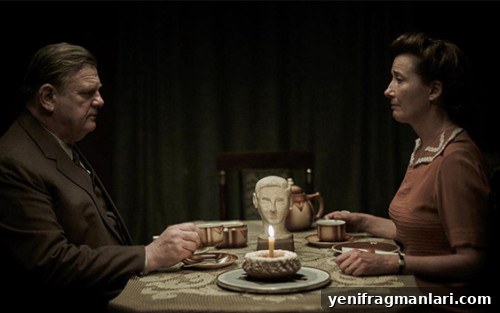
At the center of the story are Otto and Anna Quangel, played by Brendan Gleeson and Emma Thompson. They are ordinary Berliners whose world collapses with their son’s death. Previously resigned to life under the regime, their grief becomes a catalyst for action. The performances are quietly powerful: Thompson gives Anna a deep, restrained grief, while Gleeson’s Otto is outwardly stoic but visibly unraveling on the inside. That inner turmoil pushes the couple to write anonymous anti-Nazi postcards and begin a small, dangerous campaign of dissent.
The film pays close attention to the emotional and social isolation experienced by those who resisted. Ordinary daily routines — rides on trams, a walk through the city, work shifts — are portrayed as fraught and alienating. One memorable tram sequence captures Otto’s sense of dislocation as fellow passengers celebrate the Nazi victory in France, unaware that the country’s grief includes his own personal loss. Director Vincent Pérez uses such moments to show how the regime had seeped into daily life, making quiet dissent feel increasingly precarious.
Structurally, the film is disciplined. Pérez uses measured camera work and careful montages to emphasize pivotal moments and to build suspense. Scenes that might seem small on the surface — a glance, a letter dropped into a stairwell — are given weight through patient direction and thoughtful framing. A recurring visual motif is the city itself: Berlin appears alternately ordinary and menacing, and sequences of destruction or rumor of bombing operate as metaphors for the regime’s corrosive impact on German society.
The score by Alexandre Desplat complements the visual storytelling with understated but emotionally resonant music. Rather than overpowering the drama, the music supports the internal lives of the characters and helps guide the viewer through the film’s quieter, more introspective beats. Combined with the cast’s accomplished performances, the soundtrack contributes to a cinematic experience that values nuance over melodrama.
Daniel Brühl plays Detective Escherich, the investigator who gradually pieces together the Quangels’ activities. His presence provides a counterpoint to the couple’s moral conviction, illustrating the investigative machinery of the state and the tension between duty and conscience. The supporting cast fills out a world in which courage emerges in small, often solitary acts rather than grand gestures.
The film adapts Hans Fallada’s novel Every Man Dies Alone (also published as Alone in Berlin), a true-story inspired text that examines individual resistance within Nazi Germany. While some viewers might have preferred the original German language for greater authenticity, this adaptation makes the story accessible to a wider audience and invites renewed attention to the complex histories of resistance inside Germany. The film serves as a reminder that opposition existed in many forms and that ordinary people sometimes found ways to assert their humanity even in the most oppressive circumstances.
Score: 19/24
Recommended for you: More movie reviews and historical drama analyses are available for readers interested in films that explore resistance, moral courage, and wartime conscience.