
The Meyerowitz Stories (2017)
Director: Noah Baumbach
Screenwriter: Noah Baumbach
Starring: Adam Sandler, Ben Stiller, Elizabeth Marvel, Dustin Hoffman, Emma Thompson, Grace van Patten, Adam Driver, Judd Hirsch
Noah Baumbach’s The Meyerowitz Stories (New and Selected) is a quietly powerful character study about family, resentment, and the small moments that shape adult lives. Released exclusively on Netflix, the film reunites Baumbach with a strong ensemble cast and relies on sharp dialogue and intimate performances rather than spectacle. The result is a subtle, emotionally precise movie that rewards patient viewers and anyone interested in smart, modern indie cinema.
The story centers on Harold Meyerowitz, a retired sculptor and college professor whose difficult personality has left a lasting imprint on his adult children. Presented in chapter-like sections, the film gives each sibling space to reveal a different perspective on their shared history and the ways it has shaped their identities. Rather than offering a tidy arc of redemption, Baumbach explores how the past persists and how people learn, reluctantly, to live with the consequences.
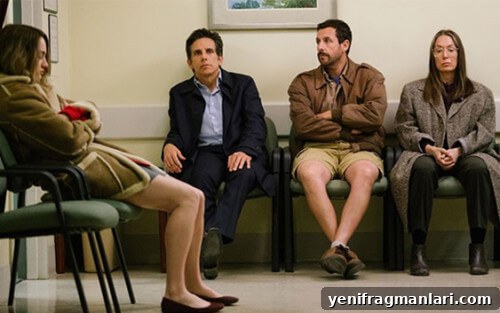
Ben Stiller and Adam Sandler carry much of the film’s emotional weight as two of Harold’s sons. Stiller returns to the kind of restrained, uneasy character he played in Baumbach’s earlier work, finding a moment of release where his tightly controlled exterior cracks and a deeper vulnerability appears. Adam Sandler delivers one of the most compelling dramatic performances of his career, playing a man whose outer bluster masks genuine tenderness and insecurity. Sandler’s portrayal is grounded and unexpectedly moving, balancing irritation and warmth in a way that feels authentic and quietly revelatory.
Elizabeth Marvel brings dry comic timing and sharp emotional clarity to the role of the siblings’ sister, her limited screen time used to great effect. Emma Thompson offers a warm, natural presence as Harold’s third wife, adding balance and depth to the family dynamic. Dustin Hoffman’s Harold is central to the story’s tensions; his performance can feel deliberately uneven—part of the film’s point is the character’s difficulty in expressing care—but it is the children’s responses that drive the movie forward.
Baumbach’s screenplay is the engine here: intelligent, observant, and full of small, resonant moments. The film often lets long, sharply written speeches and confrontations stand on their own, with sparse music or none at all, which heightens the authenticity of those scenes. The editing reinforces the fractured family history, using jumps between chapters to emphasize discontinuities in memory and understanding. Visually, the film remains modest and unobtrusive, mostly serving the performances and the text rather than calling attention to stylistic flourishes.
Some casting choices—brief cameos from well-known actors—occasionally pull the viewer out of the film’s otherwise lived-in world. Certain starry appearances read more like celebrity cameos than necessary contributions to character development. Still, these moments are relatively minor when weighed against the film’s stronger elements: its writing, its lead performances, and its steady emotional logic.
The Meyerowitz Stories is not a fast-paced crowd-pleaser. It moves deliberately and focuses on middle-class anxieties, artistic ambitions, and familial disappointments rather than conventional plot devices. That slowness is deliberate; the film aims to examine how unresolved grievances and small acts of care accumulate over time. For viewers who appreciate character-driven narratives and finely tuned dialogue, Baumbach’s film offers substantial rewards.
Overall, The Meyerowitz Stories stands out as a thoughtful, well-acted exploration of family dynamics. It showcases some of Noah Baumbach’s strongest writing and direction, and features standout work from Adam Sandler and Ben Stiller. While it may not appeal to audiences seeking broad entertainment or high-concept drama, it is an accomplished example of contemporary independent filmmaking and a memorable Netflix release.
Score: 17/24