
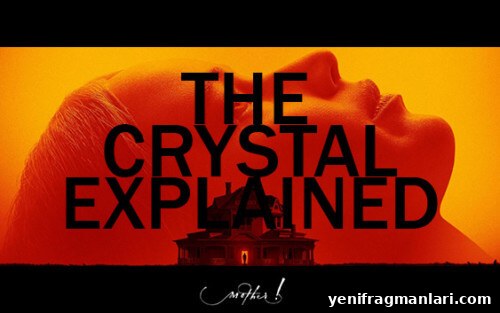
Potentially one of the most divisive films of 2017, Darren Aronofsky’s Mother! has inspired intense debate and interpretation. A quick online search will turn up numerous essays and explainers that map the film’s religious references and attempt to decode most of its deliberate enigmas. Aronofsky himself weighed in during a Reddit AMA, describing the film as the story of Him (Javier Bardem), a God-like creator, and Mother Nature (Jennifer Lawrence), who together try to build a home and a life. As Him’s poetic, charismatic world draws adoring crowds, Mother’s home is progressively destroyed. He responds with a mixture of narcissism and detachment while she continues to give, suffer, and endure.
Many critics and bloggers have unpacked the major themes, identified biblical passages that appear to have been referenced, and proposed explanations for plot points such as the flooding sink, the lighter, the powder, and even the cameo by Kristen Wiig. Yet one striking object in the film continues to puzzle and provoke strong interpretive responses: the crystal.
That crystal—destroyed by Woman/Eve (Michelle Pfeiffer) in Him’s office and apparently made from the beating heart of a previous Mother—becomes a pivotal object. Eve’s act of shattering it catalyses a fresh cascade of events and suffering for the central couple. Some viewers have read the crystalline object as a symbolic ‘apple’ from the Garden of Eden—a forbidden fruit that Eve cannot resist touching. While that reading has merit, the crystal’s function in the film seems to be more complex, operating as a concentrated metaphor for humanity’s relationship with nature and the impulse to contain, commodify, and control it.
To consider the crystal as a symbol of containment makes sense when the film’s characters are read allegorically. If Him represents a God-like figure and he is responsible for creation, then Mother Nature’s existence is simultaneously a gift and a problem for Him: she is essential to sustaining life, yet her power resists being fully domesticated. The film repeatedly stages the tension between reverence and violation—Mother is venerated in the abstract, but in practice her autonomy is repeatedly violated. Eve smashing the crystal may imply that this violence against nature has occurred again and again throughout human history; within the film’s cyclical logic, the crystal has been shattered an infinite number of times.
This interpretation extends beyond a simple Edenic reading. The crystal also reads as the physical manifestation of an attempt to extract, preserve, and display a living essence—transforming living matter into an inert, ornamental object. When Him takes the charred heart of Mother and squeezes it until it becomes a diamond, the sequence visually compresses life into a hard, static, and highly valued commodity. In a sense, the crystal is the ultimate trophy: a manufactured token of mastery over something that was once irreducibly alive.
That transformation—heart to crystal—sets up a clear contrast between nature and industry, or between organic life and human technologies of preservation and valuation. Diamonds and similar crystals form deep in the Earth under extreme heat and pressure, a process that natural science describes in terms of carbon, temperature, and geological force. By consciously turning the living heart into a crystal, the film stages a practice of containment: extracting the essence of the natural world and refashioning it into an object of human desire, control, and display.
Read this way, the crystal registers as an emblem of several overlapping conflicts: Science versus Religion, Nature versus Industry, and Her versus Us. The film’s visual language reinforces the idea that the house itself—the place Mother can feel beating when she touches the walls—operates as a microcosm of the planet. The earthy palette, the tactile sense of living material, and the way the house is gradually besieged by worship and consumption underline the fragile dependence of humanity on the natural world even as we seek to dominate it.
Moments like the scene in which Him’s followers mark themselves with ash from the rubble—an echo of Ash Wednesday ritual—point toward themes of mortality, humility, and cyclical return: “remember, man, that thou art dust, and to dust thou shalt return.” That biblical reminder is complicated by the image of ashes and diamonds: both are products of deep geological processes, but one connotes human fragility and the other human appetite for permanence and value. The crystal is the film’s concentrated metaphor for that tension.
Ultimately, Mother! presents a stark and unsettling vision of what happens when reverence becomes possession, when gratitude becomes extraction. The crystal—beautiful, hard, and immobile—is not simply a prop or a joke about Eden; it is a meditation on the suppression and containment of nature in the name of creation, ownership, and legacy. It asks us to consider whether our greatest achievements are acts of stewardship or acts of appropriation, and whether the impulse to enshrine nature as an object of desire is, paradoxically, a final act of destruction.
Recommended for you: Darren Aronofsky Directed Films Ranked
Written by Elizabeth Howlett
You can support Elizabeth at the following links:
Website – Bloggy Balboa
Twitter – @bloggybalboa