

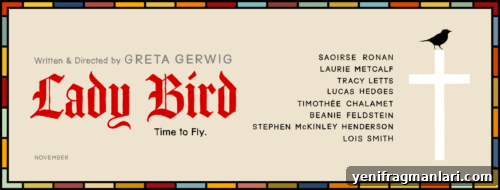
Lady Bird (2017)
Director: Greta Gerwig
Screenwriter: Greta Gerwig
Starring: Saoirse Ronan, Laurie Metcalf, Tracy Letts, Lucas Hedges, Timothée Chalamet, Beanie Feldstein, Lois Smith
Lady Bird is Greta Gerwig’s intimate, sharply observed coming-of-age film set in Sacramento during the early 2000s. The movie follows Christine McPherson—who insists on being called Lady Bird—played with intense nuance by Saoirse Ronan. It captures the final year of her Catholic high school experience and the emotional, messy process of stepping toward adulthood. At the center of the story is the fraught relationship between Lady Bird and her mother Marion, portrayed by Laurie Metcalf. Marion’s practical worries—money, work and caring for her husband Larry—clash with Lady Bird’s preoccupations about college, social status and first love, creating many of the film’s most powerful moments.
Greta Gerwig’s background as an actor and writer informs the film’s authentic tone. Although marketed as her solo directorial debut, Gerwig brought years of experience in independent film to the project, and that confidence translates into a story that feels lived-in and emotionally truthful. Her screenplay avoids melodrama in favor of small, revealing scenes that build character and empathy. The result is a drama that feels both specific to one teenager’s life and universal in its depiction of family tensions, aspiration and regret.
The performances are the heartbeat of Lady Bird. Saoirse Ronan gives a layered central performance—equal parts rebellious, insecure and tender—that anchors the film. Laurie Metcalf delivers a deeply felt turn as a mother trying to keep her family afloat while struggling to connect with her daughter. Their chemistry crackles, alternately warm and explosive, capturing the push-and-pull intimacy of a mother-daughter bond. Tracy Letts’ portrayal of Larry, Marion’s quietly suffering husband, adds another layer of restraint and compassion to the household dynamic.
Supporting actors enrich the narrative with distinct, believable characters. Lucas Hedges plays Danny, Lady Bird’s first serious romantic interest, with an innocence that later deepens into complexity. Timothée Chalamet appears as another romantic foil—aloof and charismatic in a way that belies his character’s emotional limitations. Beanie Feldstein as Julie provides one of the film’s softest, most loyal friendships; her warmth and sharp comedic timing round out the central group and highlight the differences between Lady Bird and her best friend. The film wisely leaves some of Julie’s struggles slightly off-screen, emphasizing instead the quiet acts of support that define real friendship.
Gerwig’s screenplay often favors emotional truth over plot mechanics. Many scenes show reactions and aftermaths rather than every preceding event, inviting viewers into the characters’ interior lives. A simple sequence in which Lady Bird finds Julie crying becomes a study in empathy—Gerwig lets us witness how one teenager comforts another, and how that small gesture carries more meaning than any explanation of the cause.
Jon Brion’s score amplifies the film’s emotional range, shifting between an upbeat, new-wave energy and introspective, piano-driven motifs. The music captures the volatility of adolescence: a feeling of tumbling, then regaining balance. When period songs do appear—Justin Timberlake’s “Cry Me a River” at a party, Alanis Morissette’s “Ironic” during a commute, Dave Matthews Band’s “Crash Into Me” during a painful breakup—they’re used sparingly and effectively, anchoring scenes without overwhelming them.
At its core, Lady Bird is an honest exploration of identity, shame, aspiration and the complex ways we love the people who raise us. Gerwig resists tidy resolutions: characters make mistakes, say hurtful things and cling to pride, and the film asks viewers to hold those contradictions with compassion. It’s permissive of imperfection—okay to be ashamed of where you come from, but also a call to face the consequences of your choices and to try to repair what’s broken.
The film’s strength lies in its balance of authenticity and craft. Gerwig’s writing and direction, combined with Ronan’s and Metcalf’s performances, produce a coming-of-age story that feels both familiar and fresh. Lady Bird captures the seemingly trivial anxieties of adolescence and reveals how deeply meaningful they are: the choices, embarrassments and small rebellions that shape a young person’s view of the world. The movie’s unvarnished honesty and emotional resonance explain why it received significant awards-season attention and connected with audiences and critics alike.
Lady Bird is a film about growing up that refuses to sentimentalize the experience. It’s tender, mordant and often very funny, offering a deceptively ordinary portrait of teenage life that proves anything but ordinary. Gerwig has crafted one of the most perceptive and affecting coming-of-age films in recent years.
Score: 22/24
Recommended for you: Greta Gerwig: The Essential Collection