D.W. Griffith and Broken Blossoms: Key Techniques and Lasting Influence
In this article I outline the defining features of D.W. Griffith’s films—particularly the techniques that made him a leading director of the Silent Era and one of the most influential filmmakers of the early twentieth century. This is not an exhaustive study of Griffith’s life and career, but an overview focused on his cinematic innovations and their impact.
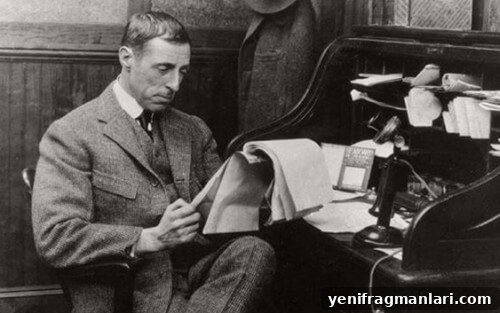
Griffith arrived in the film industry somewhat by chance. Originally intending to pursue a stage career, he shifted to motion pictures after limited success in theatre. His timing coincided with a period of rapid change in cinema (roughly 1907–1910), when new narrative and technical approaches were emerging and the medium was evolving from simple spectacles into a structured art form and industry.
At its beginnings, cinema functioned largely as affordable entertainment for the working class—short attractions intended to astonish rather than narrate. As production values rose and audiences expanded to include the middle class, filmmakers and studios began to aim for more structured stories and sustained emotional engagement. The industry responded with improvements in exhibition, higher ticket prices, more moral and educational themes, and the rise of the star and studio systems. These changes encouraged directors to develop a cinematic “language” that could sustain longer, feature-length works while encouraging a deeper identification with characters.
Within this evolving environment, Griffith popularized techniques that became foundational to film grammar. He is widely credited with advancing the use of cross-cutting (parallel editing) to show actions taking place in different locations simultaneously, helping build tension and narrative complexity. He also employed close-ups and medium close-ups to convey subtle emotions and inner life, and used visual transitions such as fade-outs and iris shots to structure scenes and signal shifts in perspective. These devices worked in tandem with larger production changes—improved theaters, longer films, and the star system—to transform cinematic storytelling.
Griffith encouraged more naturalistic performances from his actors, relying on close framing to capture nuance. While close-ups had appeared earlier in the work of James Williamson and George Albert Smith, Griffith incorporated them extensively into long-form narratives. This allowed performers to convey psychological states without exaggerated theatricality—an innovation that helped define cinematic acting.
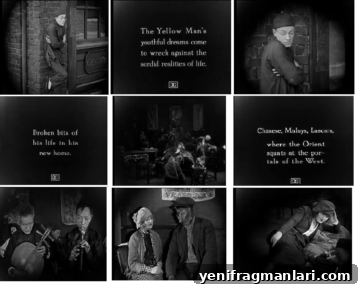
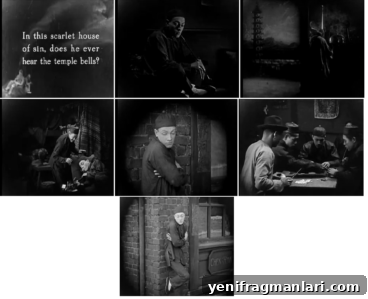
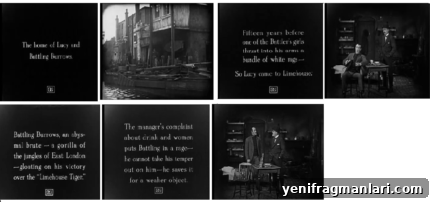
Broken Blossoms (1919) provides a clear example of Griffith’s technique and emotional aims. The film tells the story of Cheng Huan, a Chinese man who travels to London hoping to bring Buddhist teachings to the West, and Lucy, a fragile young girl abused by her father, Burrows. Griffith uses a variety of shot sizes and editing choices to shape the viewer’s sympathy and understanding: establishing long shots to set locations and social context, medium shots to stage interaction, and frequent close-ups and extreme close-ups to register emotion.
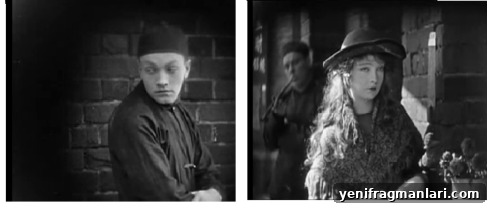
One characteristic device in Broken Blossoms is the iris shot, used to focus on a character’s mental state or to isolate a detail within a scene. In one sequence, an iris frames Cheng as he leans against a wall, revealing his private thoughts; the same iris closes the sequence to emphasize his inward reflection. Griffith balances these expressive devices with clear spatial staging—establishing shots to orient the audience, followed by progressively tighter framings that heighten intimacy.
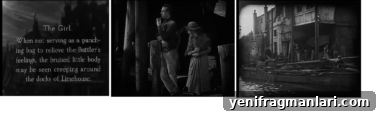
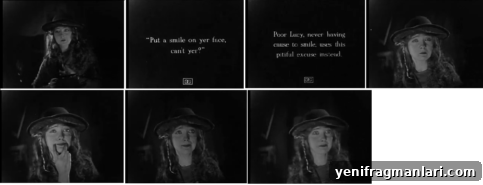
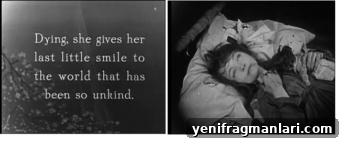
Griffith’s treatment of Lucy demonstrates his capacity to use framing to reveal inner life. She is introduced in full-body and long shots that establish her vulnerability in a harsh domestic space. Later, a progression to medium shots and finally to close-ups captures the small, fearful gestures she makes when forced to “smile” for her father—an example of how framing and editing underscore psychological detail rather than merely illustrating action.
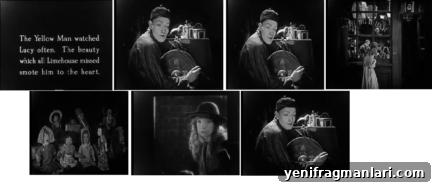
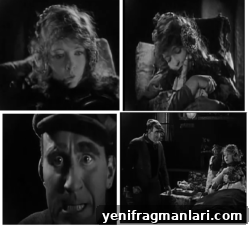
The relationship between Cheng and Lucy is developed through visual motifs and point-of-view editing. Griffith draws attention to the dolls in Cheng’s shop and uses a subjective perspective to let the audience share Cheng’s fascination with Lucy. These dolls later reappear in a key scene when Cheng rescues Lucy and asks her to embody the delicate, protected image he associates with her. Griffith’s cross-cutting and selective close-ups sustain tension as Burrows discovers Lucy’s refuge and confronts her in the shop.
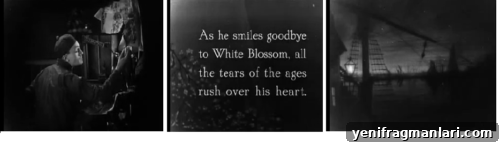
The film’s final sequences are shaped by a ring composition that echoes earlier moments: Lucy’s attempted smiles near the beginning mirror the expression she wears in her final scene. After Lucy’s death, Cheng’s ensuing suicide completes the tragic arc; Griffith ends with a distant view of London, returning the story to its urban setting and underscoring the social environment that shaped the characters’ fates.
Broken Blossoms differs markedly from Griffith’s earlier epic, The Birth of a Nation, a film that remains historically significant yet deeply controversial for its racist content. Some critics and historians regard Broken Blossoms as an artistic and moral counterpoint, showing Griffith exploring compassion and vulnerability rather than the divisive politics of his earlier work. Regardless of these controversies, Griffith’s technical contributions—cross-cutting, expressive close-ups, varied shot sizes and carefully composed transitions—had a profound effect on cinema. Filmmakers across generations cite Griffith as an early architect of film language whose work influenced directors such as Sergei Eisenstein, Orson Welles, King Vidor, Charlie Chaplin, Stanley Kubrick, and Jean Renoir.
Bibliography and further reading
Burch, Noël. Life to Those Shadows. BFI, London, 1990.
Cherchi Usai, Paolo. The Griffith Project. BFI, London, 1999–2007.